
Executive summary
Two image classifiers can produce similar overall accuracy while sending different defects down the wrong inspection route. A study of people and neural networks on natural images examines how errors are distributed between pairs of categories. Its results suggest a practical question for visual inspection. When two classes are confused, does one direction account for most of the errors, and what decision follows from that direction?
FQI takeaway
- Record each direction for a critical pair, with the number of actual examples in its starting class.
- Check whether a particular disturbance sends several different classes into one output class.
- Associate each important direction with its own consequence and review decision.
The principle at a glance
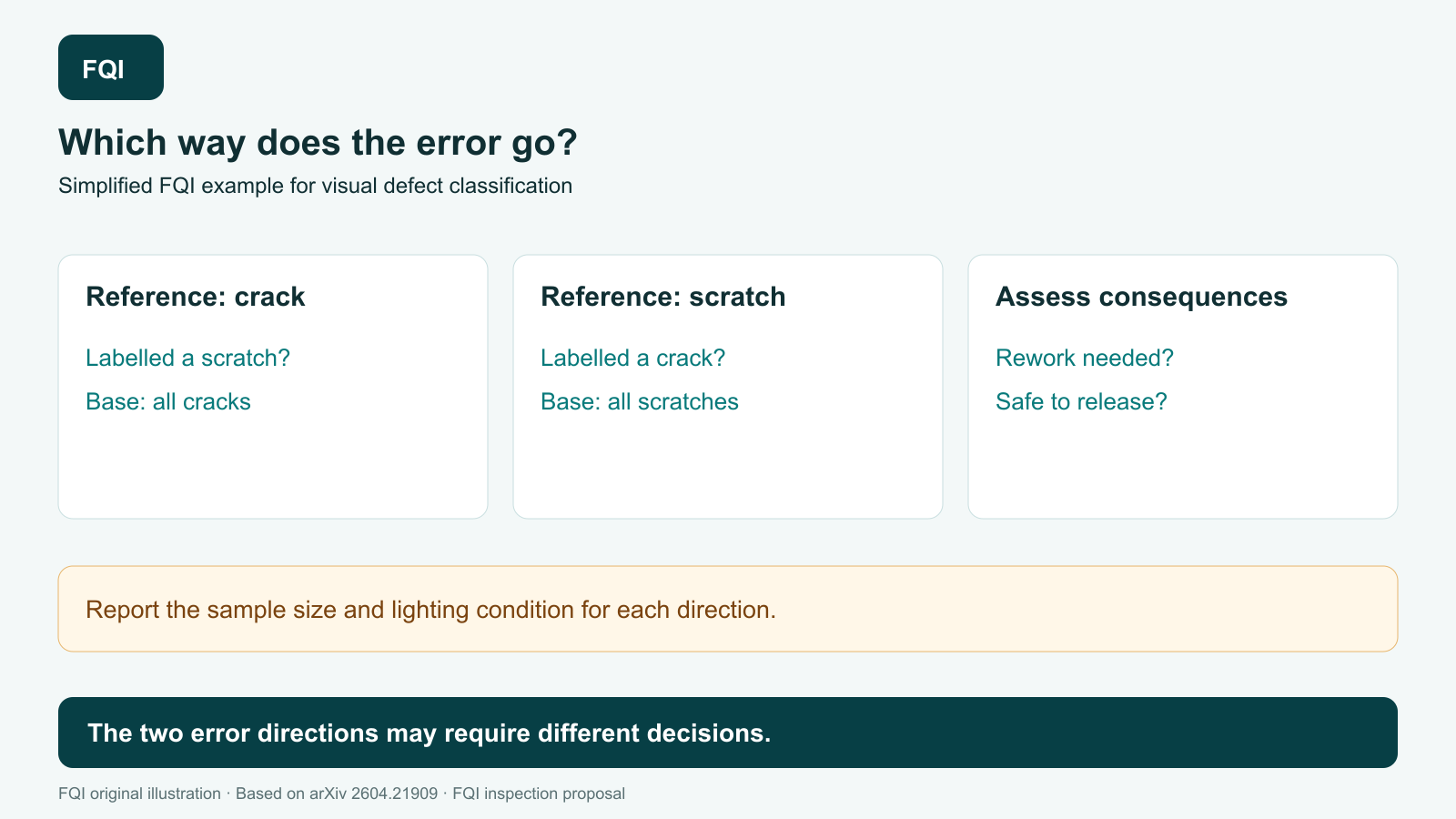
A confusion matrix records the true category in a row and the chosen category in a column. Correct classifications fall on the diagonal. The remaining cells tell the reader which class was taken for which other class. Suppose a crack is mistaken for a scratch. The relevant denominator is the number of actual cracks. For scratches mistaken for cracks, the denominator is all actual scratches. Counting the two mistakes together hides which inspection decision is vulnerable. This manufacturing example illustrates the method.
Deep dive
The primary comparison uses 16 image categories with twelve types of image perturbation, including changes in contrast and noise. The data include roughly 83,000 human trials. The researchers group results by experiment, condition and model to retain differences that would disappear in a single pooled score. They examine both the fraction of class pairs with directional imbalance and how strongly individual pairs favour one direction.
Human responses spread directional differences over a larger share of pairs. The reported average fraction of asymmetric pairs was 0.712 for people and 0.535 for the networks in this comparison. The networks tended to show stronger differences concentrated in fewer directions. These values describe the structure of the errors. They cannot be read as the proportion of images a model classified correctly. The authors also note that breadth across pooled human responses is a population-level property sensitive to the number of observations available.
In an industrial trial, an inspection team could photograph the same independently assessed parts under normal and altered lighting. A separate matrix for each condition would show whether several defects move into the same low-priority class under side lighting. The team could then check the reference classifications and repeat the trial while varying the illumination. If the concentration persists, a second inspection of that output class is a specific intervention worth testing.
Limitations and risks
The research used natural object categories. A plant must establish its own defect frequencies, images and consequences of an incorrect release. With few observations in a class, an apparently strong direction may be driven by one mistake. Report counts beside the rates so a reviewer can decide where additional independently labelled parts are needed.
The study also investigates relationships between error patterns and the way information is represented. A matrix from a production line cannot by itself establish the underlying mechanism. Errors in the reference labels, peculiarities of image capture and a model’s learned decision boundary can produce similar patterns.
FQI conclusion
Retaining the reference and predicted category for each part makes the direction available for later review. Link each direction to the downstream action. A second inspection can then be aimed at the cases where a wrong assignment would send a critical defect along the wrong route.
Sources & transparency
Author version reviewed 2604.21909v3. The workplace examples and proposed acceptance tests are FQI interpretations. Directional Confusions Reveal Divergent Inductive Biases Through Rate-Distortion Geometry in Human and Machine Vision · Version history
Codex assisted with drafting and checked the claims against the cited original sources. Johann Fischer authorized publication on 2026-11-17.