
Executive summary
An image classifier can predict the right category for one crop and still get the overall image wrong. A study of vision-language models asks whether the rule selecting views can recognise these opportunities to correct an error. Model confidence helps rank views over the full image collection. On images that the method gets wrong despite having a correct view available, the same signal barely distinguishes correct from incorrect views.
FQI takeaway
- Establish whether any crop received the correct label.
- Keep views fixed when comparing selection rules.
- Use an independently established reference class for each image.
The principle at a glance
The method produces several views by cropping or flipping an image. For each view the model assigns weights to the possible classes. Entropy describes how concentrated this distribution is. A model can concentrate nearly all its weight on a wrong answer, for instance when a background feature triggers a confident prediction. Selecting the most certain views then gives that background feature a strong voice in the final decision.
Deep dive
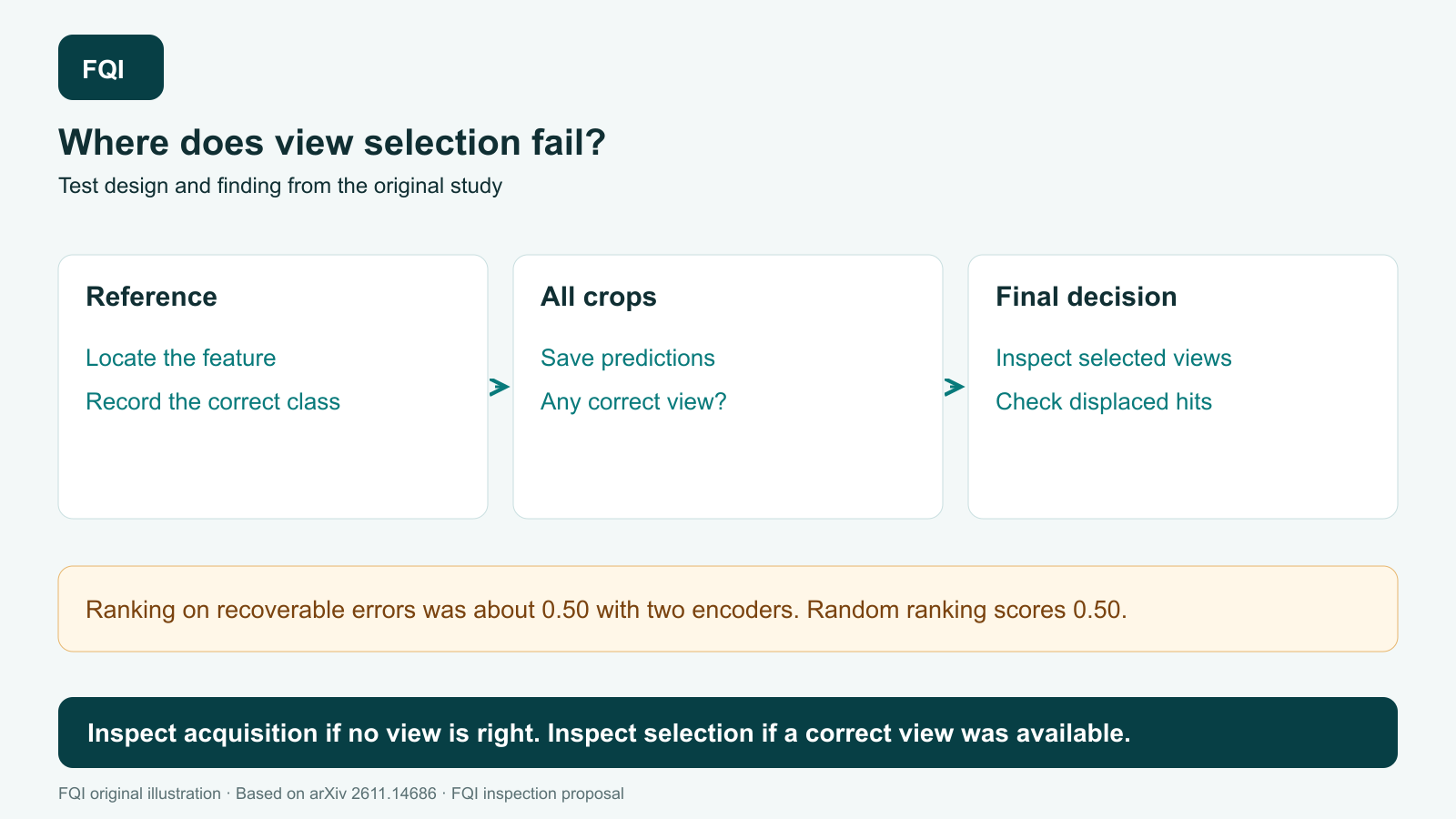
The researchers hold the views and subsequent processing fixed to isolate the selection rule. Table 2 considers images for which the current answer is wrong and an alternative view predicts the right class. On the controlled comparison the ranking measure is 0.503 for one image encoder and 0.501 for the other. Random ordering has a reference value of 0.5. An aggregate result over all images answers a different question. Easy images can give the signal a favourable score even if the rule fails precisely where changing its selection could help. The authors also test information from the cropping process itself. Across 15 datasets their geometry-based selection obtains an average accuracy of 64.2 compared with 63.2 for entropy selection. Individual datasets respond differently.
Limitations and risks
For a simplified surface inspection trial, a specialist could mark the feature on the reference image, retain every crop and record its predicted class. If the feature is outside all crops, changing their ranking has little justification on that example. If a correctly classified crop exists, the team can identify the competing view that displaced it. These are proposed inspection steps. The authors tested image classification on research datasets. Detection of a rare defect on a particular industrial surface still requires representative parts and an independent reference inspection.
FQI conclusion
Report two quantities on the same image series. How often does a correctly classified crop exist, and how often does the selection rule exploit that opportunity? Inspect cases that move in both directions after a change. A rule can recover some previously missed images while spoiling decisions that used to be right.
Sources & transparency
The figures and comparisons come from the authors’ arXiv preprint. The workplace example and proposed acceptance decisions are FQI interpretations. What Entropy-Based View Selection Cannot See: An Audit of Test-Time Adaptation for Vision-Language Models · Version history
Codex assisted with drafting and checked the claims against the cited original sources. Johann Fischer authorized publication on 2026-11-14.