
Executive summary
A plausible description of thermal video can misidentify an action, place it at the wrong time and offer an unsupported answer. A new study examines seven vision-language models on two human-activity datasets. Its findings explain why one accuracy figure is insufficient for such artificial intelligence (AI).
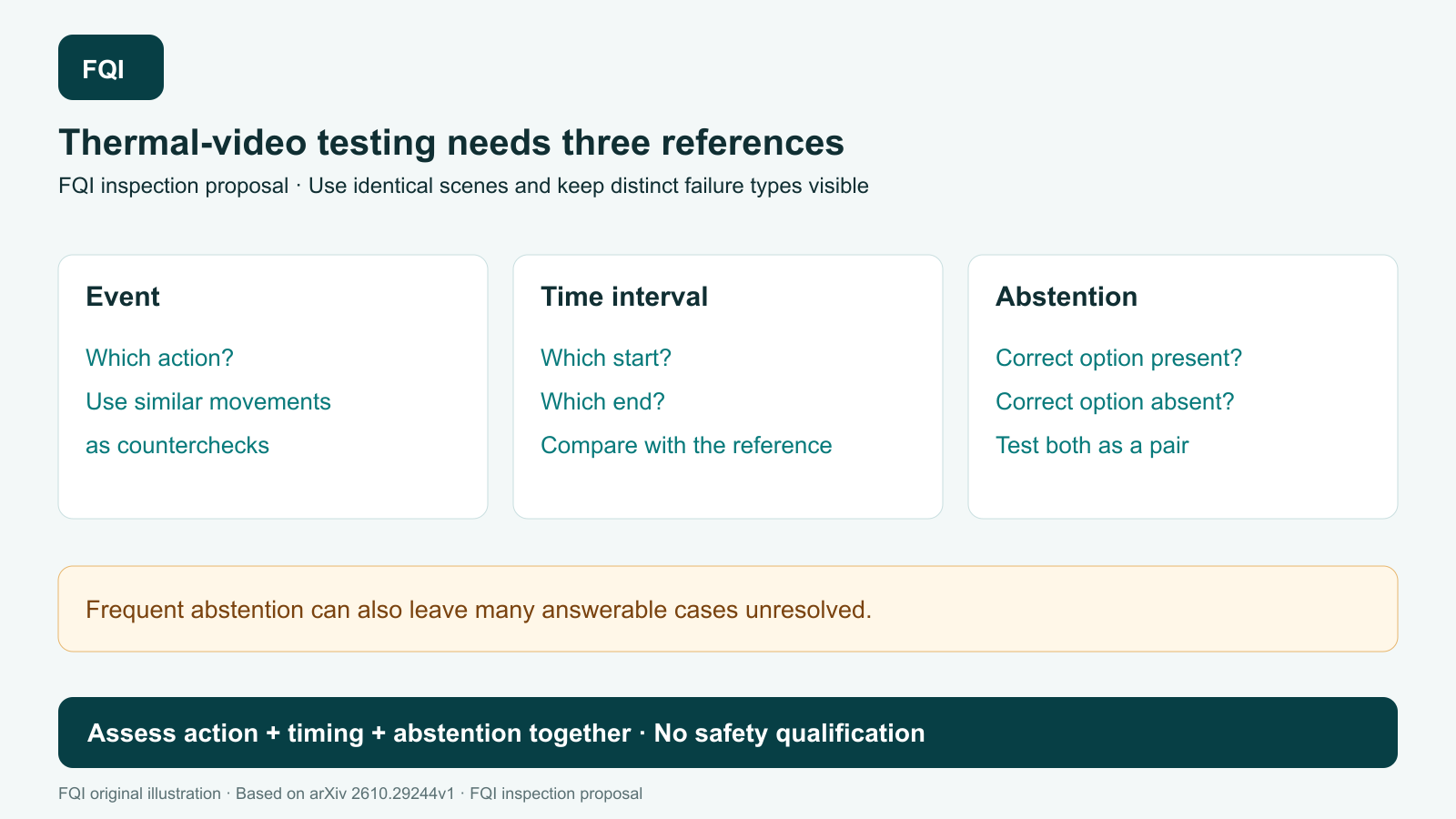
Quality practitioners gain a concrete test pattern: assess event identity, temporal localisation and justified abstention separately. The research concerns fixed cameras and recorded scenes; it does not qualify an industrial application or safety function.
FQI takeaway
- Check three outcomes: Actions, time intervals and permitted non-decisions each need a reference.
- Measure both sides of abstention: Report unsupported answers and unnecessarily withheld valid answers together.
- Pair change tests: Compare extra images, different presentation and longer deliberation on identical cases.
The principle at a glance
A vision-language model connects visual input with textual statements. Thermal images lack many details familiar from ordinary colour images. Similar movements can consequently be confused. Even a correctly identified event can receive the wrong start or end time.
Abstention addresses another failure mode: a system should avoid choosing an offered action when the video does not support it. A high refusal rate is also unhelpful if the model leaves almost every answerable case unresolved. The two behaviours need a common evaluation rather than separate headline claims.
Terms explained
- Vision-language model: A model connecting images or video with text.
- Coverage: The share of answerable cases receiving a substantive answer.
- Temporal overlap: How well a predicted event interval matches the annotated reference interval.
Deep dive
Hu and Chen first evaluate 865 short thermal clips covering 62 actions by 20 people. Every question presents the same 20 candidate answers to all models. Distractors include similar actions, allowing the test to distinguish broad activity recognition from identification of the requested action.
For temporal assessment, they use 118 separate recordings with 199 annotated action-object events. One test asks for complete event lists and time boundaries. Another already names the actions to locate.
Their comparison separates recognition difficulty from timing difficulty. Corresponding colour images provide a comparison between input modalities.
The abstention experiment changes candidate answers while holding the video constant. The correct action is present in one version and replaced by a distractor in the other. Both versions offer the same option to give no supported answer. This pair exposes opposite errors: inventing a match and declining a match that is available.
Under explicit abstention instructions, RoboBrain2.5 correctly declines 98.5 percent of cases without the right candidate. It nevertheless answers only 3.2 percent of cases where a correct candidate is present. Qwen3.6-27B answers 97.2 percent of answerable cases but correctly abstains in only 6.1 percent when the right option is missing. Neither measure alone describes usability.
More computation does not reliably solve the problem. For one of the two models tested with extra deliberation, 25 corrected answers accompany 24 newly introduced errors. New errors outweigh corrections for the other model.
Cropping, contrast changes and denser sampling also have limited or model-dependent benefits. These interventions were not evaluated across all seven models.
The FQI transfer is a separate inspection plan for video assistance. Experts first define operational events and acceptable time boundaries. They then prepare paired cases with sufficient and missing evidence.
Each configuration receives a record of action confusions, timing errors, unsupported answers and lost coverage. An additional information source is judged by the specific errors it corrects and those it creates.
An operational reference also needs a decision owner. When a case remains unresolved, the process must specify what evidence a human reviewer receives and which downstream action is permitted. This is an FQI process proposal, not a robot-control result reported in the study.
Limitations and risks
The datasets concern human activities and do not constitute acceptance testing of a production installation. Fixed cameras, selected actions and prepared answer lists differ from mobile robots and open situations. The study does not evaluate subsequent robot actions. Results for compressed large models apply to the tested configurations.
Operational reference cases are FQI interpretation. Neither study scores nor a particular model are adopted as evidence for a protective safety function. National Institute of Standards and Technology (NIST) supports documentation of conditions and limits, rather than a particular performance claim.
FQI conclusion
Thermal-video assistance needs an evaluation that keeps distinct failures visible. Correctly naming a broad activity does not establish the specific action; identifying an event does not establish useful timing. Abstention helps only while answerable cases remain covered.
Before choosing a model for a pilot, quality owners should define acceptable events, intervals and non-decisions. They can then determine whether more observation or computation improves the intended quality function. Operational release requires evidence beyond these recorded research scenes.
Sources & transparency
- Hu and Chen: Failure Modes of Vision-Language Models for Human Activity Understanding in Thermal HRI, version 1, sections III–VII.
- NIST: AI RMF Core, Measure 2.5–2.6.
Editorial note: Preliminary original research, not reproduced here. Study findings and the FQI inspection proposal are distinguished. AI-assisted article, approved for publication by Johann Fischer on 2026-10-22.