
Executive summary
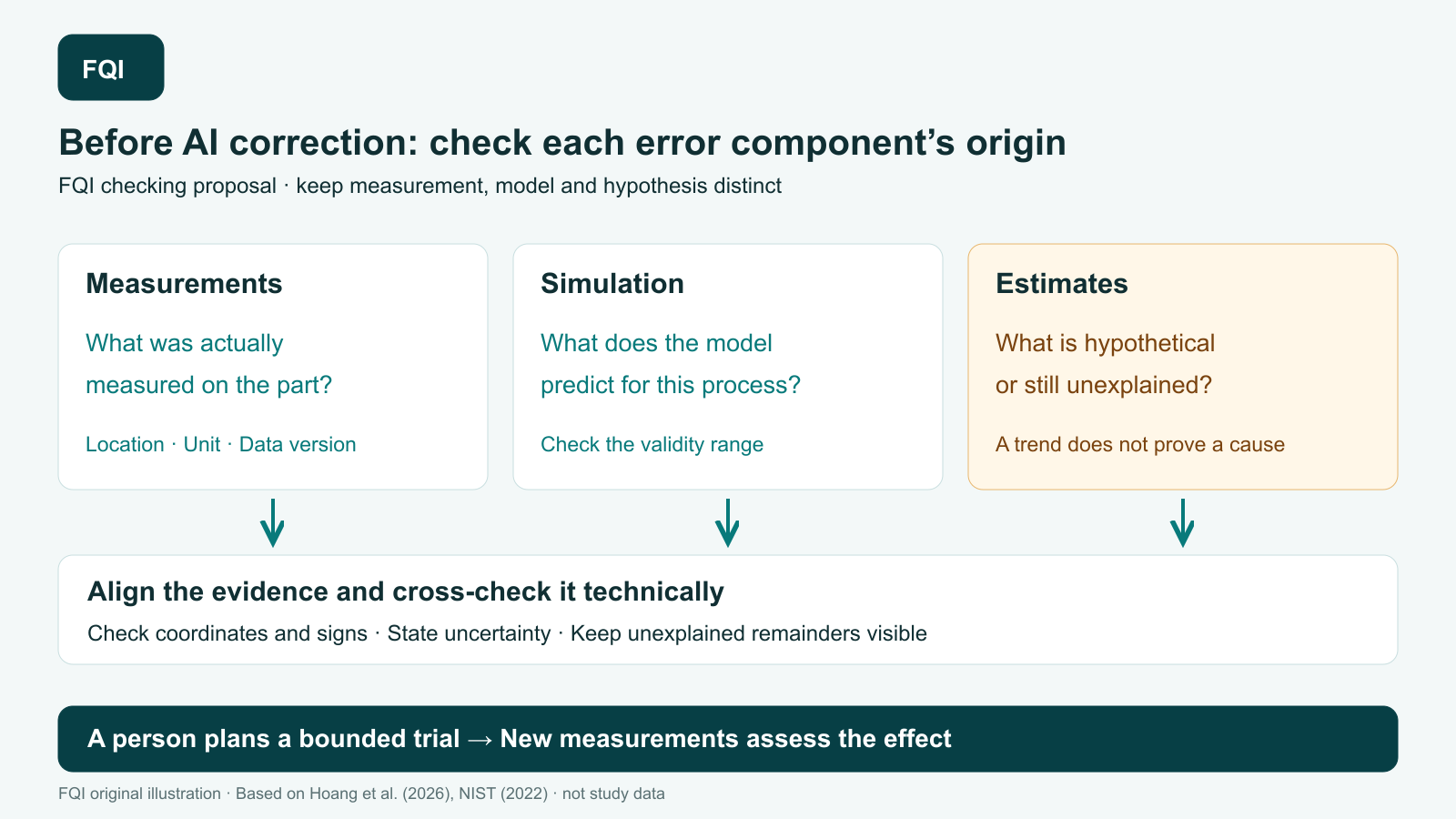
Artificial intelligence (AI) that prepares machine corrections needs more than a plausible explanation of a dimensional deviation. The decisive question is which error components were measured, simulated or merely estimated. The MAKA research architecture connects language models with calculation tools and manufacturing knowledge. The example motivates an FQI proposal: every correction should have a documented error decomposition and its own effectiveness check. The reported correction effect was evaluated in a digital twin; this does not establish a physically demonstrated improvement from closed-loop correction.
FQI takeaway
- Keep provenance attached to each component: Measurement, simulation, estimation and an unexplained remainder must retain distinct meanings in the correction proposal.
- Check calculation and cause separately: A reproducibly calculated component still needs evidence before it can be assigned to a particular physical cause.
- Measure the correction effect again: Predefined inspection characteristics and stopping rules make a bounded trial assessable.
The principle at a glance
MAKA stands for Multi-Agent Knowledge Analysis: AI roles coordinate calculation, retrieval and checking. The authors combine scans of 16 manufactured rotor blades with simulations. A trend across successive parts acts as a wear indicator; the systematic remainder is explicitly not uniquely identified as deflection. Numerical results should be traceable to specific tool outputs.
A digital twin here is a computational representation of machining. Independently, the US research agency National Institute of Standards and Technology (NIST) stresses that its credibility requires implementation checks, comparison with reality and uncertainty assessment. This supports a checking principle, but does not confirm MAKA’s performance.
Terms explained
- AI: Software methods that process requests and coordinate technical calculations in this application.
- MAKA: The investigated architecture, with separate roles for planning, analysis, knowledge retrieval and checking.
- Digital twin: A model of the real process whose suitability for the intended decision must be demonstrated.
Deep dive
This workflow is FQI’s proposal for a bounded trial, not a demonstrated study result.
In a simplified example, a thin-walled surface deviates from its target. The assistant proposes a tool correction. Before deciding, the team creates a small table: affected location, observed deviation, proposed component, provenance, uncertainty and required cross-check. Each entry identifies its data version.
First establish a common reference. Measurement points and simulation points must describe the same location. Document units, coordinate system and sign convention. A positive deviation must not mean excess material in one source and missing material in another. The team checks reference points before further evaluation. Table completeness does not demonstrate correct alignment.
Then limit what each component can establish. An error increasing over successive parts may justify investigating the tool. It does not automatically justify recording the change as measured tool wear. The trial record should therefore retain the description “estimated trend component” until additional observations support the mechanism. When a tool is changed, check whether the expected effect occurs and document other changes made at the same time.
Keep the unexplained remainder visible. A remainder must not disappear merely because a cause label is needed. The team records which influences remain unresolved and which measurement might distinguish them. Checking the fixture or repeating a measurement may be more appropriate than immediate correction. The responsible specialist chooses the cross-check that fits the particular process.
Next plan a bounded intervention. The proposal specifies affected characteristics, permissible change and expected effect. Changing several parameters together can make subsequent attribution harder. The trial plan must therefore explain which changes are combined and which are investigated separately. A qualified person approves this specific trial.
Finally measure again, independently. Define the criteria before intervening. Include possible side effects, such as changes to adjacent surfaces, alongside the target characteristic. The team compares the new measurement with the documented expectation and decides whether to retain the change, reverse it or investigate further. An AI explanation fitted afterwards does not replace this comparison.
Limitations and risks
The accessible author version and the bibliographically confirmed journal record are distinct version records; the publisher’s full text was blocked during retrieval. An example table also refers to parts up to number 20, although the experimental section describes 16 manufactured parts. This ambiguity is not resolved here, and no performance rates are adopted from it.
The FQI proposal also has limits. An unsuitable reference measurement can appear to confirm an incorrect correction. Several simultaneous influences can complicate investigation of the cause. Local responsibility, appropriate measurement methods and competent trial planning remain necessary.
FQI conclusion
The next step links each error component to its intervention. Quality teams should turn an AI correction proposal into a trial only when provenance, calculation, remaining uncertainty and expected effect are visible. A first pilot can cover one narrowly defined characteristic with documented follow-up measurement. This creates an assessable learning step: the team can see which assumption the trial supports and which remains open. A better-explained proposal still does not receive automatic authorisation to change the machine.
Sources & transparency
- Hoang et al.: MAKA, complete author version v1, May 2026; journal record. Assessment uses the author version; no textual comparison with the blocked publisher version was possible.
- Shao, Hightower and Schindel: Credibility consideration for digital twins in manufacturing, 2022. The public NIST abstract was used for methodological context.
- Publisher page of the Scout candidate: bibliographic reference; full text blocked during retrieval.
- The operational workflow and simplified example are FQI interpretations. Prepared with AI assistance and approved for publication.