
Executive summary
An artificial intelligence (AI) agent—a system that carries out assigned work—can remain technically available while producing persistently worse results. The MeshHeal preprint connects two timescales: reviewing the current contribution and controlling task allocation over time. This suggests a practical testing requirement for quality management. Accepting an output, suspending a contributor and later readmitting it require separate evidence. Repairing an individual result must not conceal a continuing loss of quality; technical restoration alone should likewise not replace assessment of task performance.
FQI takeaway
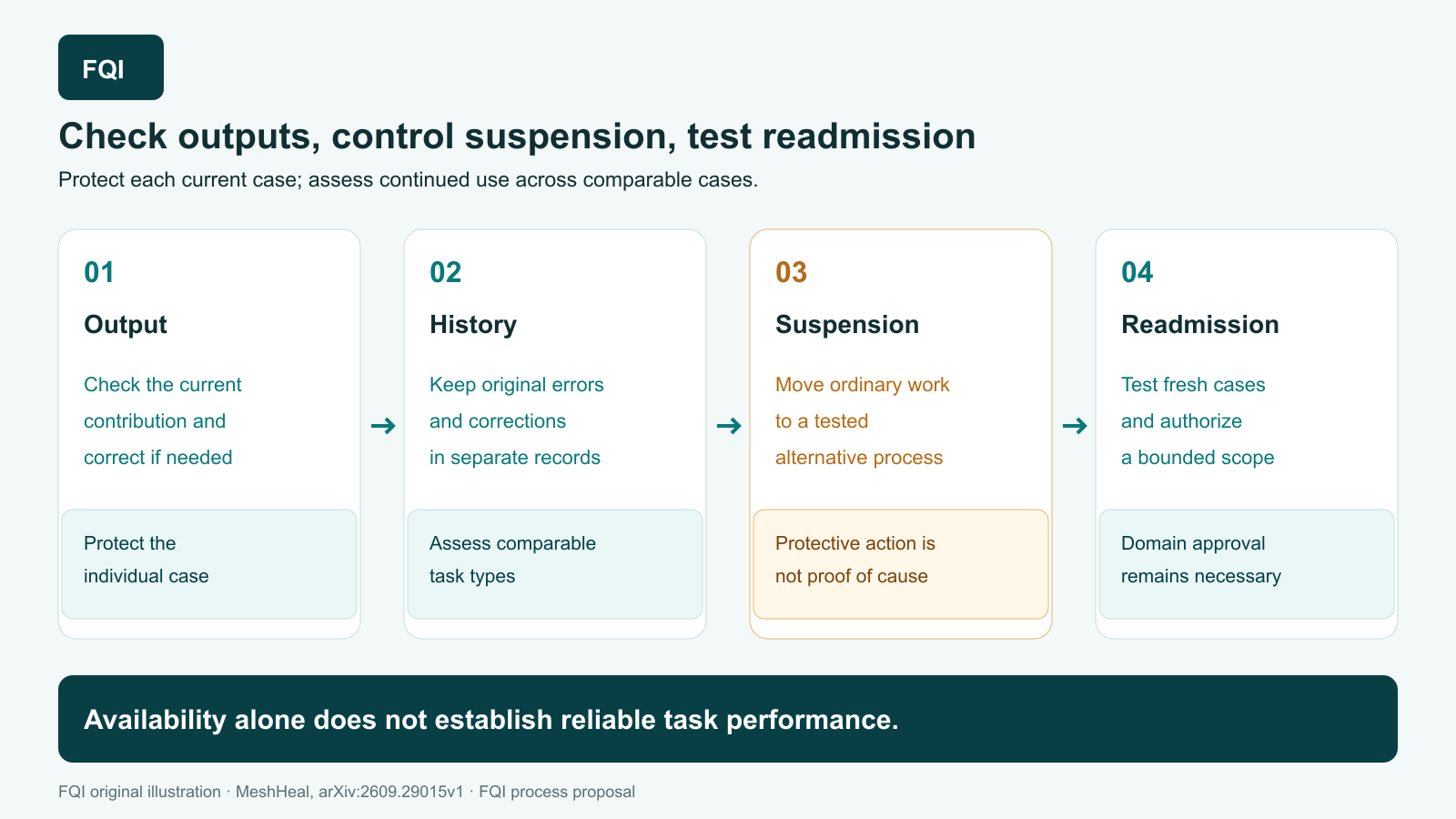
- Protect the current case: A questionable result needs a controlled replacement or review route, even while its cause remains unresolved.
- Preserve the original error: Corrections must not retrospectively improve the producing agent’s performance history.
- Test readmission separately: Suspended agents need fresh performance evidence before receiving ordinary work again.
The principle at a glance
MeshHeal has agents assess other agents’ contributions. Repeated concerns affect subsequent assignments; reviewed recovery probes allow a return. The experiment represented capabilities through stronger and weaker language models. Switching to the weaker model simulated deterioration without changing availability. This is a controlled failure scenario, not an observation from an actual factory.
The FQI pilot proposed here distinguishes three objects of assessment: the individual output, the reliability of a particular system configuration and its eligibility for renewed use. Keeping these separate helps connect immediate protective action with investigation of the underlying cause.
Terms explained
- Gray failure: A service continues to operate technically while its task performance persistently declines.
- Task allocation: The decision about which available component may perform a work step.
- Readmission: Limited renewed use after a previously suspended component has undergone documented assessment.
Deep dive
The following process is an FQI interpretation for a bounded operational pilot, not a work instruction validated by the study. A simplified example is an assistant transferring information from supplier inspection reports into an internal inspection record. Critical attributes include the correct unit, the drawing revision and the identity of the inspected batch. The responsible person retains the final product decision.
First, the team defines how each proposed record will be checked. Missing revision information or inconsistent units trigger a clarification request or manual review. This response protects the current case. It must not depend on whether enough cases have accumulated to diagnose the agent. Even an assistant with a reliable history can produce an individual critical error.
Alongside this process, the team preserves an unchanged record of the original output. It contains the system version, input source, task type, disputed attribute and assessment result. The corrected record receives a separate entry identifying the responsible person and the reason for correction. Two questions therefore remain answerable: was the current case completed correctly, and how often did the original generation require correction?
Assessment across cases requires comparable tasks. Difficult handwritten reports must not be mixed indiscriminately with machine-readable standard forms. The team therefore examines task classes and documents changes in incoming material. Deterioration may arise from the agent, its tools or altered documents. Suspension is initially a protective measure; it does not establish the cause.
For a suspended configuration, ordinary assignments move to a previously tested alternative process. A limited testing route remains available. Through that route, the component handles authorized test cases whose outputs cannot trigger uncontrolled downstream actions. Independently established expected results allow comparison with the last accepted configuration. The repair notification, technical availability and task-performance assessment are documented separately.
Before readmission, the responsible person defines the permitted task scope. Successful assessment of standard forms, for example, does not authorize processing of new document types. Suitable criteria cover critical errors, unnecessary suspensions, processing time and the burden on the alternative process. A defined observation period follows readmission. Its extent and acceptance limits must reflect the consequences of errors and operational experience; the research experiment provides no universal number.
Limitations and risks
MeshHeal is a preprint using controlled knowledge and mathematics tasks. Mutual model review does not replace an independent reference. The study sometimes uses the same reviewer in separate calls; corrected outputs do not undergo recursive review. The FQI pilot therefore needs additional reference checks and assessment of shared causes of failure. Comparison with other agents is particularly unhelpful when they all use the same faulty source. Unnecessary suspensions and delayed readmission can also disrupt the process.
FQI conclusion
A useful first step is a record that separately preserves the original output, its correction and eligibility for use. This reveals whether good final results depend on continually increasing review effort. For the proposed pilot, the team should choose a tightly bounded work step and test both the alternative process and readmission. The central decision then goes beyond service availability: for which task does current, credible evidence of adequate performance actually exist?
Sources & transparency
- Chen, Lin, Liang, Bastian and Zou: MeshHeal: Self-Healing Decentralized LLM Agent Networks under Gray Failures, version 1 dated 24 September 2026, particularly Sections 4–6 and Appendix B.5.
- arXiv publication record.
The source provides the technical principle studied. The supplier example, records and pilot process are explicitly FQI interpretations. Prepared with AI assistance and authorized for publication by the publisher’s explicit instruction. This does not assert an individual human domain review.