
Executive summary
A peer-reviewed study presents an LLM-assisted multi-agent framework that interprets unplanned product requirements, retrieves manufacturing knowledge at runtime and matches requirements with available machine capabilities. In three increasingly complex cases on an assembly test bed, the system produced executable operations while discovering capabilities and parameters dynamically. This is a strong architectural idea for flexible production, but not yet industrial evidence. Safety, technical plausibility, version control and release decisions must be secured outside the language model.
FQI takeaway
- Product requirements need a controlled translation chain: Between free text and a machine order, technical semantics, capabilities, limits and versions must become explicit.
- Dynamic planning must not bypass release gates: New operation sequences should be simulated, checked against PFMEA, the Control Plan and safety rules, and approved before execution.
- The most plausible value lies in variants and disruptions: The approach is particularly relevant to high-mix, low-volume settings where rigid pre-programming is expensive and slow.
The principle at a glance
Source facts
Lim, Zhao, Hernandez and Kovalenko describe a framework in which a Product Agent interprets unplanned product changes. It decomposes complex requirements and matches them to manufacturing capabilities across several production stages. Knowledge about machines and operations is retrieved at runtime; communication strategies are intended to expose parameters that were not explicitly modelled in advance. The evaluation uses an Assembly Task Board and three case studies of increasing complexity.
FQI interpretation
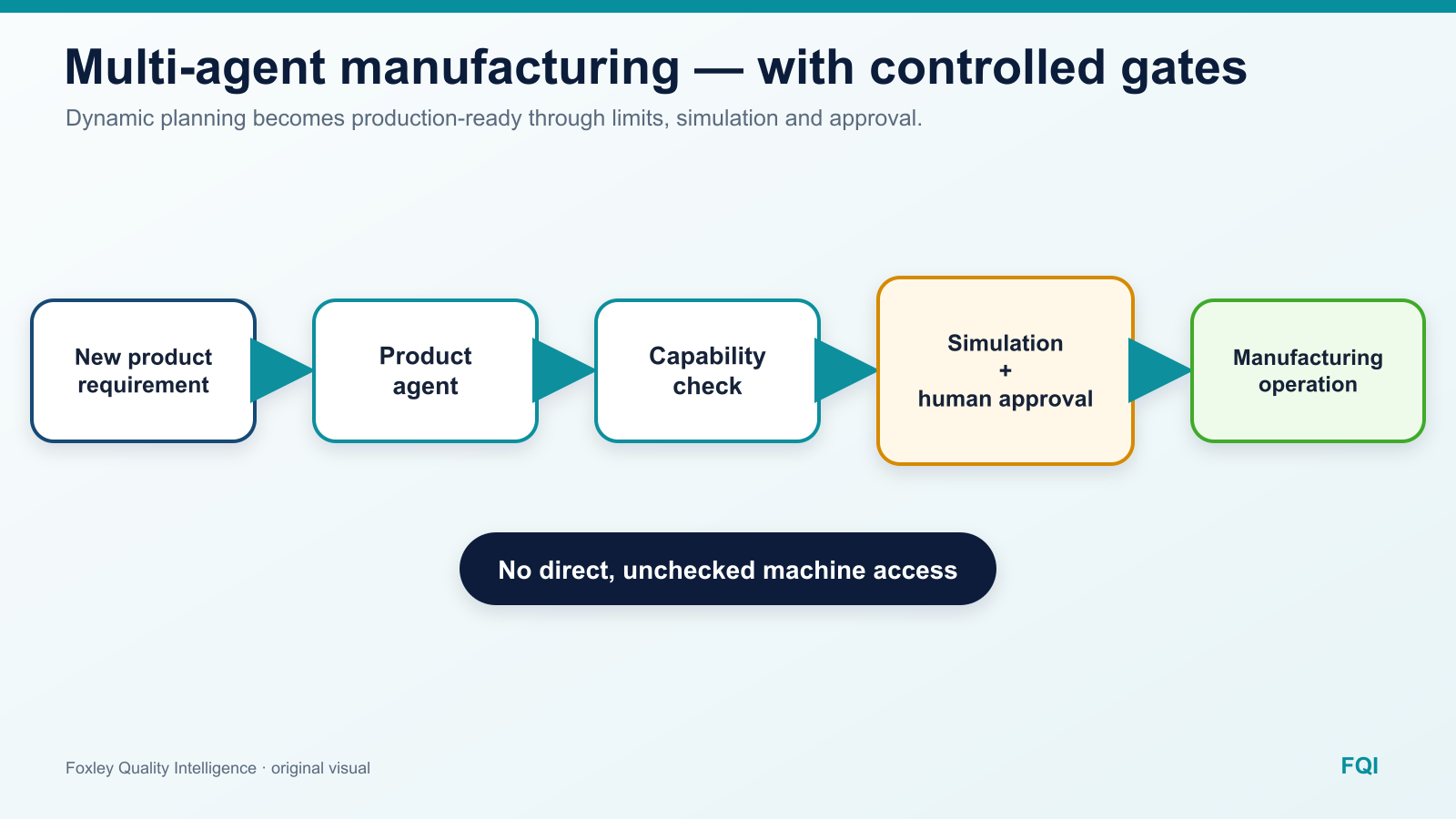
The relevant target is not an autonomous free-text command sent to a machine. It is a controlled chain: requirement → structured technical characteristics → capability matching → operation proposal → rule check and simulation → approval → execution → feedback. Quality is created in the gates between these steps.
Terms explained
- AI: Artificial intelligence; systems that derive patterns from data or support tasks automatically.
- MES: Manufacturing execution system; software for controlling and recording production operations.
- LLM: Large language model; a model for processing and generating text.
- PFMEA: Process Failure Mode and Effects Analysis for proactively assessing manufacturing risks.
Deep dive
What the study actually contributes
Conventional multi-agent manufacturing systems often use predefined capabilities. Unexpected product changes then require manual programming and validation. The study addresses that gap with an LLM intended to interpret natural-language requirements and combine them with dynamically retrieved manufacturing knowledge.
According to the abstract, the system translated new requirements into executable operations, discovered available capabilities dynamically and improved resource use. The tests demonstrate technical feasibility within the constructed test bed. They do not establish autonomous reconfiguration of real production assets or robust performance across plants, controls and safety categories.
FQI practical transfer
In an industrial pilot, the LLM should operate only within the proposal space. Binding machine parameters, allowed tool combinations, safety limits and quality-critical characteristics belong in versioned, machine-readable sources. Every proposal must reference the requirements, capability data and rule versions used.
At least four gates should precede execution. First, schema validation: Is the requirement complete and consistent? Second, technical plausibility against equipment capabilities and process windows. Third, risk and quality review against PFMEA, the Control Plan, the inspection strategy and special characteristics. Fourth, simulation or a dry run, followed by human approval for real changes.
A useful first case would not be safety-critical autonomous reconfiguration but preparation of a work plan for a new variant. The agent could propose alternative resource sequences and identify missing capabilities. Process planning and quality functions decide; after approval, the confirmed result enters the MES or control system through a controlled interface. Relevant measures include planning time, correctly identified capabilities, human corrections and errors detected before and after the gate.
Limitations and risks
- Limited evidence: Three cases on an assembly test bed demonstrate feasibility but not robust performance in real series or variant production.
- Hallucination and incorrect mapping: A plausible operation proposal may still be technically invalid or incomplete.
- Outdated manufacturing knowledge: Incorrect versions of process windows, tools or machine capabilities can make correct planning impossible.
- Safety and cybersecurity: An LLM must not receive uncontrolled write or execution access to production systems.
- Local optimisation: Better resource use may harm quality, ergonomics, maintenance or delivery when objectives are too narrow.
FQI conclusion
The study shows a credible route towards more flexible production planning: LLMs can interpret new requirements while multiple agents coordinate capabilities and resources. Industrial use, however, requires deterministic boundaries around probabilistic proposals. Versioned knowledge, PFMEA, the Control Plan, simulation and human approval are prerequisites for scalable automation, not obstacles. The next useful step is a bounded planning assistant with measurable correction rates—not direct autonomous machine access.
Sources & transparency
- Lim, Jonghan; Zhao, Jiabao; Hernandez, Ezekiel; Kovalenko, Ilya: Adaptive task planning and coordination in multi-agent manufacturing systems using large language models, Robotics and Computer-Integrated Manufacturing, Volume 100, Article 103245, August 2026, DOI: 10.1016/j.rcim.2026.103245.
- The framework, test bed and reported results are source facts. The proposed industrial gates and pilot metrics are FQI interpretations.
- The German source article, abstract and bibliographic primary source were reviewed on 14 August 2026. This AI-assisted English translation was prepared on 17 August 2026 and awaits renewed human review. Claims remain limited to the publicly available source information.
- Approval status: First-use explanations and the glossary were reviewed by a human and approved for publication on 17 August 2026. Approved by: Johann Fischer.