
Executive summary
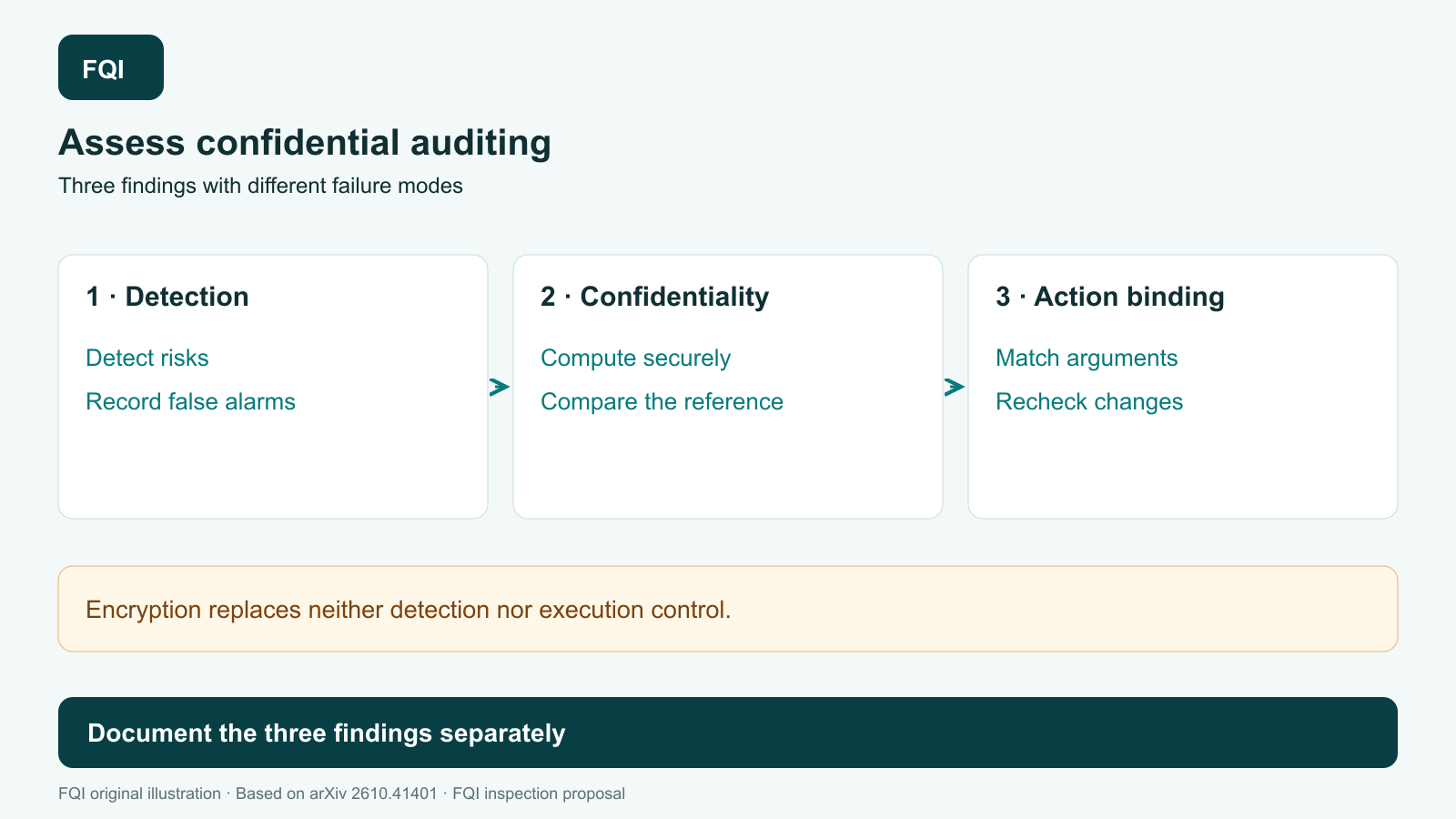
An external check of an artificial intelligence (AI) agent’s proposed action can itself expose confidential task data. The SealCall preprint investigates an architecture separating audit computation, plaintext access and execution authority. Quality management consequently needs three distinct findings: does the audit detect relevant risks, is its computation adequately protected, and does the decision apply to exactly the action executed? Successful encryption does not answer the other two questions. FQI treats the work as a bounded research demonstration with a useful acceptance structure.
FQI takeaway
- Assess detection quality, confidentiality and binding to the actual action separately.
- Recheck the audited arguments immediately before execution.
- Measure false alarms in the intended process; a calibration budget is not an operating guarantee.
The principle at a glance
The agent proposes an action. A trusted controller creates and encrypts a numerical representation. An external service computes over encrypted values. The controller decrypts the result and decides whether execution is permitted. Homomorphic encryption enables computation without revealing plaintext inputs to that service.
AI contributes the learned representation and contextual risk assessment. The representation may lose information. Its suitability therefore needs evaluation alongside the encrypted calculation.
Deep dive
The authors evaluate 1,252 binary-labeled candidates from public agent datasets using grouped, nested evaluation. One SealCall configuration reaches an F1 score of 0.840, combining precision and recall for unsafe actions. Simpler comparison models achieve better detection on the same inputs. The contribution should not be read as a general demonstration of a superior risk classifier.
FQI proposes three acceptance records for a local trial. The first contains technically permitted and prohibited actions, recording missed risks separately from unnecessarily blocked work. The second compares encrypted computation with its plaintext reference. The third changes individual action parameters after a successful audit and checks whether the previous permission becomes invalid.
A simplified example is sending a supplier report. The audited recipient is internal, but the later call contains an external address. Permission must be bound to the audited recipient, content and relevant state. Otherwise the audit may have been correct while its result is applied to a different operation.
The test series also needs missing-information cases. When an address has an unknown origin, the system must not silently treat it as explicit user authorization. The responsible team determines when clarification is required and when execution must stop. This process decision cannot follow from a similarity number alone.
Every variant records the data revision, model revision, threshold and call actually executed. Changes to context compression require renewed technical assessment because removing a restriction can change the judgment. Encryption changes additionally require the numerical comparison. A common acceptance view should expose these separate findings rather than compress them into one green indicator.
Limitations and risks
The study assumes a specified trust model, including a protocol-following but curious audit service. It does not establish security against arbitrary malicious infrastructure. The public data were exposed during development, so this is not an untouched evaluation on subsequent operational cases. The authors also show that a calibration false-alarm target can be exceeded in testing. Current detection evaluation is offline. Deployment needs representative cases and reliable mediation of tool execution.
FQI conclusion
Confidential auditing connects several quality questions. FQI recommends a separate expected behavior for each interface: appropriate information handling, a defensible judgment and an unchanged action. A useful first experiment changes arguments after auditing. It reveals whether permission protects the intended operation. Strong detection and correct encrypted computation remain valuable, but neither substitutes for that final execution-binding check.
Sources & transparency
Methods, evaluation and limitations reviewed on 3 November 2026. Scientific preprint; no independent reproduction by FQI. Operational examples and inspection proposals are FQI interpretations, not additional experiments in the study. Artificial intelligence assisted preparation. Johann Fischer explicitly approved this article package for publication on 2026-11-04.