
Executive summary
An automated reviewer can agree with people on most answers and still underperform a simple comparison rule. LEGAL-UQA tests this possibility using Urdu answers about stored constitutional passages. The study separates finding the passage, producing an answer from a supplied passage, and assessing whether the answer is adequate. Its results show why the balance between accepted and rejected answers matters when a quality team interprets agreement.
FQI takeaway
- Evaluate passage retrieval and answering from a supplied passage separately.
- Compare the judge’s agreement with the most frequent human decision.
- Inspect the source passage alongside the reference answer when grades disagree.
The principle at a glance
The dataset contains 619 parallel English–Urdu question and answer pairs linked to 305 passages. Both languages are available for the questions, reference answers and passages. The questions were created to resemble lay wording. Answering was evaluated in Urdu. Having parallel English text helps with examination of the material but does not establish how well the same system answers in English.
Consider a reference answer that names the responsible office yet leaves out an exception stated in the passage. A model comparing another answer with that reference could penalise a more complete response. This simplified example shows why a reviewer needs access to both kinds of reference, especially when the test might otherwise be used to change the answering system.
Deep dive
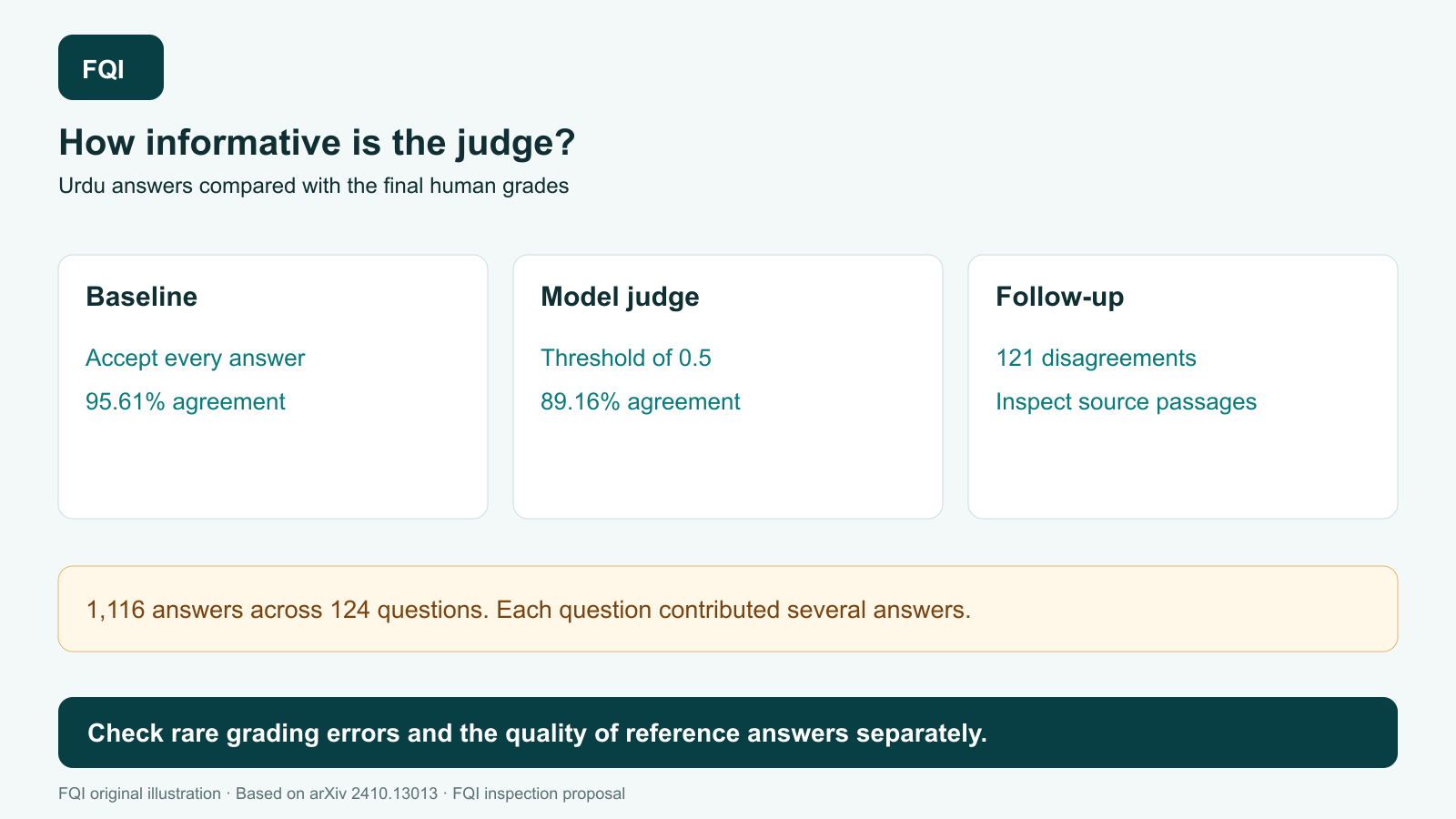
In the answering experiment the model already receives the relevant passage. The authors compare nine answer sets for 124 questions, giving 1,116 answers. A decision model called JEV judges equivalence to a reference. The human comparison uses final grades after disagreements were resolved. A separate retrieval experiment asks how often a search returns the originating passage. Retrieval success by itself says little about what a generated answer will say.
At a decision threshold of 0.5, JEV agreed with final human grades on 89.16 percent of answers. Humans gave full credit on 95.61 percent. Simply accepting every answer would therefore agree with humans on 95.61 percent of the same set. The 121 disagreements between JEV and humans are candidates for inspection. They do not establish that every disputed answer is legally wrong or that the human grade was infallible.
For a local test, the quality team can document which condition appears in the passage, whether the reference includes it and how the generated answer expresses it. If the team adjusts the judge’s threshold, it can reserve separate questions or articles for verification. Keep all answers to one question together when making the split. Otherwise a threshold that works well for familiar question wording could appear to generalise to an independent evaluation.
Limitations and risks
The source editions have an amendment cutoff in 2018. The experiment concerns the stored texts. The Urdu pages required optical character recognition and cleanup, without an independent transcription for a full comparison. The human reviewers’ legal expertise also limits what their grades establish. A high score with a supplied passage leaves open how often a deployed system would retrieve an unsuitable one and produce a plausible answer from it.
FQI conclusion
Inspect the three components separately, then run complete questions through the service. Where reference and passage diverge, a reviewer can identify whether to revise the search, the generator, the automated judge or the test material itself. Rare adverse decisions deserve individual examination before relying on a headline agreement percentage.
Sources & transparency
Author version reviewed 2410.13013v2. The workplace examples and proposed acceptance tests are FQI interpretations. LEGAL-UQA: Testing Constitutional Question-Answering Systems for Urdu Speakers with a Parallel English-Urdu Benchmark · Version history
Codex assisted with drafting and checked the claims against the cited original sources. Johann Fischer authorized publication on 2026-11-17.