
Executive summary
A language model finds evidence for a claim. A second text checker disagrees and the combined system reports insufficient evidence. A study of scientific claim verification tests this cautious-looking rule with three open language models. For each one the agreement rule lowers the average F1 score across the three possible judgments. An acceptance test for a second checker needs to track which correct and incorrect decisions its veto changes.
FQI takeaway
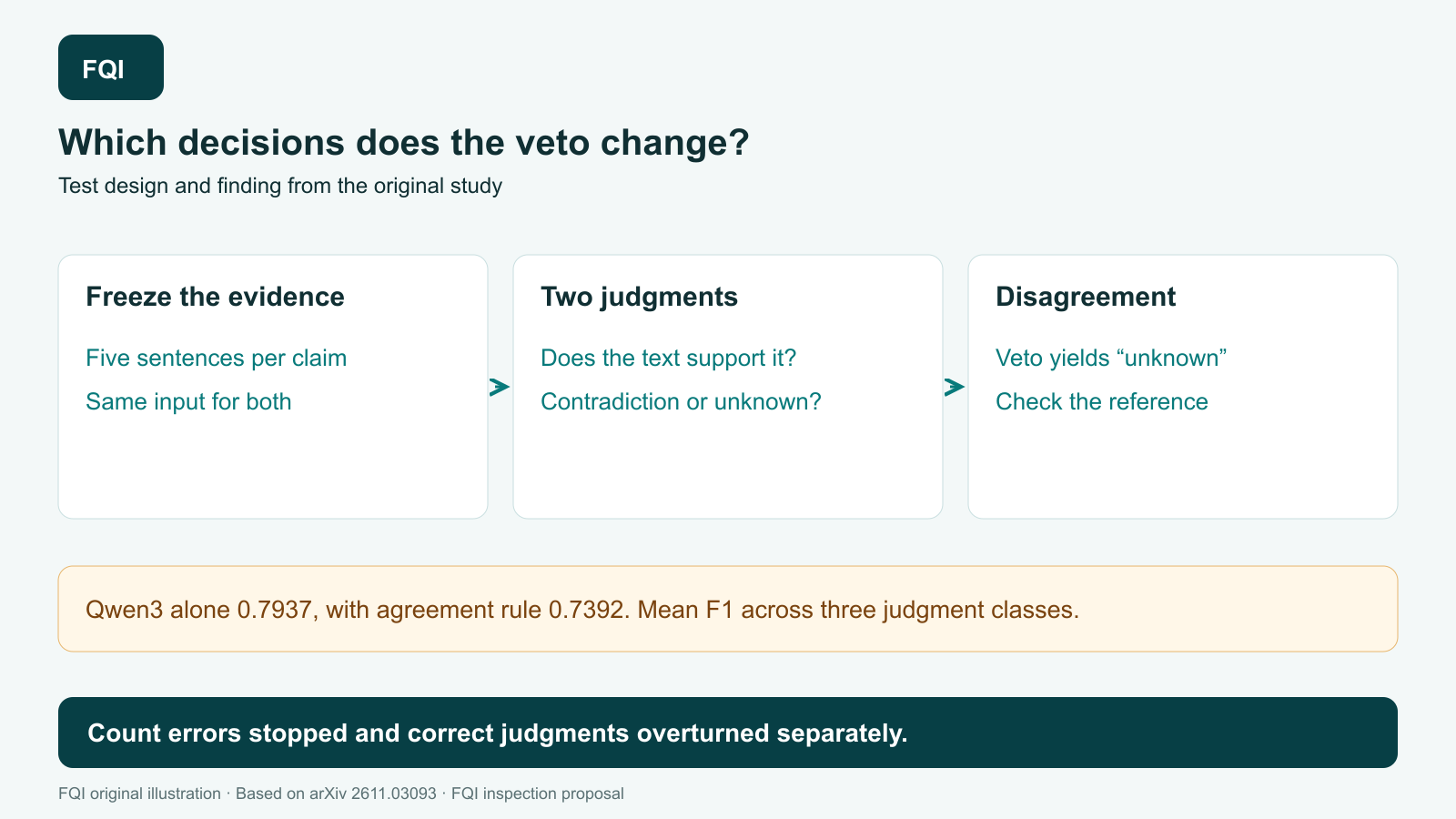
- Count wrong claims stopped by the second checker.
- Count valid judgments turned into undecided cases.
- Have a specialist establish the reference independently of both models.
The principle at a glance
The task distinguishes support, contradiction and insufficient evidence. A retrieval stage selects five sentences for each claim. The researchers cache these sentences so that every checker sees the same material. One model specialises in relations between texts. The combined system returns support or contradiction only if both checkers agree on that judgment. Disagreement defaults to insufficient evidence, even if one checker correctly read the passage.
Deep dive
The benchmark contains 2,035 claims from two collections. Of these, 858 are supported, 152 contradicted and 1,025 insufficiently supported. For each class the F1 score balances how often a reported judgment is right with how many actual cases of that class are found. Taking the plain mean gives the rare contradiction class as much weight as either common class. In Table 3, Qwen3 scores 0.7937 alone and 0.7392 with the agreement rule. Llama declines from 0.7204 to 0.6730 and Mistral from 0.6388 to 0.5991. The error analysis identifies cases in which disagreement overturns correct judgments by the language model.
Limitations and risks
For a simplified inspection case, give both checkers a claim from a report and the corresponding measurement records. Before running the test, have a specialist record the correct judgment and the necessary passage. If two related facts are required, verify that both appear in the material actually supplied. Otherwise a missing retrieval result could be misattributed to the checker. Contradictions are uncommon in the benchmark and the two collections contribute different label distributions. Local case frequencies and the cost of unnecessary escalation can change the operational value of a veto.
FQI conclusion
Compare the same evidence packets with and without the second checker. Group changed outcomes by the original judgment and the reference decision. If the veto repeatedly removes good judgments, disagreements could go to a specialist while the team establishes which kinds of conflict merit an automatic block.
Sources & transparency
The figures and comparisons come from the authors’ arXiv preprint. The workplace example and proposed acceptance decisions are FQI interpretations. An Experimental Study of Hybrid Retrieval, NLI and Open-source LLMs for Scientific Claim Verification · Version history
Codex assisted with drafting and checked the claims against the cited original sources. Johann Fischer authorized publication on 2026-11-14.