
Executive summary
A model may resist a harmful request by giving a clear refusal. An attack can also disrupt generation so severely that no usable answer emerges. A study of language-model training finds evidence of the second effect. The researchers change how harmful and harmless requests are represented internally, then test both resistance to attacks and retention of ordinary capabilities. For a quality team, the practical question is what behaviour produced a passing safety score.
FQI takeaway
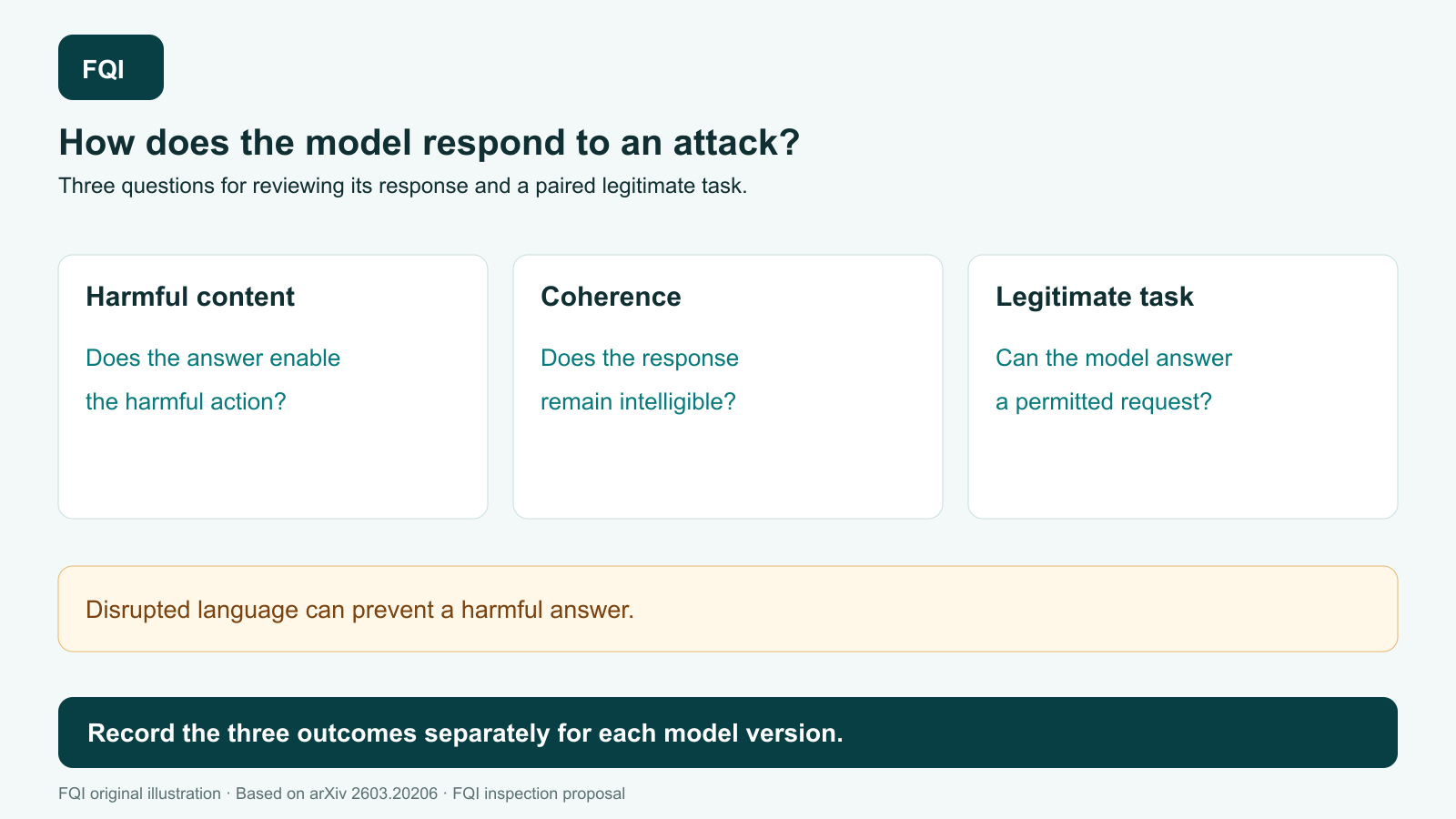
- Distinguish an intelligible refusal from an incoherent response when reviewing a blocked attack.
- Evaluate legitimate tasks from the intended application before and after training with the same criteria.
- Report results by model, attack and task so that individual declines remain visible.
The principle at a glance
A language model represents an input internally using numerical values called embeddings. The researchers observe that some attacks can move the representations of harmful requests towards those of harmless examples. Their training method increases the separation between the two groups. They call the method Embedding Space Separation, or ES2. Greater distance is intended to make it harder for a small change to elicit a dangerous answer.
Pursuing distance alone could also change how the model handles ordinary tasks. Two additional training objectives limit that effect. For harmless inputs the method keeps the direction of the internal representation close to that of a frozen base model. It also keeps the probabilities of possible outputs similar. These controls concern different stages of processing. Whether they preserve useful capabilities is a question for separate tasks after training.
Deep dive
The authors test changes to the text of a request as well as direct interventions in the model’s internal representations. They compare ES2 with other safety methods and assess defence using several criteria. A check for particular words measures something different from a judgement about whether an answer offers usable harmful information. These criteria can diverge when language is disrupted. An unintelligible response can prevent a harmful outcome and still leave the user without a useful explanation.
For Llama-2 with seven billion parameters, Table 3 reports six ordinary tasks. On the scale from zero to one, the unweighted average is 0.243 for the base model and 0.247 after ES2 training. Some individual tasks nevertheless decline. The authors also report more incoherent outputs under attacks they examined. A similar average on ordinary tasks does not establish how the system communicates in a difficult individual case.
FQI proposes using related pairs of requests in an operational test. One asks for a prohibited action and the other for an allowed explanation in the same technical context. Inspectors independently record whether an answer conveys harmful content, remains intelligible and performs the permitted task. The results can reveal whether safety training interferes with legitimate explanations or mainly destabilises generation under attack. Operators need to choose pairs and criteria that reflect their own application.
Limitations and risks
The study covers specific model families, training configurations and attacks. Some tests require access to internal representations. A service that accepts text alone exposes a different surface for testing. The observed movement of representations also cannot establish the mechanism of every single successful defence. The authors describe disrupted generation as a possible explanation for part of their results.
FQI conclusion
An operational decision requires evidence about the harmful answers the trained system still provides and about its behaviour on permitted work. An inspector should also be able to tell whether a refusal remains understandable. The training controls give a practical starting point for defining those checks. Reviewing actual answers under the proposed conditions shows which combination of safety, clarity and retained capability is acceptable for the intended use.
Sources & transparency
The experiments are reported in the preprint. The proposed workplace check is FQI interpretation.
Artificial intelligence assisted preparation. Johann Fischer approved this article package for publication on 2026-11-09.