
Executive summary
An artificial intelligence (AI) reviewer can agree with a person about a wrong answer yet give a different explanation for the mistake. Madhu Sudhan Rao Beesetty investigated both judgements on multilingual maths problems. Agreement was high on whether an answer was correct and low on one specific error category. A team planning improvements from an error chart consequently needs to check the instrument that assigns causes as well as the one that marks answers.
FQI takeaway
- Compare answer correctness and error classification separately on the same set of cases, reporting the eligible count for each.
- Where several labels apply, check whether the most frequent category changes when the decision rules are reordered.
- Retain uncertain cases and examine the question and reference answer where disagreements cluster.
The principle at a glance
The category under study describes a recognisable pattern. A model notices a necessary part of a problem, then drops it or applies it incorrectly in its solution. An evaluator can look for evidence of that pattern in a written answer. This records a feature of the visible work. Even a short solution can also fit another description, such as an incorrect final calculation. If only one label may be recorded, the first matching rule can determine what gets counted.
Deep dive
The study covered twelve models and eleven languages. For 50.1 percent of the failures the author found evidence of more than one category. Across six effective orderings of the rules, the share assigned to the category under study ranged from 26.4 to 76.4 percent. The responses were identical throughout. A team that tackles its largest error category first could therefore change its improvement priorities simply by changing the order of the checks.
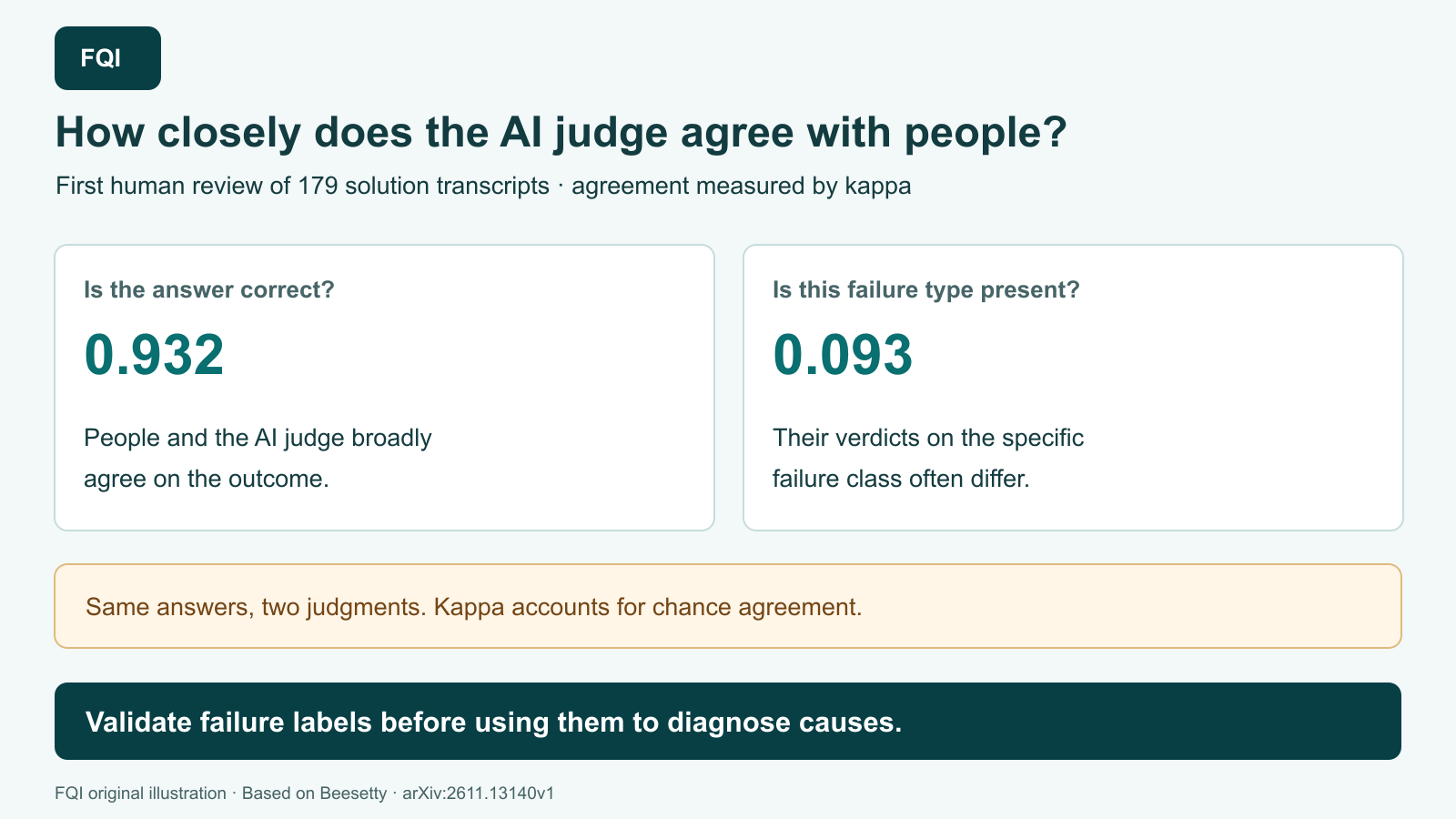
Native speakers also examined responses. In the first round they reviewed 179 records. Kappa, a measure of agreement adjusted for chance, reached 0.932 on correctness for the 178 records matched for that comparison. For the error category it was 0.093 on 142 records judged incorrect by a human. In a second round a different speaker of each language rated a subset. On the 121 pairs with definite judgements, agreement between the two people reached 0.659. These results distinguish a difficult judgement from a failure of this particular measuring procedure.
When the same AI reviewer received the narrower instructions and example given to the people, its classifications came closer to theirs on the subset with definite answers. Disagreement also exposed a defect elsewhere. In two translations a condition required to solve the problem was missing. Someone who investigates only the model’s answer could spend time correcting the wrong part of the system.
For a local acceptance check, two reviewers could independently mark every plausible category in a sample. They could then apply the rule that selects one primary cause. If the leading category changes when two rules exchange places, the report should show that sensitivity. Before investing in a change to the model, the team could refine the marking rule and repeat the comparison on fresh cases.
Limitations and risks
The experiment covered one author-defined category, a small set of maths problem structures and one AI inspector. Each round had one reviewer per language. Differences between individual reviewers and differences between languages were therefore hard to disentangle. Removing uncertain responses can also change the impression a reliability statistic gives. Each reported figure needs the number of cases eligible for that comparison and an account of the cases left out.
FQI conclusion
Before using an error distribution to choose a corrective action, ask whether different reviewers using the same definition would identify the same priority in the same answers. A separate check on answer accuracy cannot settle that question.
Sources & transparency
Madhu Sudhan Rao Beesetty, preprint version 1. The findings come from the rule-order analysis, the human ratings and the limitations in section VI. The proposed local acceptance check is an FQI application.
Codex assisted with drafting and checked the claims against the cited original work. Johann Fischer authorized publication on 2026-11-11.