
Executive summary
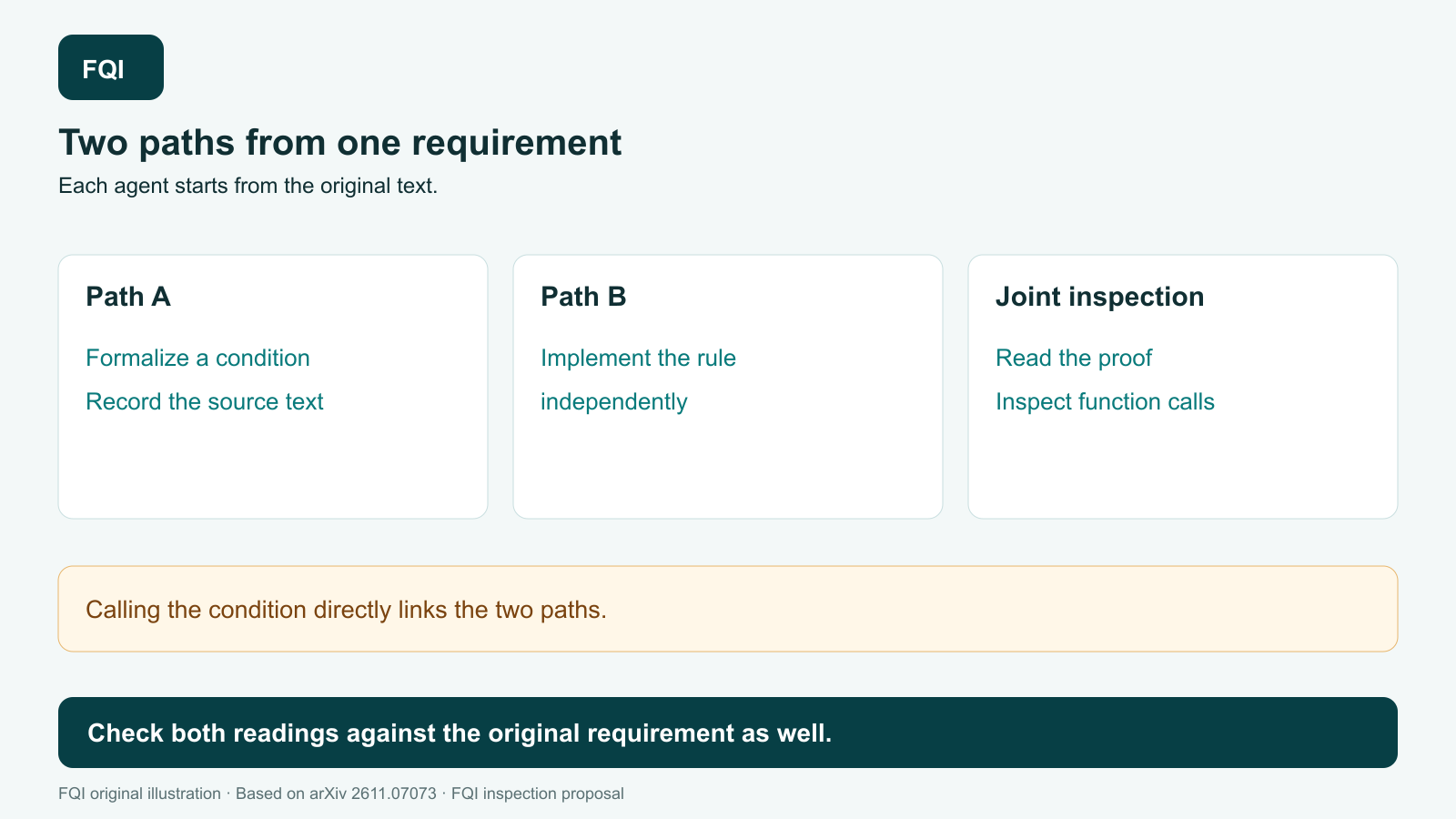
One agent translates a requirement into a formula. A second writes an implementation that a verification tool checks against the formula. If that implementation simply calls the first agent’s condition, the proof may succeed even though there has been only one interpretation of the requirement. A preprint documents such a case and describes a way to investigate genuine differences between two interpretations systematically.
FQI takeaway
- Give both agents the original wording and separate paths to their results.
- After a successful proof inspect which functions the implementation actually calls.
- Assess missing criteria, contradictory criteria and substantive correctness separately.
The principle at a glance
The researchers use 96 clinical trial documents and extract eligibility criteria that can be expressed numerically. The first agent writes a condition in Dafny, a language for verifying programs. The second derives an executable rule from the same text. A tool checks whether the implementation satisfies the condition. Quality reviewers also need to know whether the two routes were independent and whether both understood the source requirement correctly.
Deep dive
Even using the same language model on both sides, independent re-extraction agreed in 59.3 percent of cases in the reported control. Supplying already extracted facts to both sides removes much of this work. In a preliminary trial using shared facts, verification succeeded on the first attempt in 50 of 52 documents. That result concerns the consistent processing of given facts. Interpreting the original twice calls for a different test.
Role allocation also mattered. For one model pair, agreement reached 53.0 percent with the stronger model implementing the rule and 14.3 percent after switching roles. Structural inspection found a direct call to the specified condition in the second configuration. Correcting for that shortcut reduced agreement to 13.2 percent.
For machine-readable quality requirements FQI proposes giving each interpreter the original document. For every threshold, save the source passage, comparison operator, unit and scope. Combine the two sets only after both routes are complete. A missing minimum value requires a different follow-up from two conflicting minimum values. A shared call to the same helper exposes a technical dependency.
Consider a simplified receiving inspection. A requirement says that each delivery above a certain quantity must be checked. One implementation could interpret that quantity per carton, another per whole delivery. A test with a single carton scarcely separates them. A delivery made up of several small cartons forces the team to settle the intended meaning. This gives the reviewer a business-level test even when both technical routes report successful proofs.
Limitations and risks
The study lacks an independent reference specification for each document. Agreement can thus reflect a shared misreading. Swapping the roles also changed which model received the literal extraction instructions and which received the interpretive instructions. The difference cannot be attributed solely to model capability. The experiment supplies no basis for judging the clinical eligibility of an individual.
FQI conclusion
A verification report should identify the property proved, the inputs shared between the routes and their dependencies. Accepting the translation of a requirement also calls for checking cases against the original text. Cases where both agents might silently omit the same rare criterion deserve particular attention because agreement alone would make the omission invisible.
Sources & transparency
The methods, figures and limitations come from the authors’ publicly accessible paper. The proposed workplace test and simplified example are FQI interpretations. Study record. Original study.
Guidance from the National Institute of Standards and Technology (NIST) offers a framework for planning evaluation in the intended context of use. The numerical results in this brief come from the study. NIST evaluation guidance.
Artificial intelligence assisted preparation. Johann Fischer approved this article package for publication on 2026-11-06.