
Executive summary
How much of an artificial intelligence agent’s success comes from feedback provided by its tools? AutoformBench examines that question using mathematical proofs. The models complete proofs for specified statements and can check intermediate work in Lean, a language with a proof checker. When two ways of receiving executable feedback disappeared together, very few tasks were solved. This design lets a reviewer separate the loss of a particular interface from the loss of the information it carried.
FQI takeaway
- Keep the problem and the independent final check fixed when changing tools.
- Test each feedback channel on its own and then remove both.
- Record the resources available and the outcome confirmed by the final checker.
The principle at a glance
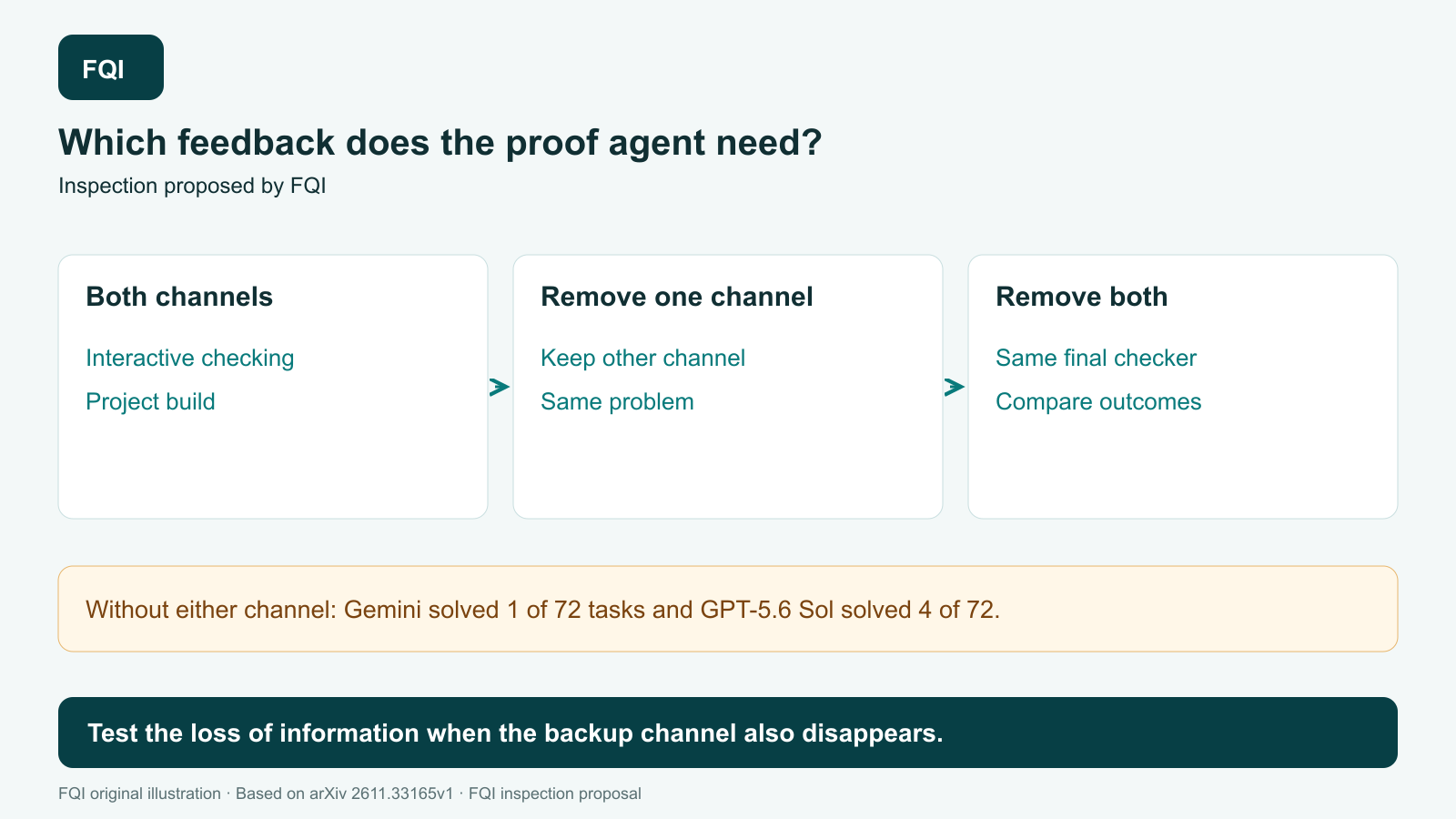
A proof checker determines whether formal steps establish a specified mathematical statement. Experts provide the target statements in AutoformBench. The agent receives the statement and mathematical context. It can supply the proof and add supporting results. While working, it may check a short piece of Lean interactively or build the whole project. Both routes give it information about whether the current work is accepted.
For grading, a separate environment receives the designated solution files. The grader checks the original definitions, goal and permitted assumptions. Accepted proofs are replayed in a second checking kernel. The tools available to the agent can therefore change without changing the final measure of success. That separation is central to interpreting the experiment.
Deep dive
The researchers used a fixed panel of 72 tasks to assess tool dependence. With all tools available, Gemini 3.7 Flash solved 38, 36 and 38 tasks in three runs. GPT-5.6 Sol solved 43, 44 and 43. Removing the interactive checker alone gave 36 and 45 successes in single runs. Looking at those two results in isolation, a team might conclude that feedback from running the work had little value.
However, the full project build was still available. Removing the build alone gave 24 and 39 successes. Removing both the build and the interactive checker yielded one and four. With file operations alone, each model solved one task. In this setting, feedback from executing Lean mattered a great deal. Dependence on any one access route varied with the alternative still available.
A deployment team can ask a similar question when moving an agent into a new environment. It could observe how the agent learns that an intermediate result is invalid. It could then remove one channel while keeping a replacement available, followed by a trial without either. The comparison needs the available feedback, resource budget and independently confirmed outcome for each condition. Otherwise a change to the grading rule could be mistaken for a change in the agent’s ability.
Limitations and risks
The panel was selected for this experiment. Restricted configurations ran once each, whereas full configurations ran three times. Their counts cannot establish precise per-task failure probabilities in service. Moreover, completing proofs of expert-specified statements differs from translating an informal requirement into an appropriate statement or developing maintainable abstractions for a shared library.
FQI conclusion
An inventory of tool names can miss a dependency that matters in operation. Two apparently different tools may tell the agent the same crucial fact about a work in progress. Removing just one can make that dependency hard to see. FQI would pair independent final grading with a documented test of how the agent fares when both the ordinary feedback channel and its backup are unavailable.
Sources & transparency
Original paper · AutoformBench v1 · Lean checker documentation · arXiv record
Measurements are attributed to the linked original version. Application examples and acceptance criteria are FQI interpretations. This review did not independently replicate the experiment.
Codex drafted the texts and checked them against the original study. Johann Fischer authorized publication on that basis on 28 November 2026.