
Executive summary
An artificial intelligence system can deliver a manufacturing process plan for every part while leaving open whether the plans contain the required operations in a usable order. Design-to-Plan illustrates the difference. In a comparison on 100 process-sequencing cases, the parallel configuration completed every run. The sequential configuration scored higher on completeness and ordering. A planning team therefore needs to know what the researchers counted as success before using that result to support a shop-floor decision.
FQI takeaway
- Check drawing-to-feature assignments separately on repeated features.
- Mark required operations, permissible additions and precedence constraints before comparing plans.
- Report run completion and technical usability as separate outcomes.
The principle at a glance
The system processes a three-dimensional design model and a corresponding engineering drawing. Geometry describes features of the part. The drawing supplies requirements such as dimensions and surface finish. A language model helps resolve ambiguous assignments. Further agents retrieve manufacturing knowledge, order operations and select tools. Intermediate results can therefore be examined before the final plan is considered.
Repeated holes illustrate an early point of failure. The system might read a drawing annotation correctly and attach it to the wrong feature. The authors tested context fusion on 20 real model–drawing pairs with 101 expert-validated mappings. Mean exact match was 0.792, compared with 0.903 for partial match. Several plausible positions remaining in the candidate set give the planner a different basis for action from a single confirmed assignment.
Deep dive
The 300 benchmark cases comprise three separate series of 100. They examine knowledge retrieval, operation sequencing and tool selection. A separate flange case illustrates the complete chain. The series provide evidence about component performance. They do not constitute an inspection of 300 manufactured parts.
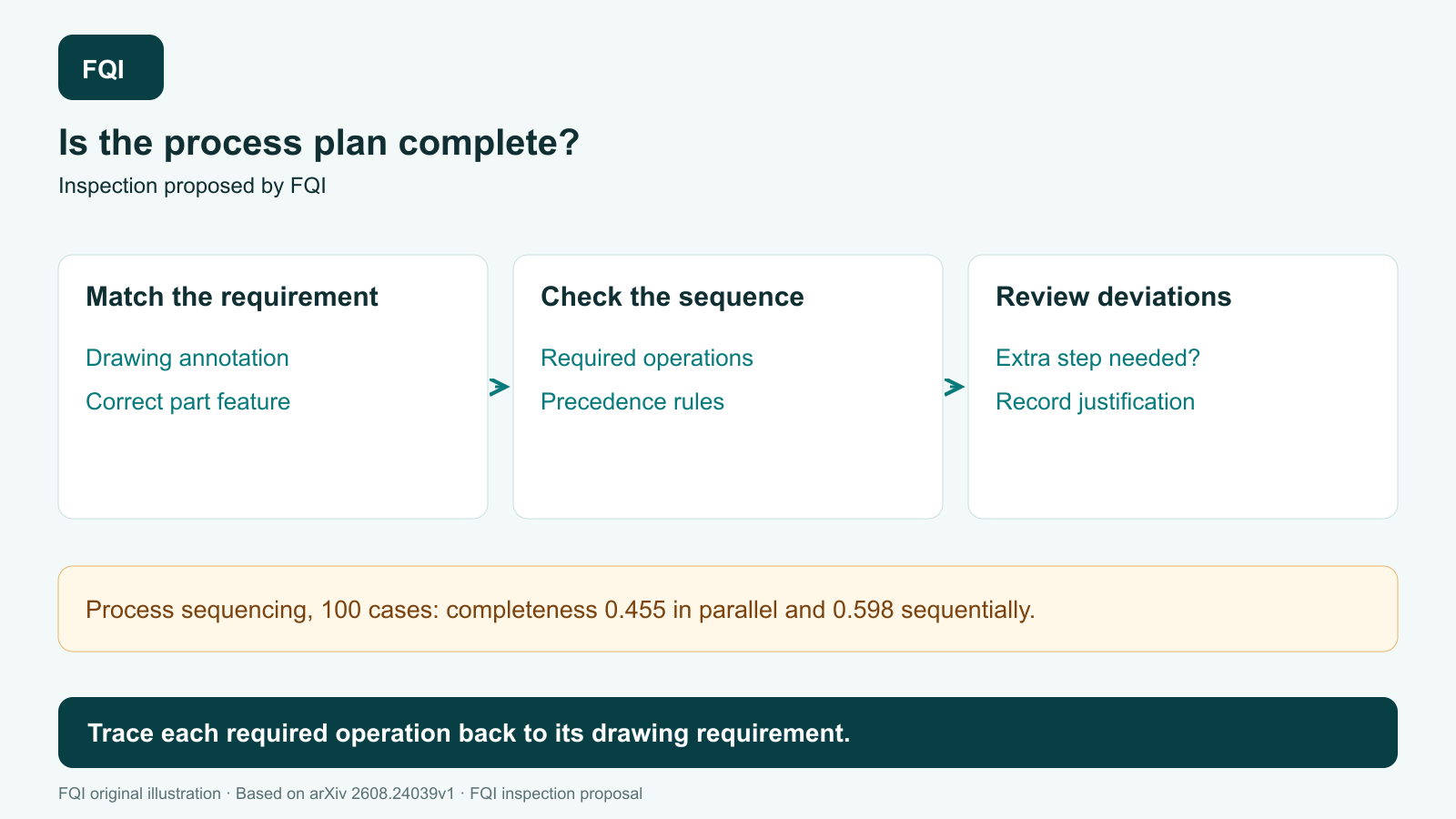
For sequencing, the technical success rates were 100% in parallel and 99% sequentially. Mean completeness against the reference was 0.455 in parallel and 0.598 sequentially. The ordering measure also favoured sequential operation, at 0.313 versus 0.147. The parallel configuration scored a little higher on compliance with dependencies. No single ranking expresses all these differences.
The authors explain why a reference sequence itself needs engineering judgment. A minimal sequence may contain only core operations. Deburring, cleaning or inspection can be sensible additions, even when they reduce overlap with the reference list. In a factory, omission of a mandatory operation warrants correction. An additional operation calls for an assessment of its purpose, cost and effects downstream. Treating every difference as equally serious could reject a workable alternative and hide a genuinely missing requirement.
Limitations and risks
The numbers refer specifically to the publicly readable author version. The journal record identifies the same work, but a full comparison of revisions was unavailable. The results also depend on the single-reference design. Agreement with a reference or compliance with selected dependencies cannot alone establish that a plan is executable on a particular machine with the shop’s tools and fixtures.
FQI conclusion
A useful release record follows a requirement from its drawing annotation to the operation that should satisfy it. Where the input remains ambiguous, the record should identify the decision that planning staff still need to make. A familiar part with repeated features and more than one acceptable operation sequence provides a practical trial. It reveals whether the system can preserve binding constraints while giving a defensible reason for a different plan.
Sources & transparency
Original paper · Design-to-Plan v1 · Journal record · Journal record
Measurements are attributed to the linked original version. Application examples and acceptance criteria are FQI interpretations. This review did not independently replicate the experiment.Figures refer to author version v1. The journal full text was unavailable for a revision comparison.
Codex drafted the texts and checked them against the original study. Johann Fischer authorized publication on that basis on 28 November 2026.