
Executive summary
An artificial intelligence system explains why another model made a decision. The strength of the explanation depends in part on who selects the test. FAX checks claims against the target model’s responses to modified situations. In the evaluation, the scenarios used to probe an explanation depend on the wording of that explanation. A cautious, narrow claim can therefore face an easier test than a broader one. Comparing systems requires attention to the challenge each one faced.
FQI takeaway
- Identify the behaviour predicted by each explanation.
- Complement explanation-specific probes with situations fixed in advance for every system.
- Report prediction accuracy, scope and human understanding separately.
The principle at a glance
FAX generates a draft explanation and breaks it into individual claims. For a suitable claim, a tool can change a feature of the situation and run the target model again. A claim supported by that check may be retained. A contradicted claim is revised or dropped. An ambiguous result remains uncertain.
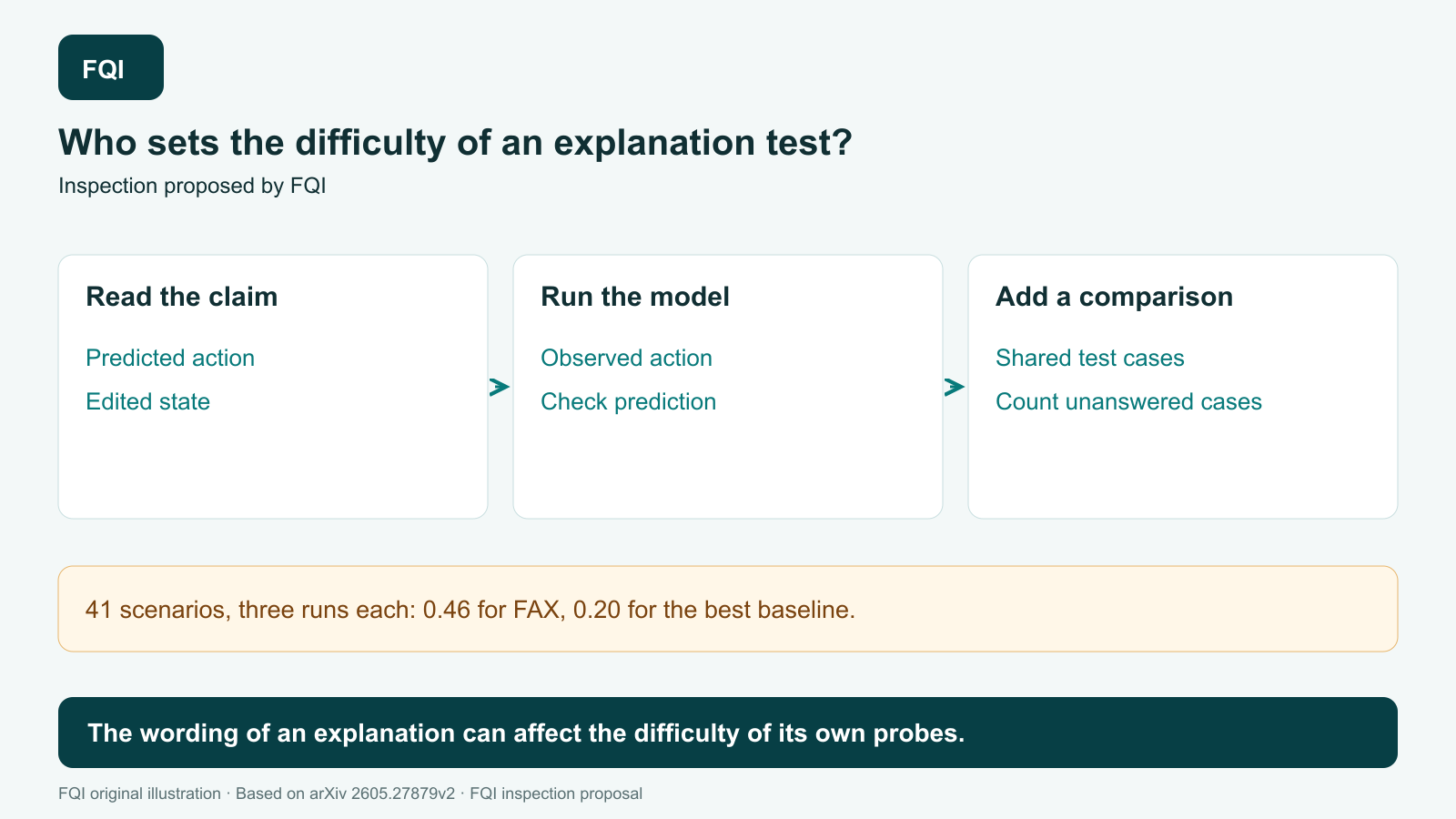
A different step evaluates the final explanation. An evaluator language model derives five hypotheses. Each specifies a change of state and the action the explanation predicts after that change. Researchers run the target model in the edited state. The score reflects agreement between predicted and observed actions. The evaluator helps choose the test and interprets the text. The target model supplies the reference action.
Deep dive
The main experiment uses the simulated world of Crafter. The team compares methods on 41 scenarios over three runs each. FAX scored 0.46 on the model-faithfulness measure. The strongest baseline scored 0.20. Generic self-reflection scored 0.18. Scores refer to behavioural prediction under the study protocol. Reading 0.46 as the proportion of factually correct sentences would change the meaning of the result.
Consider an explanation restricted to one obvious action. A second explanation addresses several possible actions in less familiar situations. When each text supplies the basis for its own probes, agreement with observed behaviour is evaluated over different sets of questions. A difference in their scores alone cannot tell a reviewer which explanation covers the model’s behaviour better across the intended use.
FQI would give a comparison two columns. One records predictions derived from each explanation’s own claims. The other records predictions for the same predefined cases. If an explanation offers no prediction for a shared case, that is informative and should remain visible. The record can distinguish a method that limits its promises from one that explains useful behaviour over a wider range of cases.
Limitations and risks
The study explicitly discusses variation in test difficulty. Its informativeness score adds context but does not fully control for that variation. All evaluation was automated, so the effect on human understanding was not tested. Verification uses additional model calls. The study lacks a comparison that gives a non-verifying agent equally many additional calls without directing it to check specific claims.
FQI conclusion
A recorded model reaction can support an explanation for the situation actually examined. Selecting between two systems requires a common point of comparison as well as evidence for their individual claims. A shared set of tests and a list of questions left unanswered help a team judge whether the explanation covers the decisions its intended readers need to understand. Human usefulness remains a further question to examine with those readers.
Sources & transparency
Original paper · FAX v2 · arXiv record
Measurements are attributed to the linked original version. Application examples and acceptance criteria are FQI interpretations. This review did not independently replicate the experiment.
Codex drafted the texts and checked them against the original study. Johann Fischer authorized publication on that basis on 28 November 2026.