
Executive summary
A statistics agent can reach the right decision using an analysis different from the one behind the reference answer. Fisher-R1 examines this problem on 425 tasks using real data. One scoring rule requires agreement on the decision. A stricter rule also requires a sufficiently close p-value. Even a specially trained model met the stricter condition much less often on difficult tasks. A quality team needs to know when a discrepancy is a calculation error and when it reflects a defensible alternative method.
FQI takeaway
- Document the question, sample and reference procedure before the test.
- Assess decision agreement and numerical agreement separately.
- When the procedure differs, review its assumptions and record the reason for the ruling.
The principle at a glance
Under the assumptions of a statistical test, a p-value measures how unusual the observed data, or more extreme data, would be under the null hypothesis. Its meaning depends on the sample, model and procedure. In P-Bench, an agent receives a research question and a dataset. It chooses a method and runs its analysis in R. The reference answers come from logged executions of the reference analysis. Experts checked the question, released data and answer key for consistency.
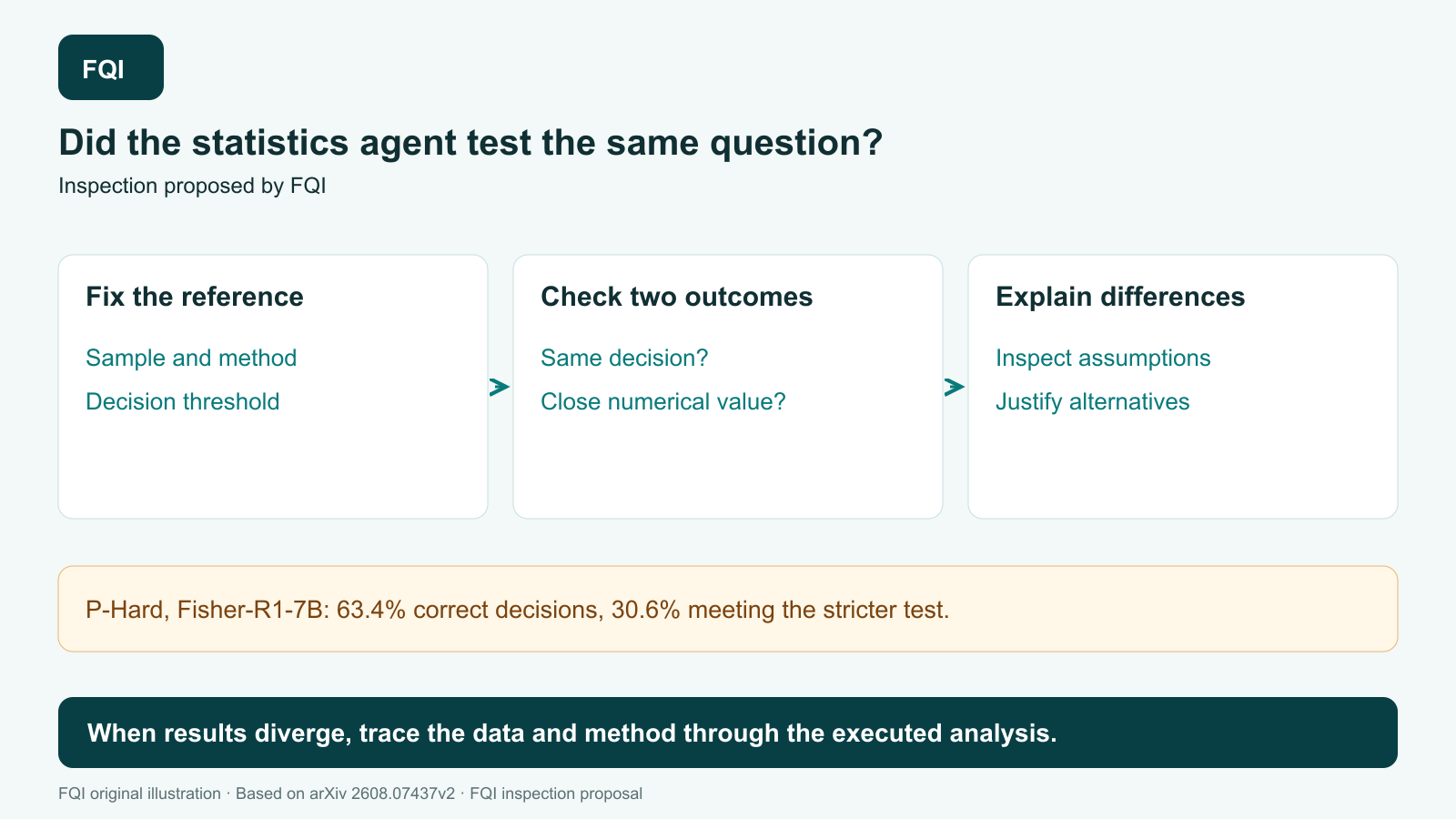
The simpler score checks whether the agent reaches the reference decision at a threshold of 0.05. The stricter score additionally requires an absolute difference of less than 0.5 between the two p-values after conversion to a two-sided z scale. This makes small values easier to compare. Decisions alone can agree even when the underlying numerical results are far apart.
Deep dive
For the seven-billion-parameter Fisher-R1 model on the difficult tasks, 63.4% of individual attempts reached the reference decision. Only 30.6% met the stricter criterion. The single-attempt measure averages over three independent runs on each task. A different measure gives credit if any of the three attempts succeeds. The latter answers a different operational question from how much confidence to place in one submitted analysis.
Version two also includes a detailed comparison using one fixed run per task for the original and trained models. On all 425 tasks, operational failures fell from 185 to 36. Of the trained agent’s remaining 213 errors, the researchers classified 78 as model or design specification problems, including 29 wrong method choices. Repeating the last arithmetic step will do little to resolve an issue introduced by the definition of the sample or by a modelling assumption.
A workplace trial could use paired measurements from two inspection methods applied to the same parts. Ignoring the pairing can answer a different question even when the code runs correctly. Conversely, more than one analysis may be defensible for a given dataset. The training reward deliberately omits a separate term for an exact method name. The numerical benchmark still refers to a canonical analysis. A qualified reviewer needs to examine a defensible alternative on its merits.
Limitations and risks
The study addresses individual frequentist tests at a preset significance level. Threshold choice, adjustments for multiple comparisons and the practical importance of an effect lie outside that evaluation. The error-type counts come from one fixed run per task. They are not averages across repeated trials. A close number alone cannot establish that a study design is appropriate for a manufacturing process.
FQI conclusion
For acceptance, FQI would ask for the executed analysis alongside the reported answer. A reviewer can then trace disagreement to the data, method, assumptions or calculation. Where a different analysis is appropriate, its justification should accompany the departure from the key. That preserves a reproducible benchmark while allowing the statistical judgment required by the actual question.
Sources & transparency
Original paper · Fisher-R1 v2 · arXiv record
Measurements are attributed to the linked original version. Application examples and acceptance criteria are FQI interpretations. This review did not independently replicate the experiment.
Codex drafted the texts and checked them against the original study. Johann Fischer authorized publication on that basis on 28 November 2026.