
Executive summary
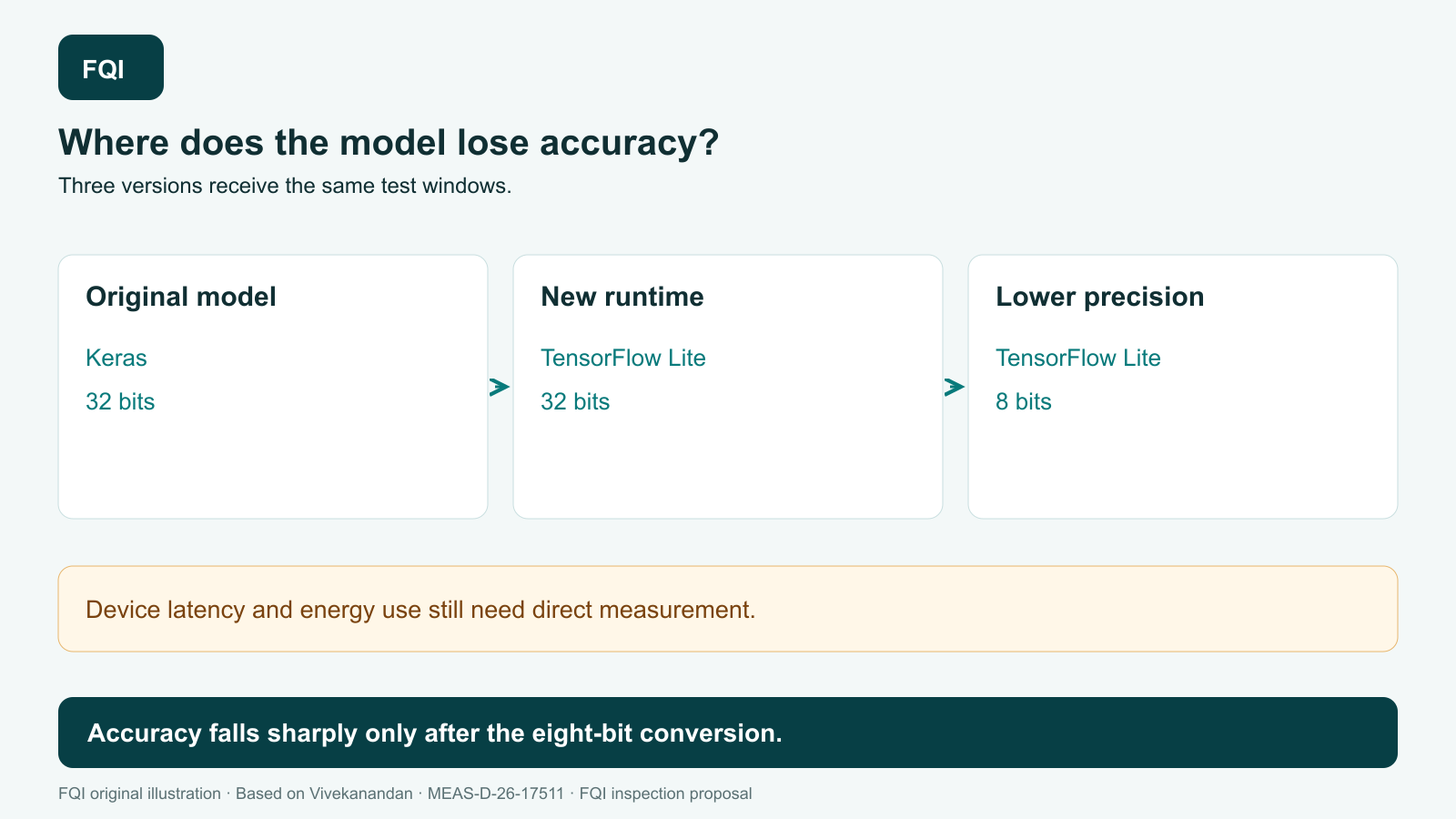
Making a model small enough for a monitoring device can involve two separate changes. The software that runs it changes, and the numbers it uses are stored with less precision. A study of simulated engine data uses three versions of the same classifier to separate those effects. The move to a new runtime preserved accuracy on the test cases. Performance dropped sharply in the subsequent eight-bit conversion. The intermediate version makes that difference visible.
FQI takeaway
- Use identical test windows in the original model and the target runtime while holding numerical precision constant.
- Compare the smaller model with both references and inspect errors by engine condition.
- Measure latency, operating memory and energy use on the intended device in a separate trial.
The principle at a glance
The researchers trained a neural network to recognise three conditions of a simulated turbofan engine. Each condition depends on how many cycles remain before the end of the simulated run. Fewer than 40 remaining cycles define the critical class. More than 120 define the healthy class. The middle range corresponds to degradation. These labels describe engine condition in the simulation. They do not identify a failed sensor.
The model receives windows of 30 successive measurements. Each new window begins just five measurements after the previous one. Assigning finished windows to training and testing at random could put nearly identical signal patterns on both sides. The authors first divided entire engine trajectories between the sets and only then created the windows. The comparison therefore evaluates engines the model has not encountered during training.
Deep dive
The published conversion comparison starts with a Keras model using 32-bit floating-point numbers. Its intermediate counterpart runs the same task in TensorFlow Lite, with the number format held constant. Both versions classify 73.19 percent of the test cases correctly. Even their individual output probabilities agree closely. This step establishes what changed in moving between the two runtimes.
The third version uses eight-bit integers. The file shrinks from about 257 to 103 kilobytes, while accuracy falls to 48.55 percent. A second measure, macro-F1, gives equal weight to each of the three classes when combining their scores. It falls from 74.06 to 41.99 percent. The two measures locate a loss along the tested conversion path. Finding the particular internal values responsible would require further investigation.
FQI proposes keeping a record of all three predictions for each window. An inspector could then retrieve cases in which only the integer version classified a critical engine as less urgent. Before adopting the smaller version, a team could decide what frequency and severity of these errors it can accept. The aggregate results in the author table do not reveal how often a critical case changed in precisely this direction.
Limitations and risks
The data describe simulated engine trajectories. Windows from one engine overlap, so their errors need not be independent. A team estimating uncertainty should retain the engine as the observational unit. The authors also document several series of trials. The relevant reference for the eight-bit result is its counterpart in the same controlled conversion series. A separate training repeat would answer a different question. Device latency, actual working memory and energy consumption still require measurements on a physical microcontroller.
FQI conclusion
A smaller file may fit a storage limit while producing substantially different condition assessments. Retaining an intermediate model in the target runtime gives an inspection team a practical way to find the stage at which accuracy changed. For this model, the evidence from the three-way comparison weighs against accepting the tested eight-bit version on the strength of the original model’s performance. A device trial would address additional questions about its operation.
Sources & transparency
All experimental figures come from the first author’s published table for the revised manuscript. The journal full text was unavailable.
Artificial intelligence assisted preparation. Johann Fischer approved this article package for publication on 2026-11-09.