
Executive summary
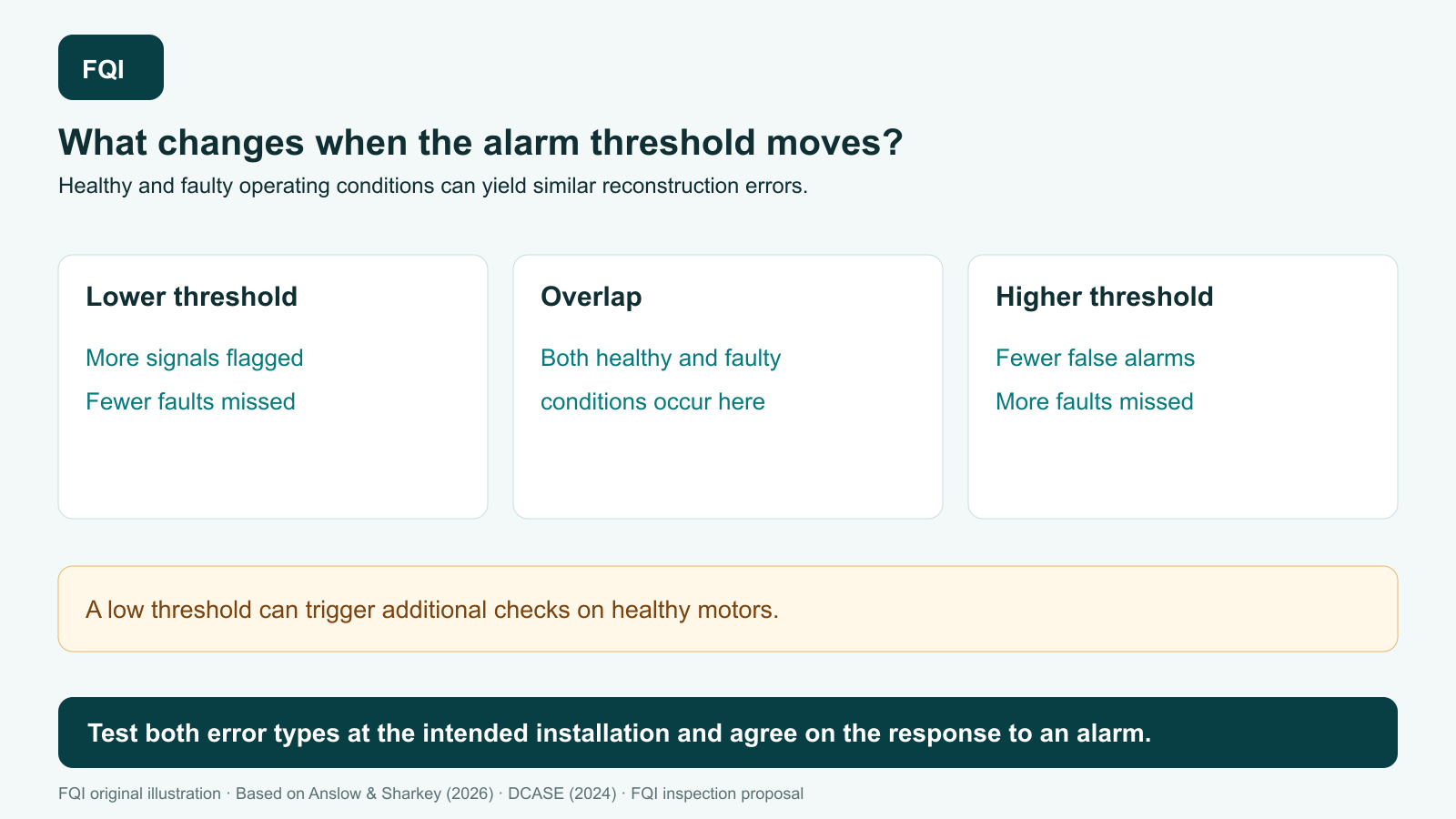
How sensitive should a motor alarm be? In an Analog Devices experiment, a neural network learned the vibration patterns of a healthy motor. During evaluation, some healthy operating conditions produced scores similar to those of actual faults. In that overlap, the choice of alarm threshold matters for maintenance. Lowering it can bring more faults to the team’s attention and create extra inspections of healthy equipment. Accepting a sensor therefore requires examples of the permitted operating conditions and an explicit decision about the consequences of a missed fault.
FQI takeaway
- List healthy operating conditions, including load and speed, separately in the test plan. A combined result can conceal which condition triggers frequent false alarms.
- For a proposed threshold, count false alarms and missed faults. Report the number of healthy and faulty cases tested alongside those counts.
- Specify the response to an alarm. A follow-up vibration measurement places different demands on a threshold from an automatic production stop.
The principle at a glance
The model in the manufacturer’s example is an autoencoder. This neural network learns to compress an input measurement and reconstruct it from that compressed representation. During training it sees only signals from healthy operation. In use, the device compares the reconstructed signal with the actual measurement. A large difference can indicate that the motor is behaving differently from the examples used for training.
The calculation produces a score. The operator decides what action that score warrants. An unfamiliar but permitted load can set off an alarm. A real defect may also produce a signal the model can still reconstruct well. Inspecting only the alarms gives the maintenance team little information about those missed defects.
Deep dive
The model receives 256 frequency values for each of three vibration axes. Its reconstruction error is the mean squared difference between the input and the output. Figure 6 in the authors’ article compares error distributions for validation and anomaly data. The authors report ten healthy operating modes and 120 fault variants. The accompanying case study describes twelve fault conditions, each tested at five speeds, with and without an additional shaft load. The resulting 120 combinations describe the scope of the test. They do not give the number of independent failures observed in service.
Cases from both groups fall within the overlap. Moving the threshold down can catch faults that previously fell below it. More healthy measurements can cross the alarm threshold as well. The decision therefore needs two inputs from operations. What would happen if a fault were missed until the next inspection? How many extra checks could the maintenance team handle?
The independent DCASE evaluation for acoustic machine monitoring provides a related testing principle. The organizers assess detection performance specifically in a low false-alarm range. They also require participants to submit a normal or anomalous decision. A recording of machine sound and a measurement of vibration acceleration are different inputs. What carries over is the need to evaluate the operating region and the decision the user actually receives.
Limitations and risks
The manufacturer’s figure illustrates the trade-off on its test setup. A new mounting position or a different motor requires evidence of its own. The name of a fault condition also says little about whether the system can detect that fault early enough to act. FQI proposes recording which motors, mounting positions, operating modes and confirmed faults were tested. That record helps the team decide which cases to repeat after a change.
FQI conclusion
A threshold is ready to support a maintenance decision when its consequences are understood under the intended operating conditions. Record the tested modes, observed false alarms, missed faults and agreed response. When a new load is introduced, those details give the maintenance team a basis for deciding whether to test again.
Sources & transparency
The model and the overlap of error scores come from the Analog Devices authors’ article, especially figure 6. The accompanying case study describes the test conditions on pages 2–5. DCASE specifies a separate evaluation for acoustic data. The proposed maintenance test plan is FQI’s application. Anslow and Sharkey · Motor experiment · DCASE 2024 · Evaluation method · Analog Devices · Test-rig case study
Codex assisted with drafting and checked the claims against the cited original sources. Johann Fischer authorized publication on 2026-11-13.