
Executive summary
Artificial intelligence (AI) can benefit from synthetic defects in one learning method and struggle with them in another. A study of industrial small load carriers compares artificial defects used as labelled examples with their use inside anomaly-detection methods. A supervised classifier benefits more from some real defects, while the tested anomaly methods already perform well with their default synthetic perturbations. FQI should therefore evaluate the role played by generated data, not only whether the images look plausible or perform well on a public benchmark.
FQI takeaway
- Separate synthetic class examples from internal training perturbations.
- Evaluate methods on the same held-out real defects.
- Test mask size and placement; greater apparent realism is not automatically better.
The principle at a glance
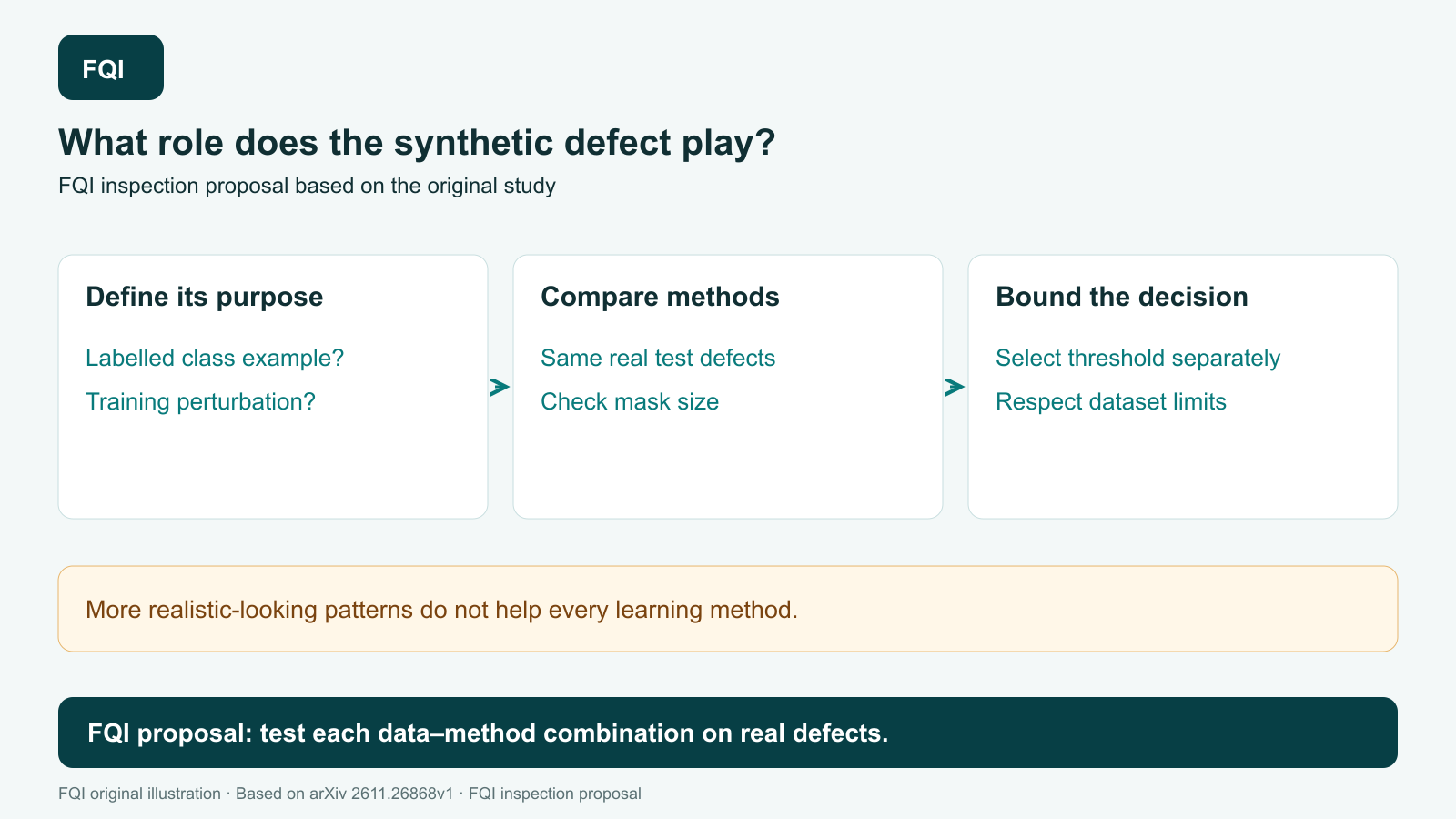
Supervised learning uses examples with known labels, such as normal and defective. A synthetic defect then stands in for the appearance of a real defect. Other anomaly methods learn mainly from normal images and use artificial perturbations within their training process.
These roles differ. A similar artificial image may therefore have different value depending on how the learner uses it. The study directly informs which data to obtain for visual AI inspection and how to use those data.
Deep dive
The authors compare ten noise patterns and several learning methods. Their own generation recipe places perturbations mostly on the carrier, matches their area to observed defect sizes and blends in textures. The intention is to bring the generated examples closer to the inspection task.
A classifier using fixed image features reaches an area under the receiver operating characteristic curve, or AUROC, of 0.70 when trained only with synthetic defects and tested on real carrier defects. Adding 5% or 10% of the real training defects raises the score to 0.81 or 0.88. AUROC measures separation across decision thresholds; it is not the detection rate at a chosen operating threshold.
On the texture categories of MVTec AD, the same comparison is almost level: 0.995 with synthetic defects alone and 0.994 with 10% real defects. The difference between that benchmark and the carrier data warns against treating one dataset’s result as general evidence of synthetic-data effectiveness.
The anomaly methods reach 0.87–0.90 on carrier data with their default perturbations. The adapted recipe provides no reliable general advantage. One method falls to 0.42, which the authors attribute to masks being too small. Smaller and more carefully located perturbations are therefore not universally better independent of the learner.
FQI would first document the purpose of each synthetic source. Is it meant to represent a real defect class, make a learning task harder or alter internal features? These uses should be compared separately. Real test defects must remain outside model selection. Acceptance should also report critical carrier classes, the chosen threshold and the resulting false alarms.
In a constructed operational example, the team must decide whether to collect additional real crack images or build a more elaborate generator. If a few real defects improve performance more than many artificial patterns, targeted data collection may be more useful. The paper supports asking that question; it does not provide an operational cost calculation answering it for every process.
Limitations and risks
The findings concern the evaluated models, four carrier classes and generation recipes. They do not establish whether much more realistic generators would help; none of the tested generators fully matches real defects. Relationships observed in feature space suggest an explanation but do not isolate a causal mechanism. Operating conditions, defect costs and long-term changes in the carriers need separate assessment. AUROC alone cannot determine an acceptable production threshold.
FQI conclusion
Synthetic defects should not be approved as a single undifferentiated data category. Their learning function and performance on real defects determine their usefulness. The study motivates a clear distinction between replacing class examples and creating internal training perturbations. It also shows that apparently more realistic design can worsen a method. A defensible test plan compares concrete data–method combinations and protects the real evaluation set from later tuning.
Sources & transparency
- Effectiveness of Synthetic Defects for Anomaly Detection in Industrial Small Load Carriers
- Effectiveness of Synthetic Defects for Anomaly Detection in Industrial Small Load Carriers
Codex assisted with drafting and checked the claims against the cited original study. Results were not independently reproduced. Operational recommendations and simplified examples are FQI interpretations.
Codex assisted with drafting and checked the claims against the cited original sources. Johann Fischer authorized publication on 2026-11-23 following review by Codex. Individual human reading is not claimed.