
Executive summary
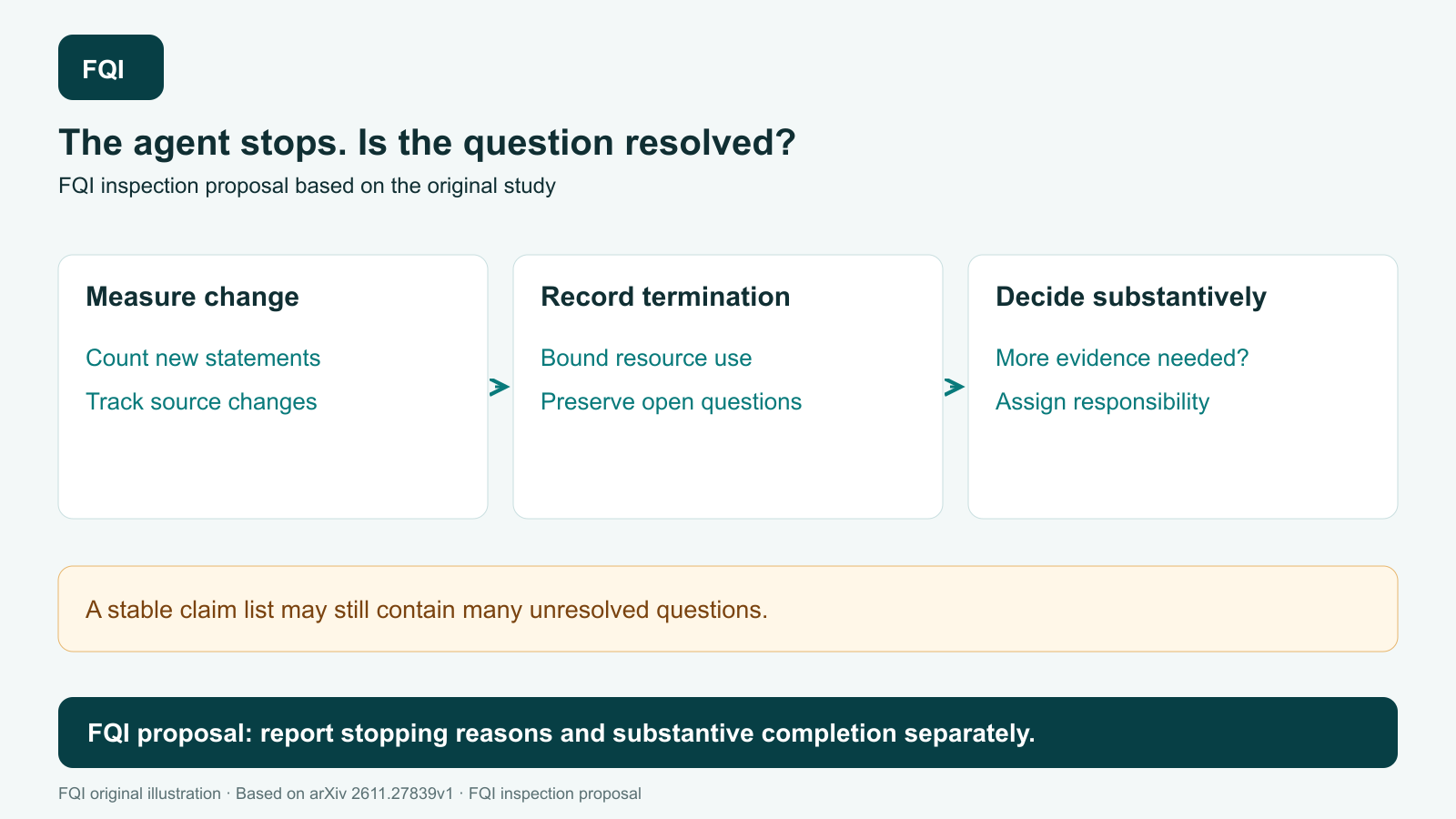
An artificial intelligence (AI) agent can stop because its statements no longer change. That does not establish that those statements are adequately supported. VerifyAgent studies this stopping rule for scientific hypothesis checking. It reduces model calls compared with three fixed rounds, while often leaving many claims unresolved. Quality teams should separate resource control from evidential completion: preserve open questions and require additional evidence before technical acceptance. Stagnation describes the process, not the truth of its answer.
FQI takeaway
- Record the stopping reason separately from substantive completion.
- Count new, removed and reworded claims explicitly when measuring change.
- Escalate stable but incomplete findings instead of automatically approving them.
The principle at a glance
VerifyAgent assigns three roles to a language model. One seeks support for a hypothesis, another challenges it and a third judges the exchange. Claims receive states such as supported, contested, refuted or unknown. Source excerpts are intended to make support traceable.
After each round, a change measure compares the claim list with its previous state. Small changes end the run. This can prevent endless discussion, but its meaning depends on what the measure counts and how many unresolved claims remain at termination.
Deep dive
The study evaluates 40 research hypotheses from two domains under five configurations, producing 200 executions. Every agent role uses the same local DeepSeek-R1-32B model. Different instructions do not make these independently trained experts. Lower textual similarity likewise does not demonstrate independent substantive judgement.
The stopping rule matches only claims with exactly identical wording. A changed status or a sufficiently changed confidence score counts as a change. New and removed claims do not increase the change numerator, and paraphrases are not matched as the same claim. The value can therefore stay small while the content changes. The paper explicitly acknowledges this limitation.
Clarification requests received a neutral synthetic response supplying no further information. Under this protocol, 36 of 40 runs stopped after their first round with zero measured change. Average model calls fell to 8.28, compared with 19.52 for three fixed rounds. This demonstrates savings under that protocol, not that informative clarification would be unnecessary.
The authors define premature stopping as finishing with more than 30 percent of claims unresolved. By this definition, 77.5 percent of complete-system runs stopped prematurely. At the same time, the study records no over-iteration under its stability metric. Both findings can hold: a process avoids repetition while leaving its substantive task incomplete.
The evidence audit uses short excerpts from scientific abstracts and a separate model that judges whether an excerpt supports a statement. The reported hallucination measure is 21.7 percent versus 25.9 percent for the comparison system; the difference is not statistically established. Empty excerpts can also survive when attempts to enforce mandatory evidence fail.
A simplified FQI transfer concerns a complaint investigation. An assistant may stop searching after exhausting available evidence while recording that two possible causes remain unresolved. Accepting one cause requires further measurements or a responsible technical decision. This application was not tested in the paper.
For implementation, FQI proposes stable claim identifiers and separate counts for additions, removals, new sources, status changes and wording changes. Teams can then examine whether a small change value actually represents stable evidence. This is a proposed inspection of the stopping mechanism, not a demonstrated improvement to VerifyAgent.
Limitations and risks
Evidence comes from one model, 40 selected hypotheses and automatically assessed support relationships. Abstract excerpts do not replace a full methods review. Comprehensive human judgements of final correctness and heterogeneous model-team comparisons are missing. The paper supports a bounded process finding, not a general reliability guarantee.
FQI conclusion
Controlled termination can be sensible even when a task remains unresolved. The result status and stopping reason must remain distinct. Quality teams should ask which changes the metric detects, which it misses and who receives the open questions. These records turn an automatic ending into an accountable handover. Fewer model calls and fewer unresolved claims are different outcomes; the study illustrates why neither should stand in for the other.
Sources & transparency
- Beyond Self-Critique: Epistemic Convergence Control for Multi-Agent Research Verification
- Beyond Self-Critique: Epistemic Convergence Control for Multi-Agent Research Verification
Codex assisted with drafting and checked the claims against the cited original study. Results were not independently reproduced. Operational recommendations and simplified examples are FQI interpretations.
Codex assisted with drafting and checked the claims against the cited original sources. Johann Fischer authorized publication on 2026-11-25 following review by Codex. Individual human reading is not claimed.