
Executive summary
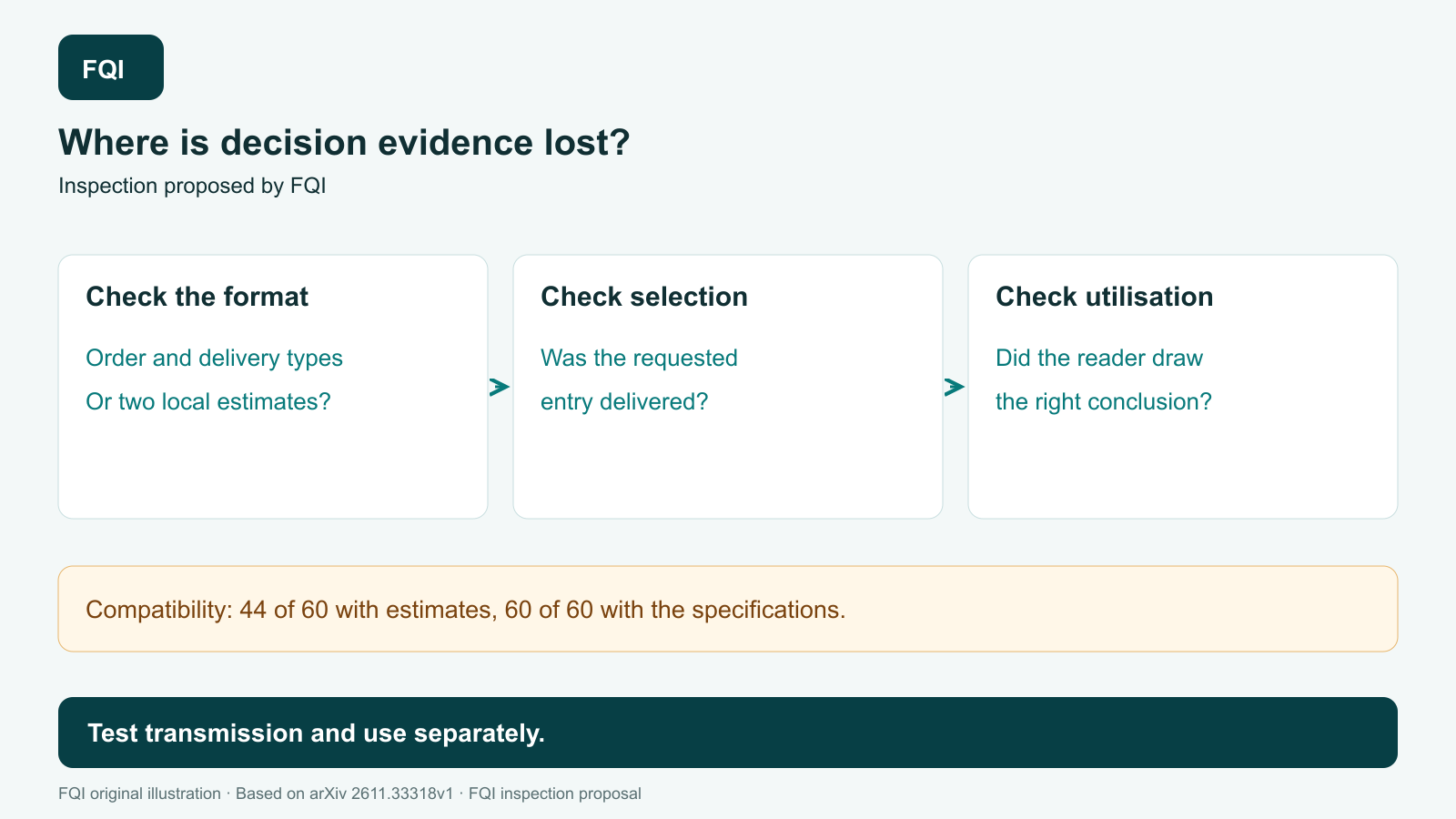
A team of language-model agents can possess all the evidence required for a decision yet lose it during communication. Researchers distinguish three problems. A message format can discard information, a sender can omit the relevant fact, and the receiver can draw an incorrect conclusion from a complete message. Controlled tasks with known answers allow the researchers to examine these failures separately. The distinction matters when deciding which part of an automated handover to revise.
FQI takeaway
- Check whether the message format can represent every fact needed for the decision.
- Compare a targeted question with a compact, complete one-way message.
- Give the receiver complete evidence to test its ability to use what arrived.
The principle at a glance
Suppose one agent knows which connector was ordered and the other knows which connector arrived. Each might correctly estimate the same probability of a match from its own observation. Those two probabilities can be identical whether the connector types match or differ. Transmitting the types themselves makes the answer recoverable. The problem can therefore occur even if each local estimate is accurate.
Deep dive
The authors used synthetic monitoring, compatibility and table-lookup tasks. In the monitoring task the sensor readings obeyed specified independence conditions. Corrected combination of local probabilities could recover the reference prediction. In the compatibility task the details of the order and product mattered jointly. Combining local probabilities gave 44 correct answers in 60 held-out cases. Sending the specifications under a fixed collection rule gave 60 correct answers. The two Qwen models produced correct local probabilities in this comparison.
In a lookup task, one participant held the error code and another held the manual. When the query was initially private and delivery was limited to 64 tokens (units of text), asking for the code first gave the Qwen models 100 correct answers in 100 cases. Fixed one-way collection yielded 74. When the query was public, both protocols scored 100. A sufficiently compact representation of a complete short table could also remove the advantage of asking first.
A longer table revealed a different failure. The complete representation fitted the transfer budget, yet the reader initially answered only 22 of 25 questions correctly. With more computation for reading the same messages it reached 25 of 25 in the follow-up. Another model family sometimes omitted the query itself. The examples illustrate different places where an automated handover can fail.
FQI would use a fixed set of cases to record what each agent knew and which evidence actually reached the decision maker. A second run can supply all required facts directly to the same reader. Missing information points towards a format or selection problem. Continued errors with the full evidence point towards interpretation. The comparison should also report communication costs and the computation used to read the messages.
Limitations and risks
The tasks used structured facts, few model families and mostly one deterministic generation per call. A precise reference is available because the tasks are synthetic. The same diagnosis will be harder when records are incomplete or ambiguous. Shorter messages can also take more effort to decode. High scores in short-table experiments do not establish general reliability in operational conversations.
FQI conclusion
The practical design question is which decision must be possible after each handover. Once that is written down, a team can check whether the format preserves the necessary details, whether the sender transmits them and whether the reader uses them. Those observations support different changes. Adding another conversation turn helps only if it addresses the specific missing evidence or processing error.
Sources & transparency
What Must LLM Agents Communicate? From Information Loss to Communication Failures · arXiv v1
Author preprint v1. FQI checked the cited sections of the original study. Workplace examples and inspection proposals are FQI interpretations. The experiments were not independently replicated.
Codex drafted the texts and checked them against the original study. Johann Fischer authorized publication on that basis on 26 November 2026.