
Executive summary
When an image-based artificial intelligence (AI) model answers correctly after zooming, missing image information need not explain its initial error. A crop can rearrange existing pixels, remove distracting context or introduce higher-resolution details from the original image. A controlled study separates these effects in three vision-language models. FQI proposes checking whether existing information is sufficient before acquiring another image. The results, however, concern known target regions and selected errors that an ideal targeted zoom could already correct.
FQI takeaway
- Preserve the image actually processed by the model, not just the original file.
- Test enlarged existing pixels separately from added original-image detail.
- Evaluate target localisation separately; knowing the correct crop is not an operational given.
The principle at a glance
Vision-language models combine images with language questions. They preprocess images into internal visual units representing image regions. With limited computing budgets, an image is often reduced before this step. The original file, processed pixel grid and internal representation are therefore different objects.
A zoom may simultaneously remove background, assign more internal units to already seen pixels and reveal higher-resolution original pixels. A better answer after zooming does not identify which factor mattered.
Terms explained
- Vision-language model: an AI model processing visual information together with language.
- Visual units: internal units representing regions of an image.
- Sham intervention: the same operation applied to a random comparison region to measure nonspecific effects.
Deep dive
The authors first reconstruct the exact pixel grid used in the initial model call. They then compare second looks that reuse internal representations, isolate a target, enlarge already seen target pixels or add higher-resolution original pixels. Random crops of matching size provide controls.
The study examines Qwen2.5-VL, Qwen3-VL and InternVL3 models with seven to eight billion parameters across three visual-question datasets. It considers 2,753 errors corrected by a targeted zoom. Its regime partition uses 2,202 cases from configurations where the initial image had at least a twofold reduction in pixel count. These denominators matter: reported percentages are not overall accuracy or proportions of every model error.
Even at roughly 17-fold pixel-count reduction, enlarging already seen pixels corrects 47–73 percent of zoom-correctable errors, depending on the tested combination. Random comparison crops correct only 1–3 percent. Much of the benefit under these conditions therefore comes from processing existing information. The factor of 17 describes pixel count, not image side length.
Useful magnification depends on content. Object questions improve up to roughly six- to twelvefold side-length enlargement of the target relative to the initial processed image. Text benefits plateau around fourfold enlargement; stronger enlargement may hurt. These are experimental results, not universal settings for an industrial camera.
The authors also test a sequence that reprocesses existing pixels first and adds original detail only if answer confidence remains inadequate. Within the selected error group, this sometimes avoids extra information acquisition. Cases that still need original detail incur another processing step. Cost assessment must therefore consider computation, extra calls and lost corrections together.
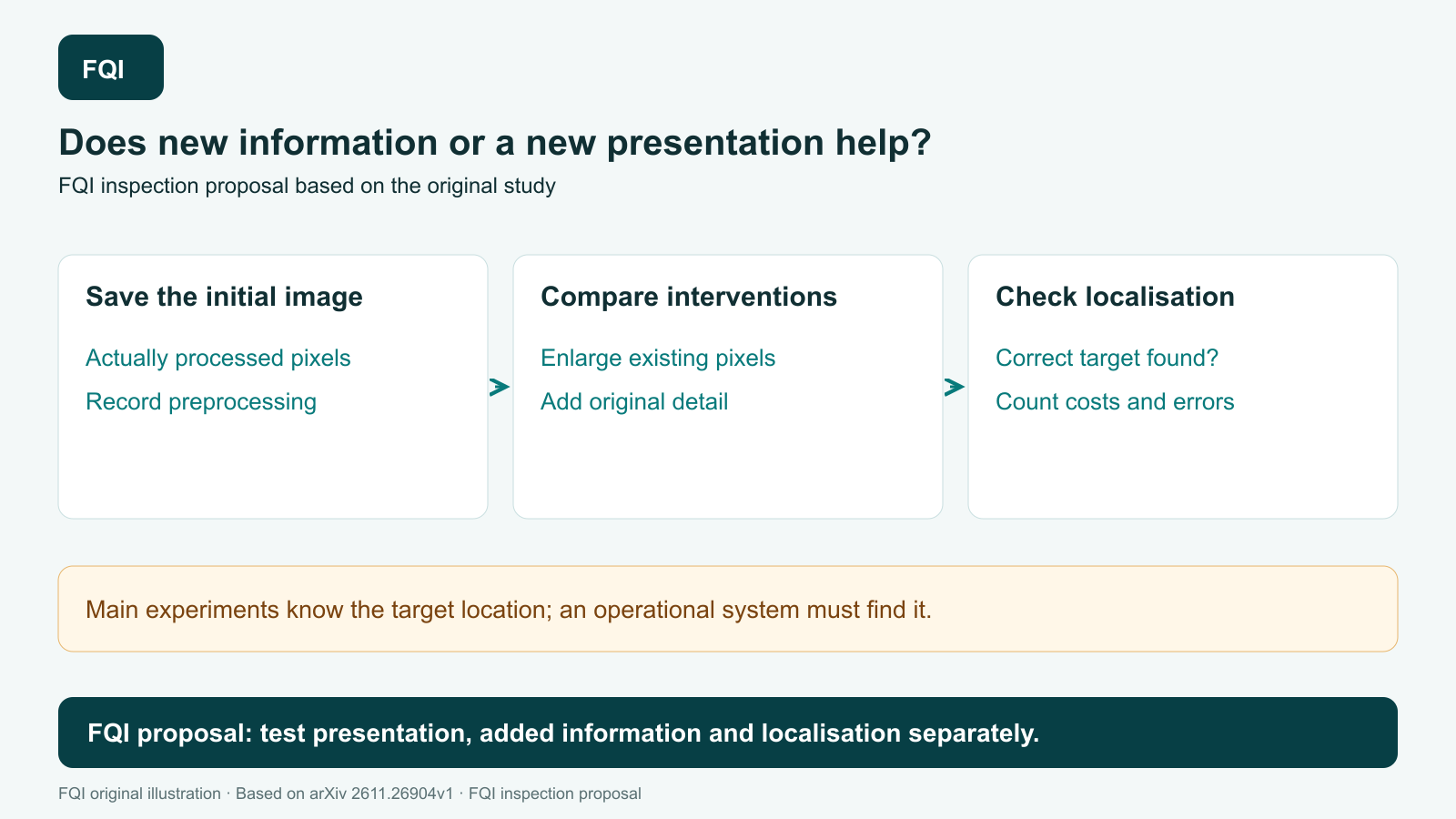
FQI proposes fixing the model, question and initial image, then constructing the same relevant crop from the processed grid and from the higher-resolution original. Include suitable comparison crops. Only then decide whether a different representation, more original detail or a new physical capture is necessary. A new capture is a separate measurement action not generally evaluated by this paper.
Limitations and risks
The main experiments already know the correct target location. When models predict it themselves from strongly reduced images, their boxes cover the target for only 19–62 percent of questions. With these predicted boxes, no tested intervention helps 33–78 percent of previously correctable errors. Localisation remains a separate weakness.
The datasets favour small, identifiable targets and cover few model sizes. They cannot justify general industrial inspection performance or camera procurement. Assigning the least expensive successful intervention also does not uniquely explain every internal mechanism.
FQI conclusion
A second look should address the cause of an error. The study supports separating new presentation from new image information. Operational testing starts by preserving preprocessing: which pixels did the model actually receive? Controlled comparisons can then reveal what helps. A usable workflow additionally requires validated target selection. Results obtained with known crops offer research evidence for that design, not a finished acceptance decision or a general promise that further image acquisition is unnecessary.
Sources & transparency
- What Does a Zoom Actually Add? Decomposing Fine-Grained Perception Failures in Vision-Language Models
- What Does a Zoom Actually Add? Decomposing Fine-Grained Perception Failures in Vision-Language Models
Codex assisted with drafting and checked the claims against the cited original study. Results were not independently reproduced. Operational recommendations and simplified examples are FQI interpretations.
Codex assisted with drafting and checked the claims against the cited original sources. Johann Fischer authorized publication on 2026-11-25 following review by Codex. Individual human reading is not claimed.