
Executive summary
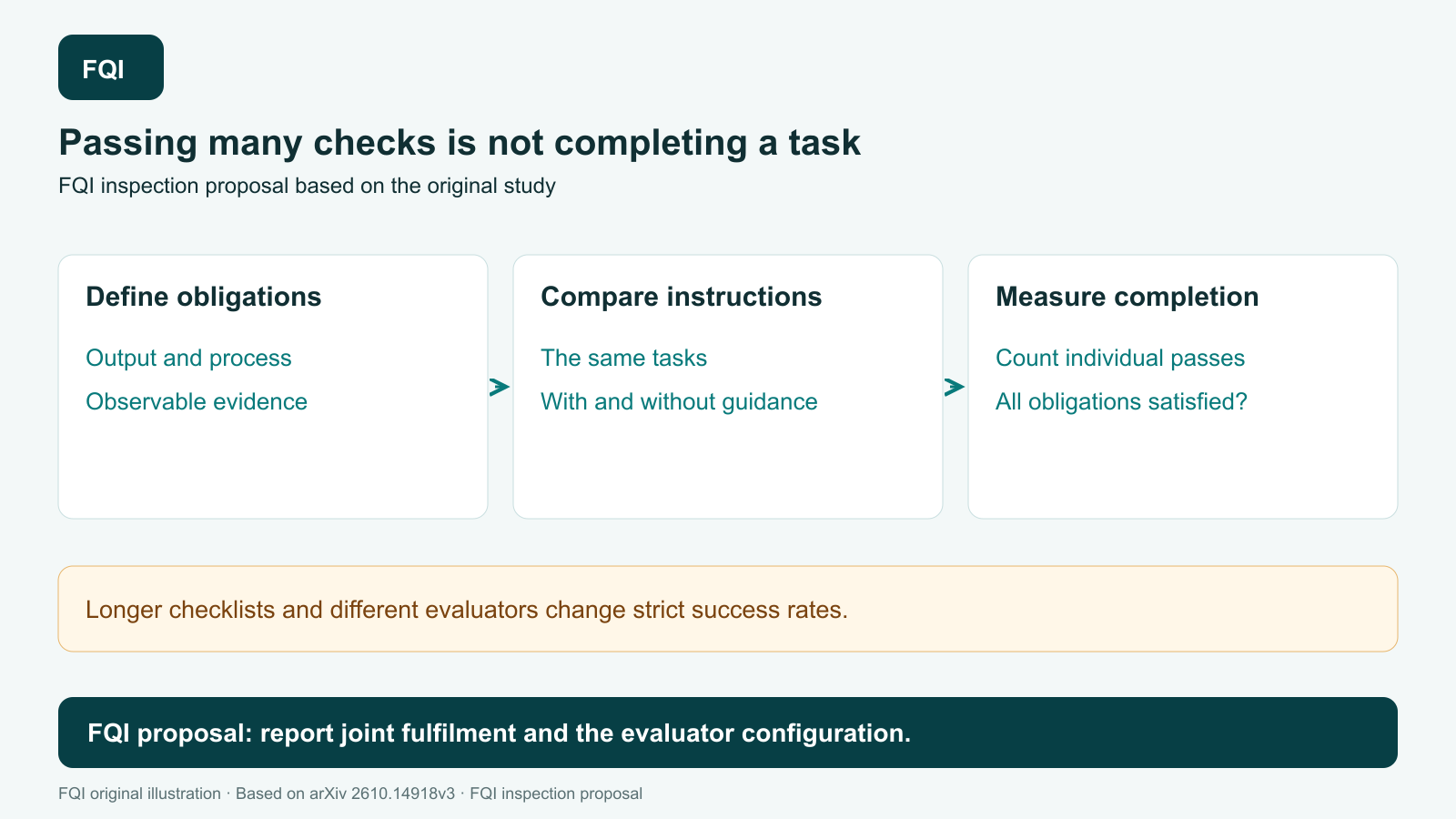
An artificial intelligence (AI) agent may satisfy many individual requirements without completing a task that meets every acceptance condition. SkillForgeBench exposes this distinction by measuring individual criteria and their joint fulfilment. It also compares workflows with and without procedural instructions. FQI draws a practical decision rule: assess an instruction by whether more complete tasks succeed, while separating output requirements from process obligations. A high average across individual checks cannot answer either question on its own.
FQI takeaway
- Report individual criterion scores separately from fully completed tasks.
- Test the added value of instructions on the same tasks with and without them.
- Justify mandatory criteria and assess the reliability of the automated evaluator.
The principle at a glance
The paper uses skills: written instructions describing professional procedures and working rules for an agent. These support executable tasks with input files, references and evaluation criteria. Agents work in a bounded environment; output files and execution records are assessed afterwards.
Evaluation has two axes. Completion criteria concern the requested artefact’s content and structure. Process criteria concern required steps and checks. Each axis has an average over individual criteria and a strict task-level score, which requires every criterion on that axis to pass.
Terms explained
- Skill: a reusable professional instruction for an AI agent.
- Rubric: an evaluation criterion with an observable passing condition.
- Execution trace: a record of actions actually performed and their results.
Deep dive
The reviewed third version contains 842 tasks across five professional domains and compares eight model configurations. Tasks are partly generated from existing materials, with human checking and calibration. They constitute a research collection using realistic resources, not a random sample of all workplace activities.
With skills provided, average satisfaction of individual completion criteria ranges from 70.0 to 85.7 percent. Strict fulfilment of every completion criterion ranges from 12.6 to 40.9 percent. These ranges describe the tested systems and tasks; they are neither general success probabilities nor a permanent product ranking.
Instruction benefits also depend on the metric. Strict completion increases by 19.2 percentage points for the strongest system discussed, compared with 5.8 points for a weaker one. Instructions therefore do not automatically help initially weaker systems most. Local procurement should test this effect on the organisation’s own task collection.
A simplified FQI example concerns revision of an inspection report. An agent might produce a correct table, reference its sources and follow the requested format, yet omit a mandatory cross-check. Output and process scores would tell different stories. Acceptance depends on which criteria are genuinely obligatory. This is an illustrative transfer, not a study task.
FQI proposes separating output and process obligations, defining observable evidence for each and running matched tasks with and without instructions. Reports should display individual checks, fully passed tasks, effort and missing evidence together. Criterion count and difficulty must remain comparable: extending a checklist can lower the strict score without any deterioration in the model.
The authors examine checklist length and test the evaluator on a subset. They compare model judgements with human judgements on 50 tasks. A second evaluator from another model family preserves the ordering of three tested systems but gives systematically lower absolute scores. Evaluator configuration therefore belongs in the report. A stable ranking does not automatically validate an absolute acceptance threshold.
The voluntary AI risk framework from the US National Institute of Standards and Technology (NIST) supports documented, context-appropriate evaluation. It does not confirm SkillForgeBench’s results. The paper includes university and Tencent contributors; its findings remain author-reported research, while the proposed operational acceptance design is FQI’s interpretation.
Limitations and risks
Partly synthetic task creation, local execution and the chosen skills limit transfer. Human cross-checking covers only a subset. Requiring all criteria simultaneously makes sense only when each is a necessary obligation. Minor preferences should not become release barriers after the fact.
FQI conclusion
A good average can conceal many almost-finished tasks. Quality teams need to identify which obligations must hold together and how their fulfilment is observed. Instruction value should be checked at task level. Separate completion and process scores, paired comparisons and a documented evaluator create more informative evidence. They do not establish a universal ranking or justify unrestricted autonomy. The acceptance decision still belongs to a defined operational context.
Sources & transparency
- SkillForgeBench : Evaluating Agent Reliability Grounded in Agent Skill Specifications
- NIST AI RMF Core
- SkillForgeBench : Evaluating Agent Reliability Grounded in Agent Skill Specifications
Codex assisted with drafting and checked the claims against the cited original study. Results were not independently reproduced. Operational recommendations and simplified examples are FQI interpretations.
Codex assisted with drafting and checked the claims against the cited original sources. Johann Fischer authorized publication on 2026-11-25 following review by Codex. Individual human reading is not claimed.