
Executive summary
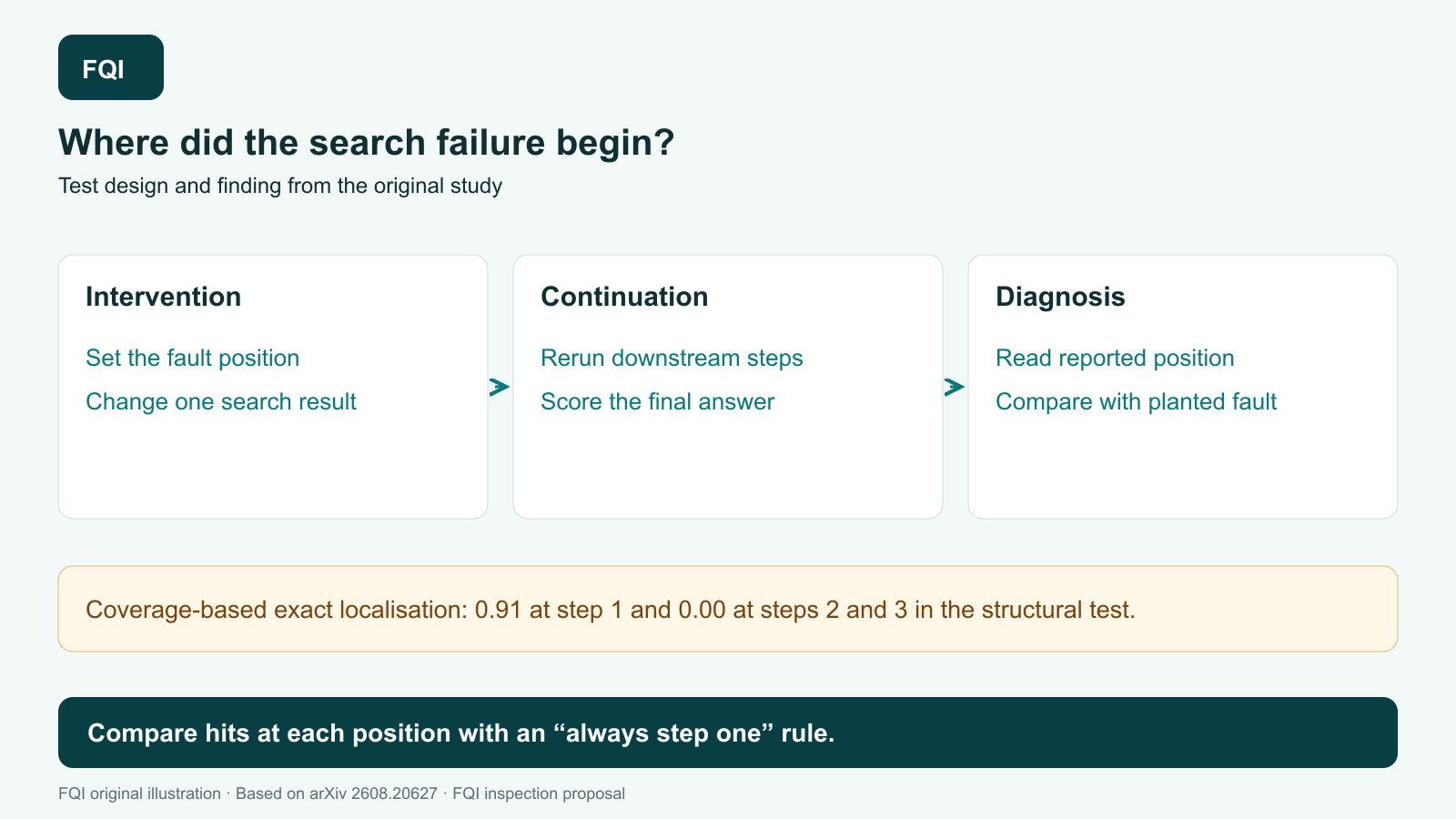
A research assistant reads an outdated document in step two and gives the wrong answer after step three. A diagnostic tool might blame the last answer or routinely suspect the first search. AgenticRAG-FP tests localisation by planting faults at known steps and letting subsequent steps run again. Investigators can then compare the reported position with the position they actually changed.
FQI takeaway
- Record planted and reported positions for each failed run.
- Break down exact matches by the depth of the intervention.
- Compare the diagnostic tool with a rule that always picks the first search.
The principle at a glance
In multi-step retrieval, earlier evidence influences later queries. A bad result can misdirect the next search, be corrected downstream or have no effect. The researchers change a specified step and regenerate the remaining trajectory. Interventions include missing evidence, unrelated hits and topically plausible but misleading material. They then inspect failed trajectories to see whether a diagnostic method can identify the step where the intervention occurred.
Deep dive
In a comparison on three-step MuSiQue questions, a coverage-based diagnostic achieves exact localisation of 0.91 for an intervention in the first step. Its score is zero for interventions at steps two and three. The three groups contain 43, 36 and 21 failed trajectories respectively. The method selects the first step in almost every case. Its high early score offers little evidence that it can discriminate among positions. Another experiment considers corruption of content that still looks relevant. Among 51 failed second-step cases, a language model judging the trace located about 49 percent of interventions and a method testing a repair to a frozen step located about 59 percent. The paired comparison did not establish a statistically significant difference.
Limitations and risks
A quality team could use a redacted search for a work instruction. It could substitute an older revision in one known step and record the substitution before running the test. The diagnostic tool sees only the intended trace information. Record whether the assistant answered incorrectly, whether it later corrected the error and which step the tool flagged. Successful recovery belongs in an analysis of propagation even when failed answers form a separate group for localisation. Real incidents may have several causes. The number of diagnostic probes allowed also matters. Positions that the method never had budget to test must be marked untested.
FQI conclusion
A useful position estimate should narrow the specialist’s next inspection. Begin with documented early and late interventions. Report how often each produces a wrong answer and, among those failures, how often the diagnostic identifies the known origin. This keeps robustness of the research assistant distinct from accuracy of the tool investigating it.
Sources & transparency
The figures and comparisons come from the authors’ arXiv preprint. The workplace example and proposed acceptance decisions are FQI interpretations. When Failures Propagate: Causal Failure Attribution in Agentic Retrieval-Augmented Generation · Version history
Codex assisted with drafting and checked the claims against the cited original sources. Johann Fischer authorized publication on 2026-11-14.