
Executive summary
A judge can order two answers by risk correctly while systematically overstating how often a problem occurs. A study of an image-and-text model examines what that difference means during training. A calibrated measurement channel and a change to how the control signal reaches training helped reduce harmful responses while keeping refusals of legitimate requests low in the reported tests.
FQI takeaway
- Evaluate the ordering of answers separately from estimates of failure frequency.
- Use separate denominators for harmful assistance and refusals of legitimate requests.
- On held-out cases check whether tighter budgets move the observed rate in the intended direction.
The principle at a glance
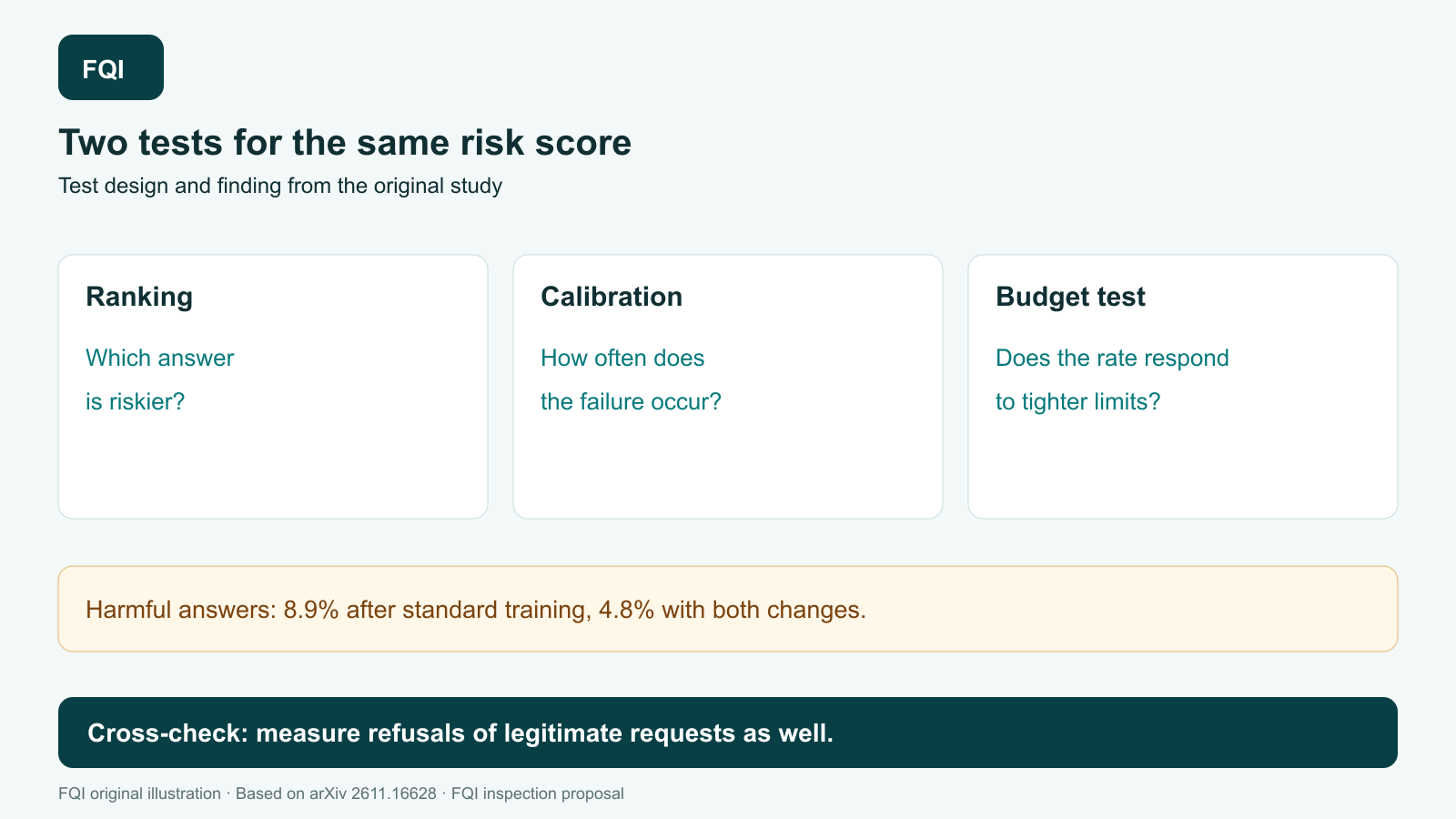
The same automatic assessment serves two purposes. During learning, the system compares several responses to the same request. An accurate ordering helps it favour a better response. A controller also compares the average score with a specified safety budget. For that second use, the average must represent the observed frequency of the behaviour closely enough to support the decision.
For a simplified illustration, add five percentage points to every estimated risk in a set of responses. All the cases retain their positions in the ranking. A controller comparing their average with a fixed limit now receives a different signal. It can react more strongly even though the responses and the independent judgments about them have stayed the same.
Deep dive
The study also asks whether the correction actually reaches learning. The baseline procedure standardises rewards within groups of answers. That operation can cancel the influence of the multiplier the controller uses to penalise a violation. In the revised method, raw scores remain available for comparing answers. The budget calculation uses a scale fitted to judged training responses, and the learning signal preserves the multiplier.
The researchers tested a vision-language model with two billion parameters. Across 1,037 held-out challenging requests, harmful assistance occurred in 8.9% of responses after standard training. An uncalibrated budget produced 7.6%, and the revised procedure produced 4.8%. On a separate set of 400 legitimate requests, excessive refusal remained at most 2% with the revised method. This second set matters because refusing a great many requests can improve the first figure while making the model less useful.
An operational test can deliberately shift the level of the judge’s scores while preserving their order. The team can then observe the controller and independently judge the resulting answers. Recording which examples establish the reference rates makes it possible to investigate a discrepancy later. A rank comparison on pairs alone cannot establish that the average is a valid estimate of frequency.
Limitations and risks
The test cases, model and judges limit generalisation. A training target does not guarantee the same rate on the requests a service will receive. Another population may change both the mix of requests and the errors its judge makes. The revised procedure includes two repairs, so the full observed difference cannot be attributed to calibration alone.
FQI conclusion
Report how well the judge orders pairs, how closely its average tracks a reference rate and how the trained system responds to a tighter budget. Read these findings alongside the rate of unwarranted refusals. Together they connect a technical training setting to the quality objective an operator can actually check.
Sources & transparency
The study is an author preprint. The proposed operational checks are FQI interpretations. Safety as a Budget: Calibrating the Control Channel of Constrained GRPO for Vision-Language Models · Version record
Codex assisted with drafting and checked the claims against the cited original sources. Johann Fischer authorized publication on 2026-11-15.