
Executive summary
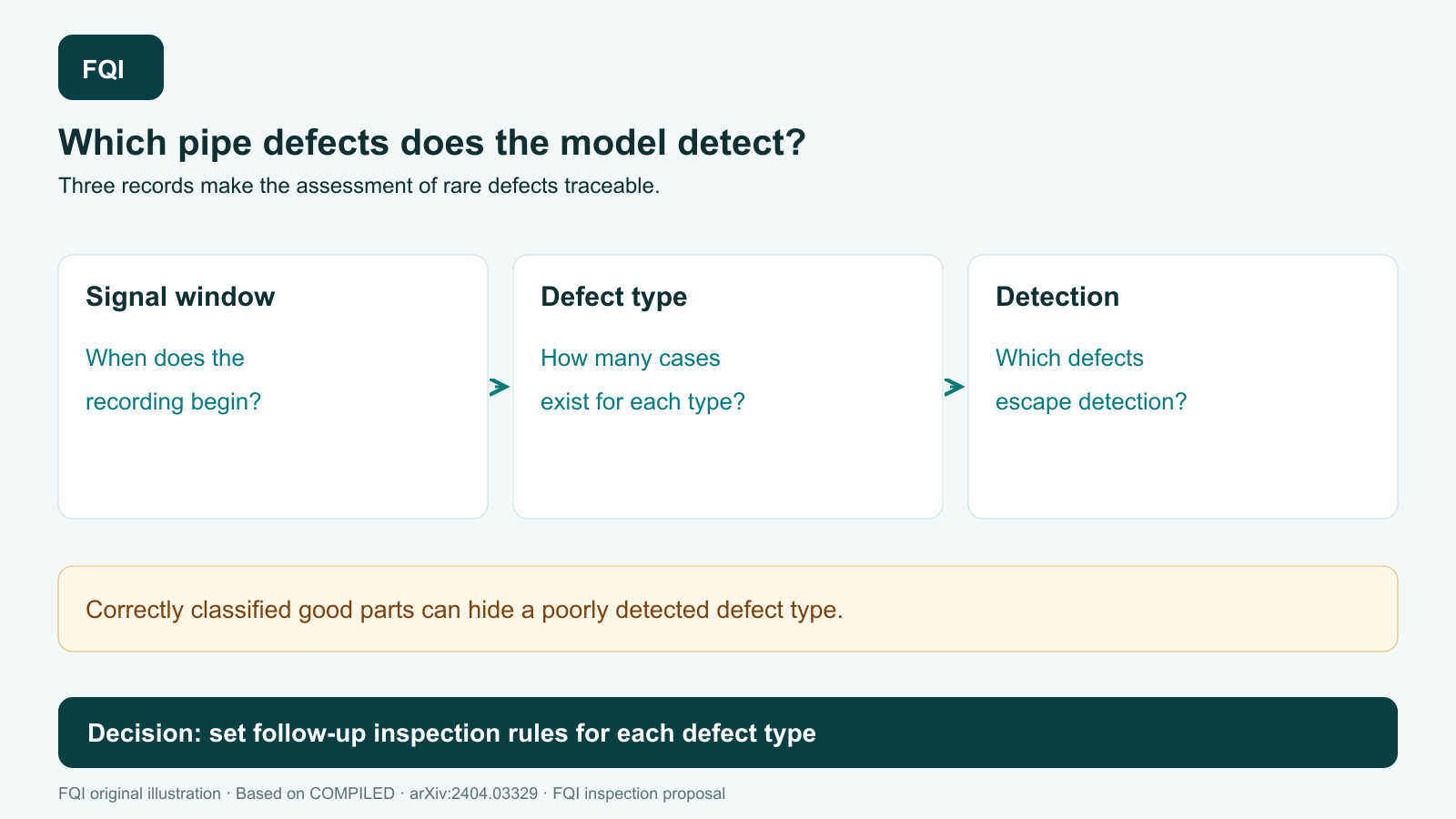
A high overall pass rate for inspecting threaded pipe connections can hide a model’s difficulty detecting a rare defect. The authors of COMPILED study a second problem as well. Sensors capture only part of the joining process. A neural network learns from several time-dependent signals which connections resemble others in the same defect class. Two questions follow for acceptance testing. Which phases can the system actually observe? How many known cases of each defect can it identify under those conditions?
FQI takeaway
- Report how many connections of each defect class were tested and how many were identified correctly.
- Record when measurement starts alongside the signal trace.
- Compare the model with a simpler method on the same rare defects.
The principle at a glance
Torque and speed change as a pipe connection is made. Part of the operation takes place before the measurement window opens. An unobserved value means something different from a measured zero. A team that brings traces to a common length must preserve that distinction. Otherwise, the classifier might mainly learn how long a recording lasts.
COMPILED processes multiple measurement channels and learns a measure of similarity. In its internal representation, examples from the same class should be closer together than examples from different classes. The method includes a way of padding traces designed for partially observed curves. The paper evaluates the combination of these choices using production data.
Deep dive
In five-fold cross-validation, each subset takes a turn as the test set. Table 1 in the authors’ version reports a class-averaged detection rate of 0.897 for COMPILED. The overall figure conceals differences. For the first defect type, detection ranges from 0.50 to 1.00 across the five test groups. For the second, it ranges from 0.83 to 1.00. The method correctly identifies all normal connections in all five groups. For inspection planning, the spread for the first defect type deserves particular attention.
A plant trial could start by recording which signals are actually available. For each connection, the team records the start of acquisition, the channels present and the basis for the independent defect assessment. It then partitions connections by production lot or period for development and testing. Several excerpts from the same connection belong on the same side of that split.
Give each rare defect its own row in the acceptance report. Record the case count, missed defects and the action taken when the signal is incomplete. Run the comparison method on the same measurement windows. This shows where the learned similarity measure could spare a manual check and where an additional inspection remains necessary.
Limitations and risks
The tables come from the publicly accessible 2024 authors’ version. The subject and authorship link it to the later journal article. Whether the final publication reports identical figures remains open. The study covers a specific joining process. Different threads, acquisition start times or defect frequencies could change the decision. Even a correctly identified defect type does not by itself establish its cause.
FQI conclusion
For the production line, the relevant result is the number of missed defects of each type within its own acquisition window. Start a pilot with cases for which the recorded trace and independent judgment can both be traced to an individual connection. Where too few examples of a rare defect are available, keep a manual follow-up in the inspection plan. More good parts increase the data volume but do little to resolve that particular acceptance question.
Sources & transparency
COMPILED authors’ version, sections 4–6 and Tables 1–2; values have not been checked against the later journal version.
Operational examples and inspection proposals are FQI interpretations. The source study has not been independently replicated by FQI.
Artificial intelligence assisted preparation. Johann Fischer approved this article package for publication on 2026-11-06.