
Executive summary
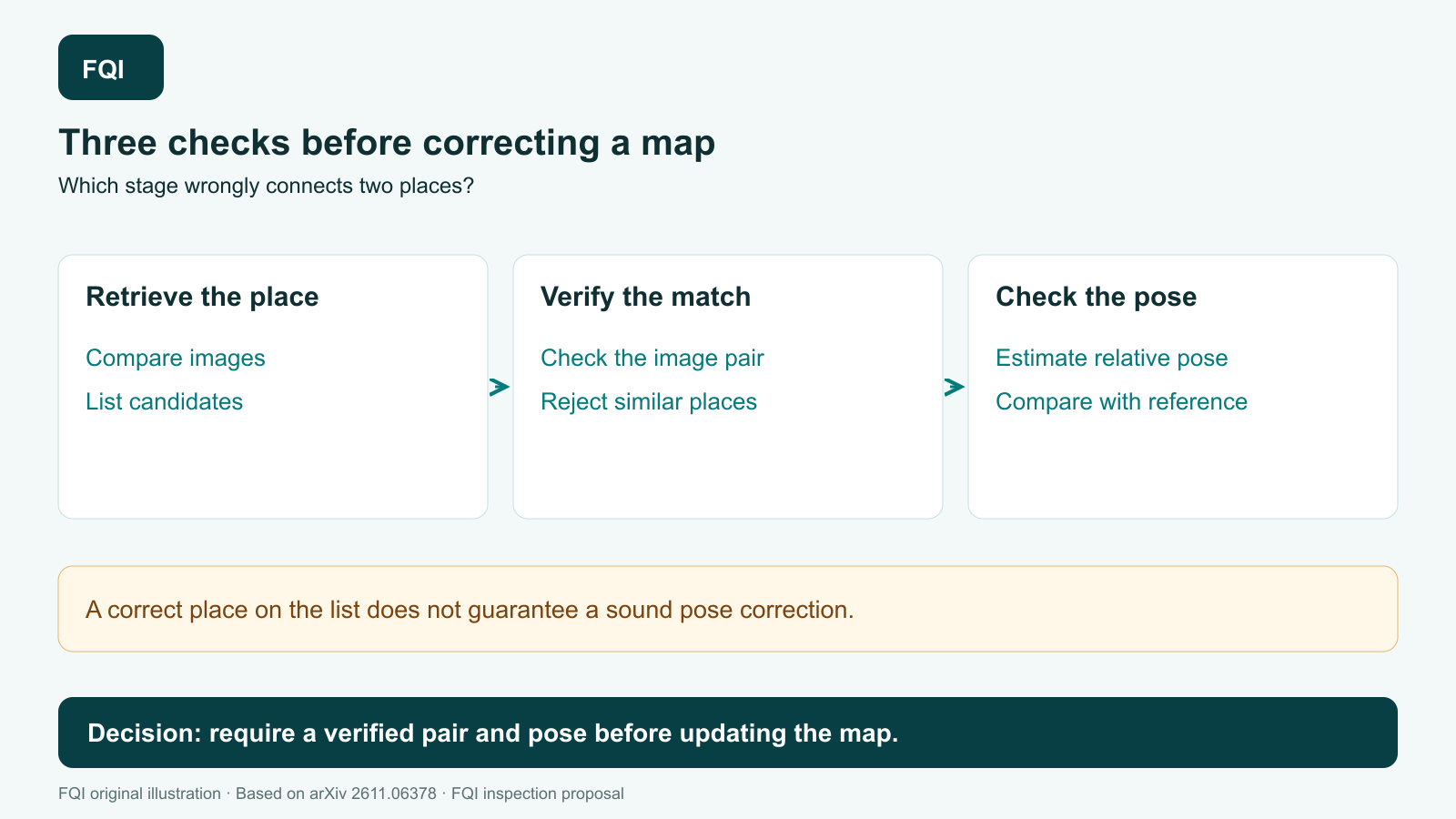
A mobile robot can use a previously visited place to correct drift in its estimated position. An incorrect match can join two different places on the map. UniLoop uses a shared learned image representation to retrieve candidates and examine them in more detail. For acceptance there are three questions. Is the right place in the candidate list, does the pair pass verification, and is the inferred camera pose accurate enough for the intended correction?
FQI takeaway
- Evaluate retrieval even when a later check rejects the candidate.
- Include visually similar but spatially distinct places as hard counterexamples.
- For confirmed matches, check relative camera pose against an independent reference.
The principle at a glance
A position estimate accumulates small movement errors. When a robot recognizes a previously visited place it can correct the resulting drift, a process called loop closure. The system first searches for images that may match the current camera view. A second stage assesses an image pair. For an accepted pair, the system must still estimate how the two camera positions and viewing directions relate in space.
Deep dive
UniLoop uses a pretrained geometric image model. Retrieval relies on a compact representation. Pair verification can draw on finer features from the same images. The model’s geometric prediction then supplies a constraint for correcting the map. Sharing this computation avoids extracting the same image features repeatedly. Each stage nevertheless has different consequences when it fails.
On MSLS and Pitts30k, retrieval achieved recall within the top ten candidates of 96.6 and 99.3 percent, respectively. This measures how often the list contains a correct place. Dedicated comparison methods led on other datasets. For verification, the authors also report strong performance when summarized across decision thresholds. At the setting requiring complete precision, however, some true loops remained unconfirmed. A high retrieval rank alone cannot justify a correction.
FQI suggests making two trips through a location with repeated structures. Independently label which views show the same place. Include two similarly furnished aisles in different parts of the building. Examine whether retrieval missed a match, verification accepted the wrong pair or the right pair produced an unsuitable pose correction. Each observation points to a different technical change.
The authors describe deployment on a real robot as future work. One option for an initial trial is to record proposed corrections separately. Apply them to a copy of the map and compare the effect with an independent reference point. The team can then decide under which viewing conditions loop closure may affect live navigation.
Limitations and risks
Reported retrieval results refer to particular image collections. A hall with reflections, changing lighting or regularly moved bins may have different ambiguities. A threshold with no false matches in a finite sample offers no guarantee about future operation. Report the number and kinds of difficult counterexamples alongside the measured rates.
FQI conclusion
Follow the decision all the way to its effect on the map. FQI would weigh a missed loop separately from a false connection. A robot that misses an opportunity may localize again later. A false connection can already deform a plausible map. These consequences determine how strict confirmation should be and which uncertain image pairs merit retention for subsequent investigation by an operator.
Sources & transparency
The methods and results are reported in the authors’ paper. The proposed workplace test and illustrative examples are FQI interpretations.
Artificial intelligence assisted preparation. Johann Fischer approved this article package for publication on 2026-11-07.