
Executive summary
A robot can update part of its artificial intelligence (AI) control system by comparing a predicted contact force with the force measured after an action. M2AdaptVLA combines visual history with force and torque history. In a small study of a board-wiping task, a four-layer update performed better on average than a wider update. For quality teams, the scope of adaptation and the link between sensor reading and action are separate acceptance questions.
FQI takeaway
- Match each reading to the action that produced it.
- Compare restricted and wider updates with a fixed controller.
- Measure update time and the response to missing feedback.
The principle at a glance
The robot sees the scene and senses contact at its wrists. Colour and shape can help it locate a connector. Contact can reveal whether it has seated. The model predicts a movement and an associated force and torque. A subsequent reading can supply a learning signal if it belongs to the relevant completed step. Small trainable components allow much of the original model to remain fixed.
Deep dive
The larger study covers eight tasks on two bimanual robot platforms, including connector handling, a safe and a whiteboard. The complete system averaged 82.71% task success. Several design elements contribute to this architectural comparison. The more focused test of online adaptation used wiping under two changed board conditions and 20 trials per policy and condition.
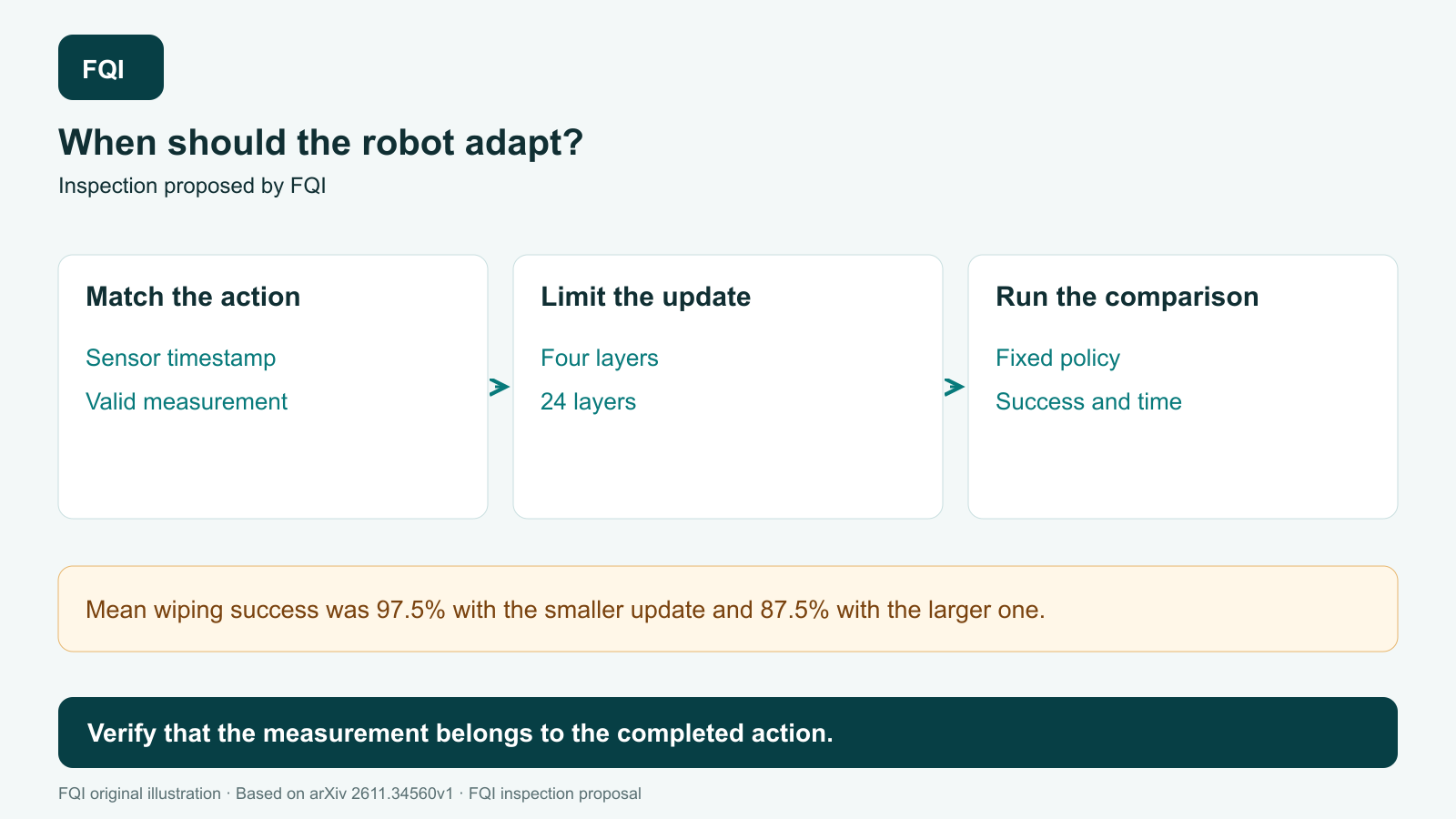
With the board raised, the fixed policy succeeded in 90% of trials and the four-layer update in 100%. With the board flipped and its rear edge raised, the corresponding figures were 80% and 95%. Updating all 24 layers yielded 80% and 95%. The averages were therefore 85% for the fixed policy, 97.5% for four layers and 87.5% for 24. The extra degrees of freedom did not improve the mean in these conditions.
On the tested graphics processor, updates took 159.5 milliseconds for the smaller adaptation and 267.7 milliseconds for the larger one. These are update times. An application that needs a total response-time bound must also measure the rest of its control path.
Appendix C describes how the researchers matched measurements to actions. They required a complete, finite wrist sample received by step completion with a timestamp within the preceding eight milliseconds. A missing sample was masked. If no coordinates qualified, the update was skipped. A missing measurement therefore did not become a measured zero.
Limitations and risks
The contact-change tests used one wiping task and two altered board conditions. Neither long-term industrial reliability nor permissible force limits were established. Maintaining two kinds of memory also increased processing latency. The eight-millisecond window belongs to the authors’ setup and would need justification in another process.
FQI conclusion
A useful acceptance record links each change to the measured signal that triggered it. In a simplified assembly trial, a plausible force from the previous movement could otherwise teach the controller the wrong association. Check how the learning path treats delayed or missing readings, compare adaptation scopes on the same conditions and measure total timing separately. These observations support a process-specific decision on when updates may occur.
Sources & transparency
M$^{2}$AdaptVLA: Multimodal Memory-Augmented Vision-Language-Action Model with Predictive Test-Time Adaptation · arXiv v1
Author preprint v1. FQI checked the cited sections of the original study. Workplace examples and inspection proposals are FQI interpretations. The experiments were not independently replicated.
Codex drafted the texts and checked them against the original study. Johann Fischer authorized publication on that basis on 28 November 2026.