
Executive summary
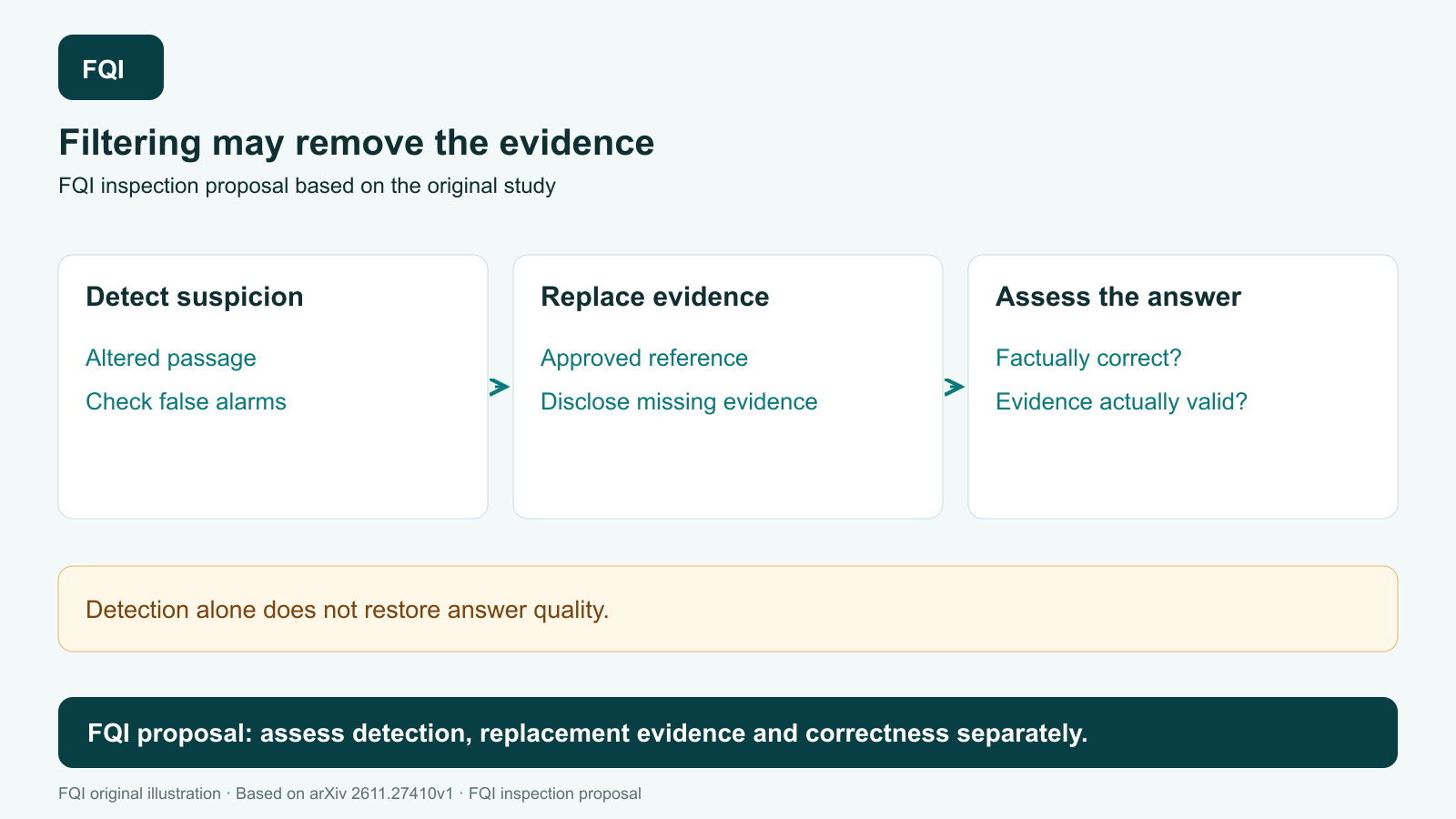
Artificial intelligence (AI) that answers from documents can reject manipulated passages and still perform worse. In a small cybersecurity knowledge base, word substitutions mainly caused missing evidence and refusals. A detector identified many altered passages, but filtering alone did not restore answer quality. A trusted replacement source was needed for a substantial improvement. FQI should therefore assess attack detection, retained access to evidence and answer correctness as separate outcomes rather than treating a strong detection score as successful recovery.
FQI takeaway
- Check whether the evidence needed for an answer remains available after filtering.
- Maintain trusted replacement sources with recorded versions.
- Test false quarantine decisions on unchanged documents.
The principle at a glance
Retrieval-augmented generation, or RAG, combines a language model with document retrieval. Relevant passages become evidence for the answer. If those passages have been manipulated, fluent wording is not proof of quality.
The study modifies existing documents through word substitutions. A smaller language model helps score unusual substitutions in context. A separate runtime monitor checks generated answers against trusted data. Both incoming evidence and generated output are therefore inspection objects.
Deep dive
The experiment uses 18 documents from MITRE ATT&CK and CAPEC and 44 reviewed questions. Only nine questions are held out. A fixed language model answers using retrieved passages. The authors compare clean documents, substituted words and a layout-only control.
The judged correctness score falls from 0.714 to 0.555 after poisoning. Much of the damage involves lost evidence and refusals rather than numerous false claims. This matters for quality assessment: a system can become substantially less useful without frequently producing explicit falsehoods.
The contextual detector achieves an area under the detection curve of 0.95 in the evaluated setup. This describes separation across thresholds, not certainty that an individual passage is safe. Thresholds are fixed on development documents, and clean passages can still be flagged.
Filtering reduces the delivery of edited passages to the generator. However, the removed passage often contains the information needed to answer. Correctness consequently does not recover automatically. A monitor uses a separately pinned official MITRE reference. When it can provide a trusted replacement entry, the reported correctness score reaches 0.786.
FQI would require three independent questions in an operational trial: was the manipulation detected, is a supported answer still possible, and is that answer correct? A constructed example is an altered inspection instruction. Blocking the questionable document initially protects the assistant. A current approved version is still needed to support a reliable answer. If no replacement exists, the system should disclose the evidence gap rather than improvise.
Quarantine also needs an accountable review path. The study’s persistent exclusion rule prevents a rejected passage from reappearing, but false blame can remove legitimate knowledge. FQI recommends recording the reason, affected questions and approved replacement when a document is excluded. This is an operational interpretation, not a field deployment result reported by the authors.
Limitations and risks
The study is small and restricted to one knowledge domain, generator and embedding setup. A language model judges correctness; a manual check by the first author is not independent technical review. The monitor also quarantines clean passages. Its trusted reference covers MITRE, and stronger adaptive attacks may behave differently. Detection should therefore be treated as evidence for review, not proof of a passage’s integrity or an answer’s truth.
FQI conclusion
A filter score is not a complete acceptance criterion for a knowledge assistant. The system must reject unsafe material while preserving its ability to answer legitimate questions from verified evidence. The paper provides a concrete separation between detection and recovery. A pilot should document replacement sources, approved versions and false alarms explicitly. Quarantine is useful only when assessed together with its consequences for correct answers and justified access to information.
Sources & transparency
- Detecting Word-Substitution Poisoning of a RAG Knowledge Base with Relative Entropy and Runtime Verification
- Detecting Word-Substitution Poisoning of a RAG Knowledge Base with Relative Entropy and Runtime Verification
Codex assisted with drafting and checked the claims against the cited original study. Results were not independently reproduced. Operational recommendations and simplified examples are FQI interpretations.
Codex assisted with drafting and checked the claims against the cited original sources. Johann Fischer authorized publication on 2026-11-23 following review by Codex. Individual human reading is not claimed.