
Executive summary
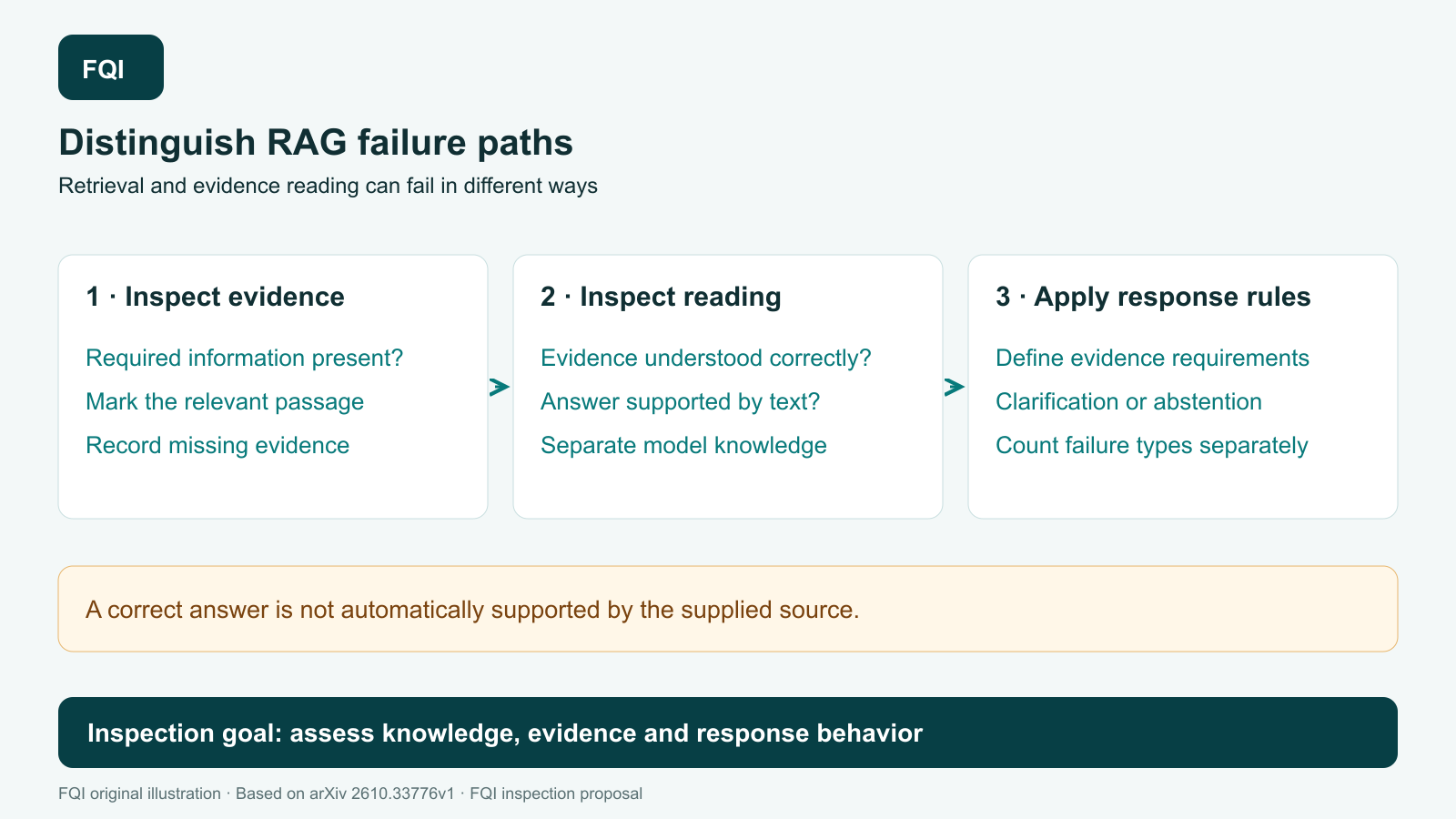
Artificial intelligence (AI) with document search can fail because it does not find evidence or because it processes available evidence incorrectly. TriageRAG investigates a training diagnosis that treats these situations separately. It also reveals a problematic selection rule: training only on examples whose sources are successfully retrieved removes precisely the cases with unhelpful context. Quality management should therefore inspect the composition of training data. Better answer accuracy still does not establish dependable refusal when supporting sources are missing.
FQI takeaway
- Diagnose evidence retrieval and answer processing before changing training.
- Keep examples with missing evidence visible in training selection.
- Assess answer accuracy and source-bound answering separately.
The principle at a glance
Retrieval-augmented generation, or RAG, supplies a language model with retrieved document passages. The search component is called the retriever; the answering model must interpret the material. A passage can be topically relevant without containing the answer.
TriageRAG generates question–answer examples from a domain corpus and probes the model with and without retrieved context. It also records whether the original evidence passage appears among the results. These observations identify different failure situations and help route examples to appropriate training signals.
Deep dive
The central comparison fixes important conditions: starting model, generated example pool, training budget and retriever. This makes it possible to examine the contribution of example selection and context construction. The main method adapts the reader while keeping the retrieval component unchanged.
Results cover eleven benchmarks in medicine, science and computer science. TriageRAG outperforms a reimplemented comparator at the same budget. However, much of the difference comes from retaining examples without helpful retrieved evidence. Compared with an appropriate random-selection control, the additional contribution of the triage itself is substantially smaller for the smaller models.
A particularly informative countercheck inserts the correct passage into training contexts for retrieval-failure cases. This makes training contexts contain the answer again. The variant loses much of the benefit in the tested tasks. A seemingly cleaner training example can therefore represent the later failure condition less faithfully.
Additional retriever tuning does not reliably improve the overall system either. In one configuration, both retrieval recall and answer accuracy decline. The authors attribute this to biased training pairs and retain the frozen retriever in their main configuration. That negative finding concerns the tested recipe rather than every possible retrieval update.
An FQI report should distinguish three questions: did the source collection contain suitable evidence, did that evidence reach the particular model context, and was the resulting answer correct? Training changes can then be evaluated on a separate fixed test set. Retaining the case groups prevents an improved aggregate result from hiding deterioration when retrieval fails.
For operational diagnosis, record the actual retrieved passages rather than assuming that the nominal source collection represents what the model saw. Changes to selection and reader behavior need separate comparisons so the team can identify which intervention merits further testing.
Limitations and risks
The method uses generated questions and answers. Filtering reduces certain errors but does not replace an independent domain reference. A fixed example pool also limits the benefit of additional training rounds; the paper observes saturation and occasional regression.
For applications requiring traceable sources, a crucial limitation is that the missing-evidence route teaches answering despite unhelpful context. It is not an abstention mechanism. Normative information and quality decisions requiring approval therefore need additional rules defining when an answer without a demonstrable source is unacceptable.
FQI conclusion
The main contribution is failure decomposition before corrective action. More retrieved passages and clean-looking training data are insufficient quality objectives. An inspection plan must include situations where relevant evidence is absent. Appropriate behavior then depends on the assignment: supplementing from model knowledge and strictly evidence-bound answering are different requirements. Acceptance should define and measure them separately. The research supports a diagnostic design, while operational suitability and the response to missing evidence remain local decisions requiring their own proof.
Sources & transparency
Primary source: TriageRAG: Failure-Aware Self-Training for Adapting Retrieval-Augmented Language Models to Specialized Domains; versioned original. The public original was read on 29 October 2026. This is a research preprint; completed peer review is not assumed. The reported experiments were assessed editorially, not independently reproduced. Operational checks and examples are FQI interpretations, not demonstrated results of industrial deployment. AI-assisted article. Editorially approved by Johann Fischer on 2026-10-31.