
Executive summary
A plausible reliability score for artificial intelligence (AI) answers can hide opposing errors within the same topic. A research paper therefore supplements topic groups with observable properties of generated reasoning, the model’s written account of processing steps. Joint calibration improves prediction quality in the studied tasks. For quality management, the central decision is which subgroups an acceptance assessment must report separately. The benefit is an inspectable error diagnosis: convincing reasoning does not thereby become proof of truth or a guarantee for an individual answer.
FQI takeaway
- Check reliability scores within interpretable reasoning groups as well as topics.
- Develop and evaluate additional calibration groups on separate data.
- Assess improved overall scores alongside the weakest application-relevant groups.
The principle at a glance
Calibration means that among answers assigned the same predicted reliability, the corresponding fraction should actually be correct. An average can apparently satisfy this condition while one subgroup is rated too optimistically and another too cautiously. Multicalibration extends assessment to several potentially overlapping groups.
The authors use properties of visible reasoning text, such as uncertainty or consideration of several possible answers. Such text is often called a chain of thought. Here it serves as an observable statistical signal; it need not faithfully describe internal model computation. What matters is whether the grouping reliably distinguishes patterns of error.
Deep dive
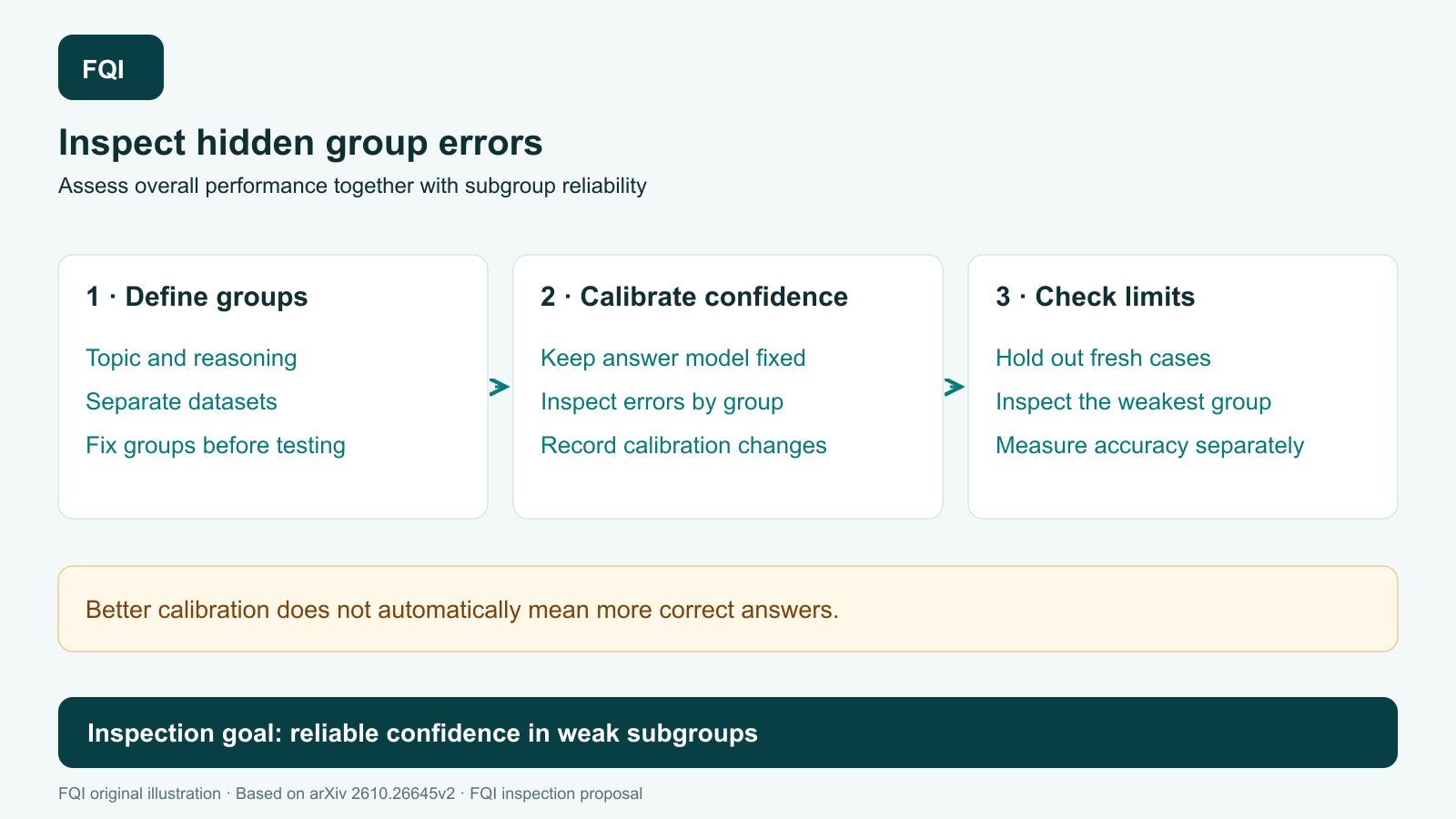
The study holds the answer-generating model and initial scoring function fixed. Another language model assigns reasoning traces to groups using diagnostic questions. Reliability scores are then corrected after generation. Comparisons include topic-only calibration and joint topic-and-reasoning groups. Evaluation uses held-out examples.
Across four knowledge benchmarks for Qwen3-8B, joint calibration produces lower Brier error than topic-only calibration. This measure is the squared difference between a predicted probability and the observed outcome. The reported relative reduction is 4.5–15.0 percent. It describes the reliability predictor, not a corresponding increase in the unchanged language model’s answer accuracy.
Application groups do not benefit uniformly. The additional safety evaluation also shows why a better overall measure and deterioration in the worst group can coexist. Acceptance criteria should therefore specify overall error and group-specific limits separately.
An FQI inspection process would first establish a stable expert reference for correct and incorrect answers. Reasoning properties are then defined and explored on development data. The correction is frozen before evaluation on an independent test set. Each group’s report should include sample size, mean prediction, observed outcome rate and uncertainty. Groups with too few cases should remain explicitly under-supported.
As a simplified operational example, consider an assistant for work instructions. Answers proposing several contradictory solutions are assessed separately from unambiguous answers. Only a dependable reference can establish whether this distinction actually adds inspection value. Group labels must not become a substitute for checking the answer itself.
Limitations and risks
The method requires representative data with reliable outcome labels. Errors by the model assigning groups can distort diagnosis. Visible reasoning is unavailable in some services and may change between model versions. Transfer to a different application remains a separate validation task.
The study does not justify unlimited subdivision into ever smaller groups. Apparent differences become unstable when cases are scarce. Group selection must not repeatedly optimize the same final test set after its results become visible. Group construction, calibration and final evaluation therefore require separate roles.
FQI conclusion
The work offers a concrete response to false reassurance from good averages. An assessment should establish which answer groups lie behind a confidence score and which are systematically overrated. The appropriate intervention is an additional, evidence-based group assessment. Important application topics remain mandatory even when language features improve overall scores. Only stable findings on an independent set support a defensible decision about warnings, further review or limited use. The score remains a probabilistic measurement rather than certification of each answer.
Sources & transparency
Primary source: Reasoning-Aware Multicalibrated Reliability Predictors for Language Models; versioned original. The public original was read on 29 October 2026. This is a research preprint; completed peer review is not assumed. The reported experiments were assessed editorially, not independently reproduced. Operational checks and examples are FQI interpretations, not demonstrated results of industrial deployment. AI-assisted article. Editorially approved by Johann Fischer on 2026-10-31.