
Executive summary
Artificial intelligence (AI) agent rankings can depend on how the same task is phrased. Matching Matters investigates this dependence alongside the interaction between model and tool environment. Its comparison design lets several source systems contribute task-preserving descriptions, then evaluates all targets on the same mixture. For quality management, this suggests a practical procurement and acceptance method: compatibility with wording must not silently be interpreted as general capability. Quality, resource consumption and expensive failures remain separate decision-relevant observations.
FQI takeaway
- Compare complete model–tool configurations on the same tasks.
- Freeze task variants before target evaluation and weight sources equally.
- Report quality, cost and expensive failed runs alongside composite scores.
The principle at a glance
An AI agent includes more than a language model. Its command-line environment defines tool calls, observation formats and failure handling, among other things. The paper consequently treats the combination of model and interface as the evaluation unit.
It also examines task descriptions. Two formulations can preserve the same goal and acceptance criteria yet favor different systems. Explicitly stating an output structure may help a system that previously had to infer that requirement by inspecting files.
Deep dive
AgentMeter combines task quality, budget-conditioned performance and particularly costly runs producing no useful outcome. The composite AgentMeter Score therefore embodies a particular evaluation choice. The authors also report success and cost statistics because one score cannot capture every operational priority.
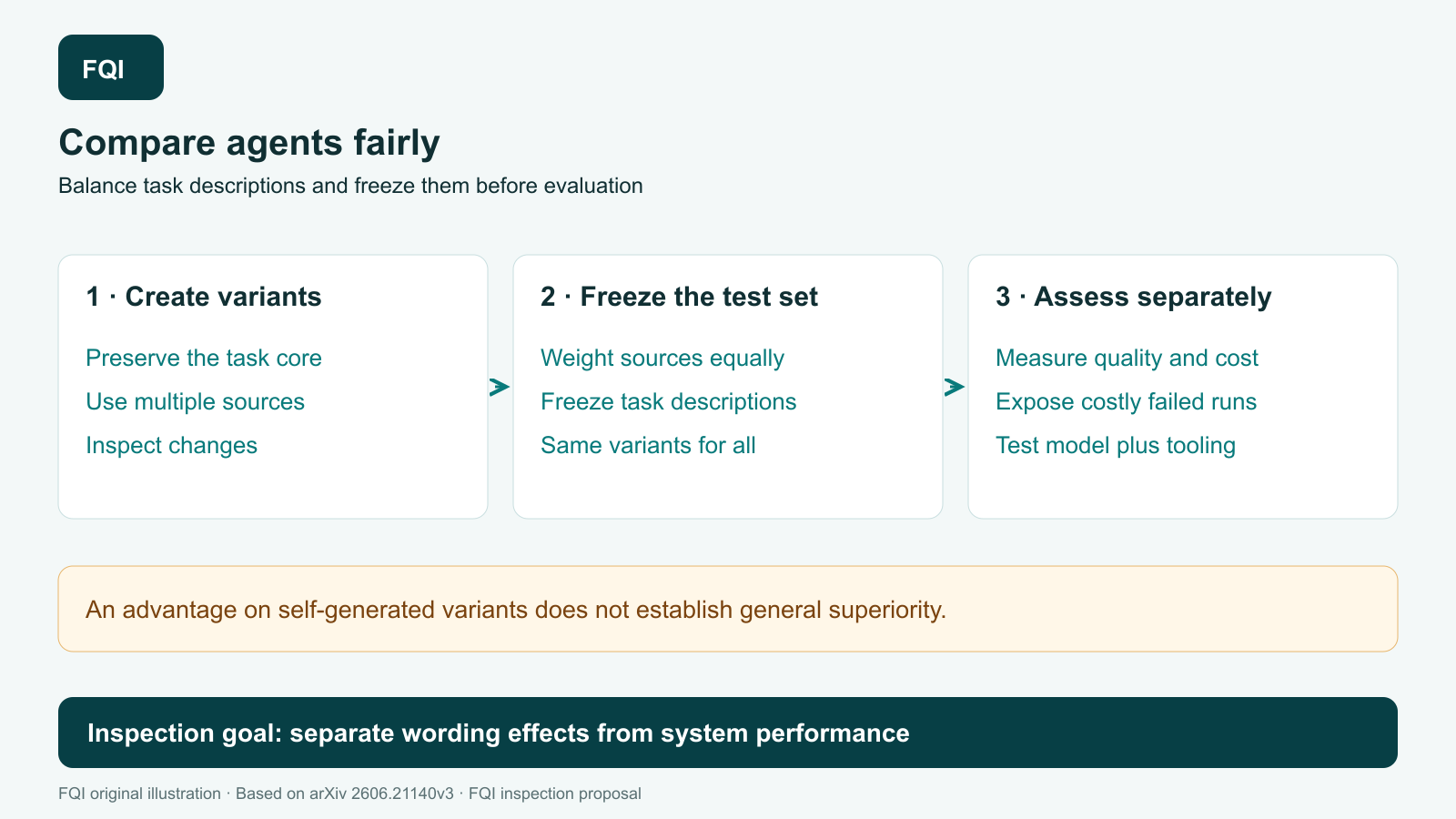
For the wording comparison, execution traces from a source configuration are analyzed to generate clearer task descriptions. A preservation gate rejects changes to objectives, input artifacts, required outputs or success criteria. Hidden evaluation information and prescribed solution steps must not be introduced.
Selection uses the source configuration’s outcomes. The chosen description is then frozen before evaluation on other target configurations. Each source contributes descriptions with equal weight to a common test collection. Every target receives the same mixture rather than a separately optimized test.
This separation matters. A source improving on its own selected wording is partly expected from the selection process. Transfer to other systems and evaluation on the shared balanced collection are more informative for the comparison question. The study observes uneven transfer and altered rankings under this design.
An FQI acceptance plan could first document immutable task elements: inputs, output format, technical conditions and measurable success criteria. Several understandable descriptions are checked against those elements and fixed before comparison. All configurations receive the same variants, environments and budgets. Results are reported by task as well as across the mixture.
As a simplified example, consider an agent producing inspection reports from tables. Clearer wording may explain filenames and their roles. It must not insert a model solution or remove a previously required source check. Such a change creates a different task and must be excluded. Preserving that distinction keeps a wording experiment from becoming an undisclosed simplification of the assignment.
Limitations and risks
An automated task-preservation gate cannot prove full semantic equivalence of natural language. Expert spot checks therefore remain useful. A balanced artificial collection also does not automatically represent the instructions later users will actually provide.
Rankings depend on tasks, cost assumptions, reference configurations and execution conditions. The results establish no universally best tool interface. Another description generator or human-written variants could produce different effects. The study examines one controlled construction, not a general guarantee of neutrality. Operational comparison should therefore retain the tested descriptions and settings alongside results.
FQI conclusion
The paper adds a concrete element to agent acceptance: the distribution of task formulations belongs in the assessment specification alongside the technical system. A fair comparison needs shared conditions and a traceable check that variants preserve the task. Decisions should consider quality, resource use and failures while exposing wording effects separately. This strengthens procurement evidence without prematurely transferring a research ranking to unrelated business tasks. The appropriate outcome is a bounded comparison of configurations under documented conditions.
Sources & transparency
Primary source: Matching Matters: A Fair Quality-Efficiency Benchmark for Command-Line Agents; versioned original. The public original was read on 29 October 2026. This is a research preprint; completed peer review is not assumed. The reported experiments were assessed editorially, not independently reproduced. Operational checks and examples are FQI interpretations, not demonstrated results of industrial deployment. AI-assisted article. Editorially approved by Johann Fischer on 2026-10-31.