
Executive summary
A language model can base a decision on a feature that appeared useful during training but is irrelevant in deployment. Research investigates whether targeted input edits can reduce such shortcut dependence at inference time. The weighting of predictions is central: optimal weights cannot simply be read from a model without additional assumptions. Quality management must therefore assess the selection of the correction method itself. Stable rankings and dependable probabilities are different objectives, even when both arise from the same collection of edited inputs.
FQI takeaway
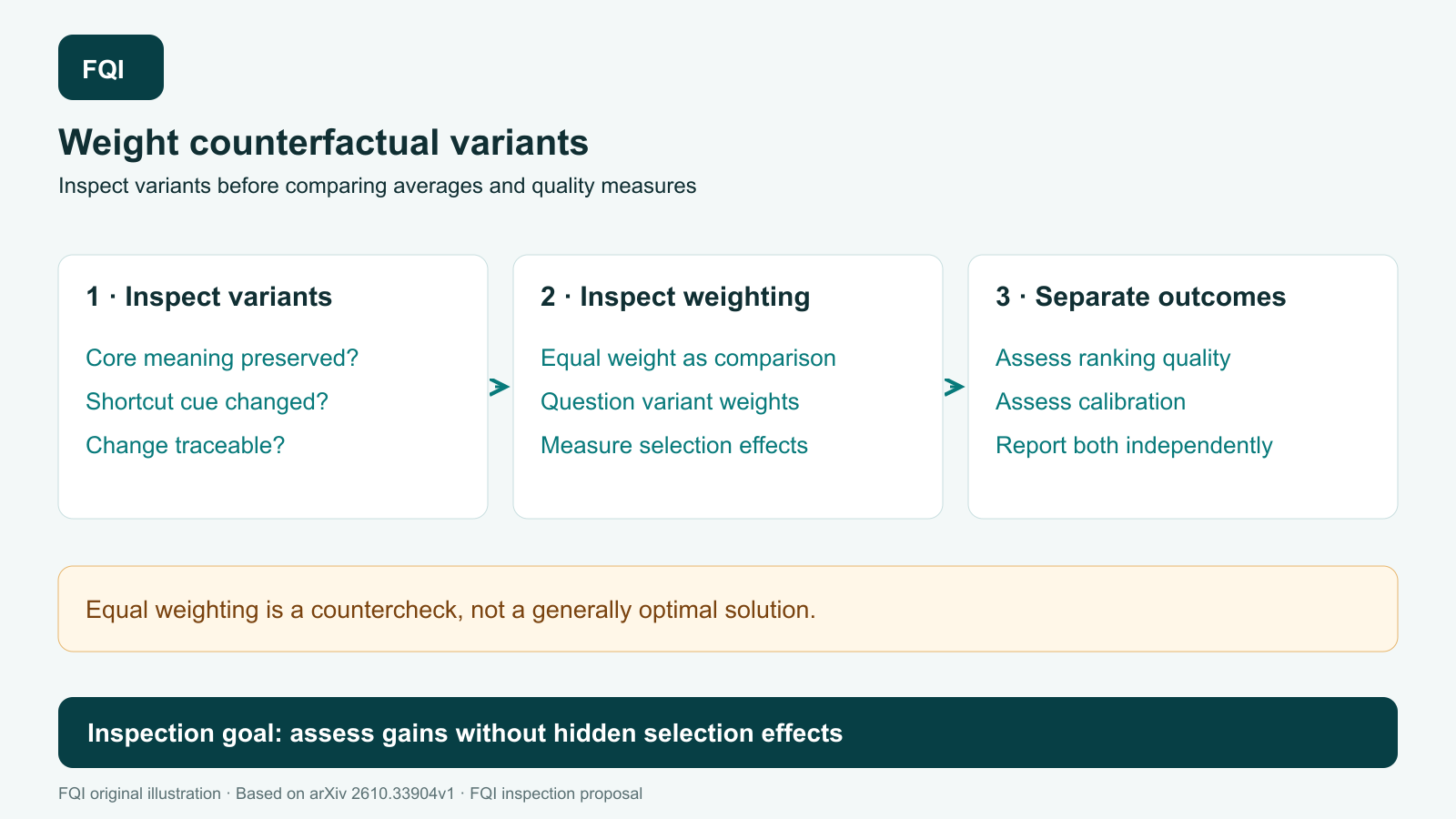
- Define the unwanted feature and permitted edits in advance.
- Test assumptions behind model-derived weights with explicit diagnostics.
- Evaluate ranking quality and meaningful probability estimates separately.
The principle at a glance
A counterfactual variant changes a suspected nuisance feature while preserving decision-relevant content. In text classification, this might involve changing irrelevant name-related features. The model evaluates several such variants, and their predictions are combined.
Counterfactual Test-Time Augmentation, or CTTA, changes how the existing model is used without retraining its weights. The paper examines fixed weighting and weights derived from the model’s probabilities for the edited texts. Artificial intelligence (AI) is both the classification system under assessment and, where used, the editor that constructs variants.
Deep dive
The theoretical starting point is a particular data-generating model. Within this framework, the authors characterize a predictor insensitive to the known shortcut. Its optimal weights depend on the training distribution, which users of a finished model ordinarily do not fully know.
Estimating these weights from the model requires additional assumptions. Classification behavior and text likelihoods must reflect the same underlying distribution. Editing must also avoid changing length, wording or other properties in ways that make probabilities differ for reasons beyond the intended shortcut.
Select-CTTA uses diagnostic tests to choose between model-derived and uniform weights. The empirical evaluation covers two text-classification tasks and six language models. Different training regimes produce different conditions, so no single weighting choice is appropriate across every configuration.
One important result concerns the target measure. Under the theoretical assumptions, fixed weights can attain the same ranking quality as the optimal predictor while their probabilities remain miscalibrated. Correctly ordering difficult cases and making a meaningful claim such as “90 percent correct” therefore require separate evidence.
An FQI inspection plan starts with an expert-approved editing rule. A sample of generated variants is checked to confirm that the underlying task is unchanged. The report then documents diagnostic assumptions, chosen weights and resulting error on an independent set. It should also identify inputs for which no dependable counterfactual variant could be constructed.
A simplified example is prioritization of complaint descriptions. Changing an irrelevant greeting must not change the actual damage described. A better aggregate score is insufficient if some variants also rewrite the extent of the defect. Variant validity and prediction quality must remain separately inspectable throughout the workflow.
Limitations and risks
The method assumes that the shortcut and its possible values are known. It does not automatically discover every problematic correlation. Theoretical guarantees also depend on the stated assumptions about distribution change and editing accuracy.
The model-weighted version needs text likelihoods, which not every interface exposes. Multiple variants increase the number of model calls. The studied tasks do not establish general protection for arbitrary free text or safety-critical decisions. Label-free diagnostics can guide method selection without becoming a substitute for an independent operational evaluation.
FQI conclusion
A post-processing correction must do more than produce attractive final scores: its own prerequisites need to hold. This includes the validity of counterfactual edits and the weighting of their predictions. Particularly when thresholds drive risk-based decisions, acceptance should report ranking and calibration separately. That distinction shows whether the method sorts cases usefully, delivers defensible probabilities or provides only limited diagnostic value. FQI therefore treats correction design as part of the measured system, with explicit assumptions and bounded claims.
Sources & transparency
Primary source: Counterfactual Test-Time Augmentation for Shortcut Removal in Language Models; versioned original. The public original was read on 29 October 2026. This is a research preprint; completed peer review is not assumed. The reported experiments were assessed editorially, not independently reproduced. Operational checks and examples are FQI interpretations, not demonstrated results of industrial deployment. AI-assisted article. Editorially approved by Johann Fischer on 2026-10-31.