
Executive summary
Artificial intelligence (AI) models for spatial measurement can look convincing under random data splits and perform much worse at a new site. A satellite-derived bathymetry study therefore compares spatially separated validation with transfer to unseen locations. Its practical FQI contribution is the validation design: local calibration, spatial interpolation and new-site transfer are distinct performance promises. They require separate test sets and cannot be replaced by one pooled accuracy figure. The ability to withhold a measurement when information is insufficient is also part of the assessment.
FQI takeaway
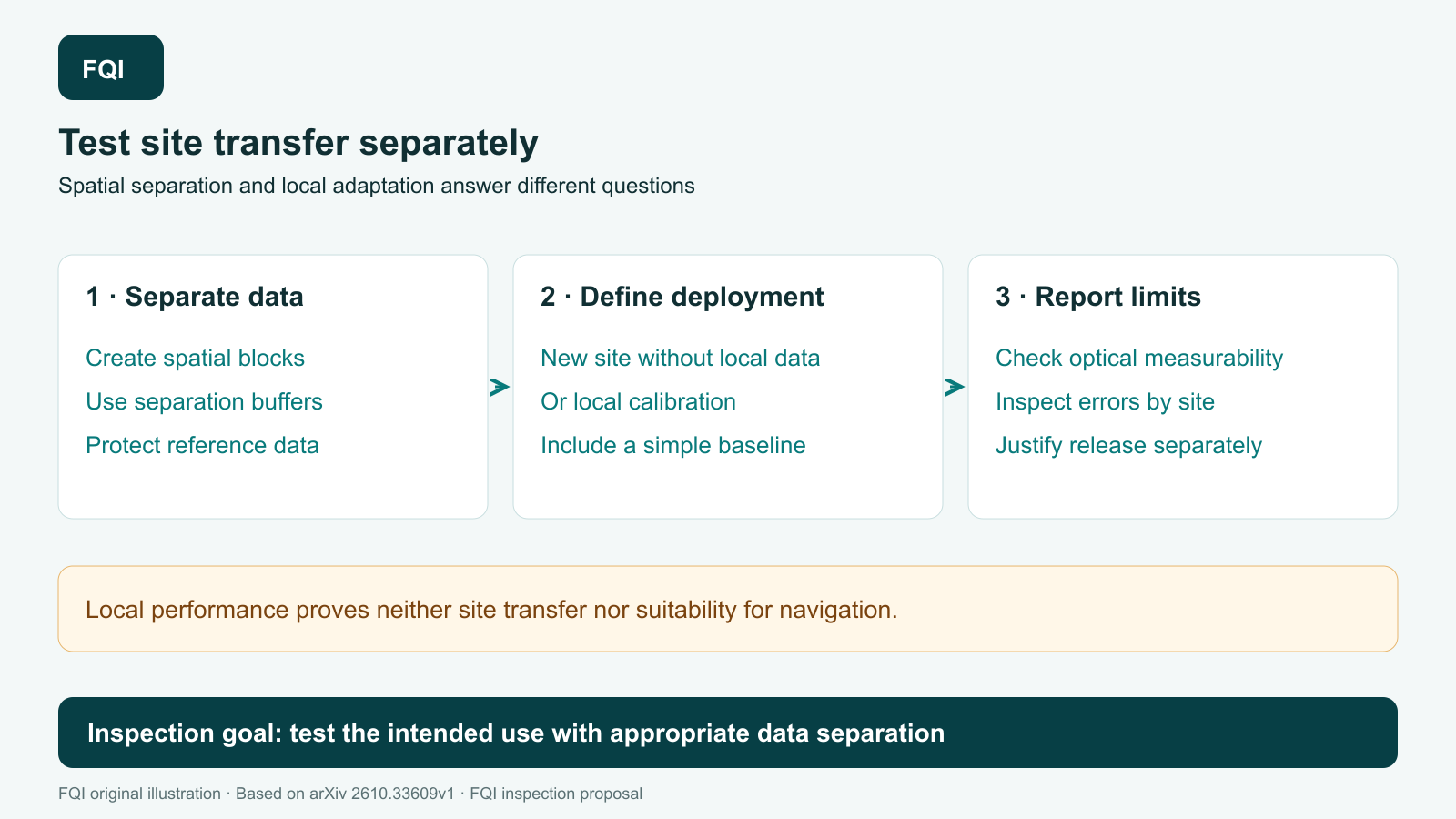
- Separate neighboring training and test points with justified blocks and buffers.
- Assess local calibration separately from application at an unfamiliar site.
- Report missing measurability rather than forcing an AI estimate everywhere.
The principle at a glance
Nearby image points often share conditions. Randomly distributing them between training and testing can reward familiarity with local structure. That evaluation answers a different question from transfer to a genuinely new location.
The paper examines this distinction for water-depth estimation from satellite images. It compares simple empirical methods, machine learning and deep neural networks. Independent hydrographic measurements provide reference values, making AI a direct component of the measurement chain under examination.
Deep dive
The collection includes twelve survey datasets from six port areas along the Abu Dhabi coast. The authors assign different roles to data before training. Besides training and cross-validation sets, they retain independent sites and a temporally separated test. Spatial blocks and buffers limit proximity between calibration and test points.
Two operating modes remain distinct. Transfer mode applies a model where local survey data have not been used for adaptation. Local-control mode permits local reference points for calibration, while evaluation still uses separate points. The second task has more information and cannot be presented as proof of performance in the first.
Model rankings depend on this distinction. In unseen-site transfer, the more complex learning methods do not outperform the simple ratio method in this study. Learning methods can nevertheless offer advantages within surveyed areas. The work therefore provides a concrete example of why model complexity does not automatically establish transferability.
Measurement limits matter equally. When water is too deep or turbid, the optical signal does not contain sufficient seabed information. The processing chain should withhold estimates and provide quality flags. A completely filled map would not itself demonstrate measurement quality.
FQI applies this design principle to other spatial AI assessments. Before acceptance, define the application area, permitted local adaptation and reference acquisition. Justify the separation between training and test regions technically. Report performance by site and operating condition. Subsequent local recalibration creates a different operating mode and should be documented accordingly.
A simplified industrial example is image inspection across several production cells. Randomly separated images from one cell test something different from an entirely held-out cell with different lighting. Both can be useful assessments, but the resulting claims must retain their respective boundaries.
Limitations and risks
The study concerns specific coastal waters, sensors and surveys. Its numerical results cannot be transferred to industrial image inspection. Some reference data are not publicly available, and FQI has not independently reproduced the findings.
Timing differences between imagery and surveys, water conditions and image products further limit individual comparisons. Even a suitably calibrated statistical uncertainty interval does not replace a suitability decision for the actual measurement task. The authors frame their products as reconnaissance and monitoring aids. This report provides no authorization for nautical use or a claim that the maps meet all applicable survey requirements.
FQI conclusion
The most important decision is choosing the performance promise being tested. Claims about new sites require independent testing at new sites; good local results must not silently be generalized. Recognizing insufficient input information is also part of measurement quality. A clear acceptance report therefore separates local adaptation, unfamiliar locations, uncertainty and withheld outputs. That makes the demonstrated capability visible and gives decision makers a basis for restricting use, collecting additional reference data or planning another validation stage.
Sources & transparency
Primary source: Satellite-derived bathymetry of Arabian Gulf ports under leakage-free validation: a multi-site benchmark of empirical, machine-learning and deep-learning models against 285,000 multibeam soundings, with an outlook for UAE waters; versioned original. The public original was read on 29 October 2026. This is a research preprint; completed peer review is not assumed. The reported experiments were assessed editorially, not independently reproduced. Operational checks and examples are FQI interpretations, not demonstrated results of industrial deployment. AI-assisted article. Editorially approved by Johann Fischer on 2026-10-31.