
Executive summary
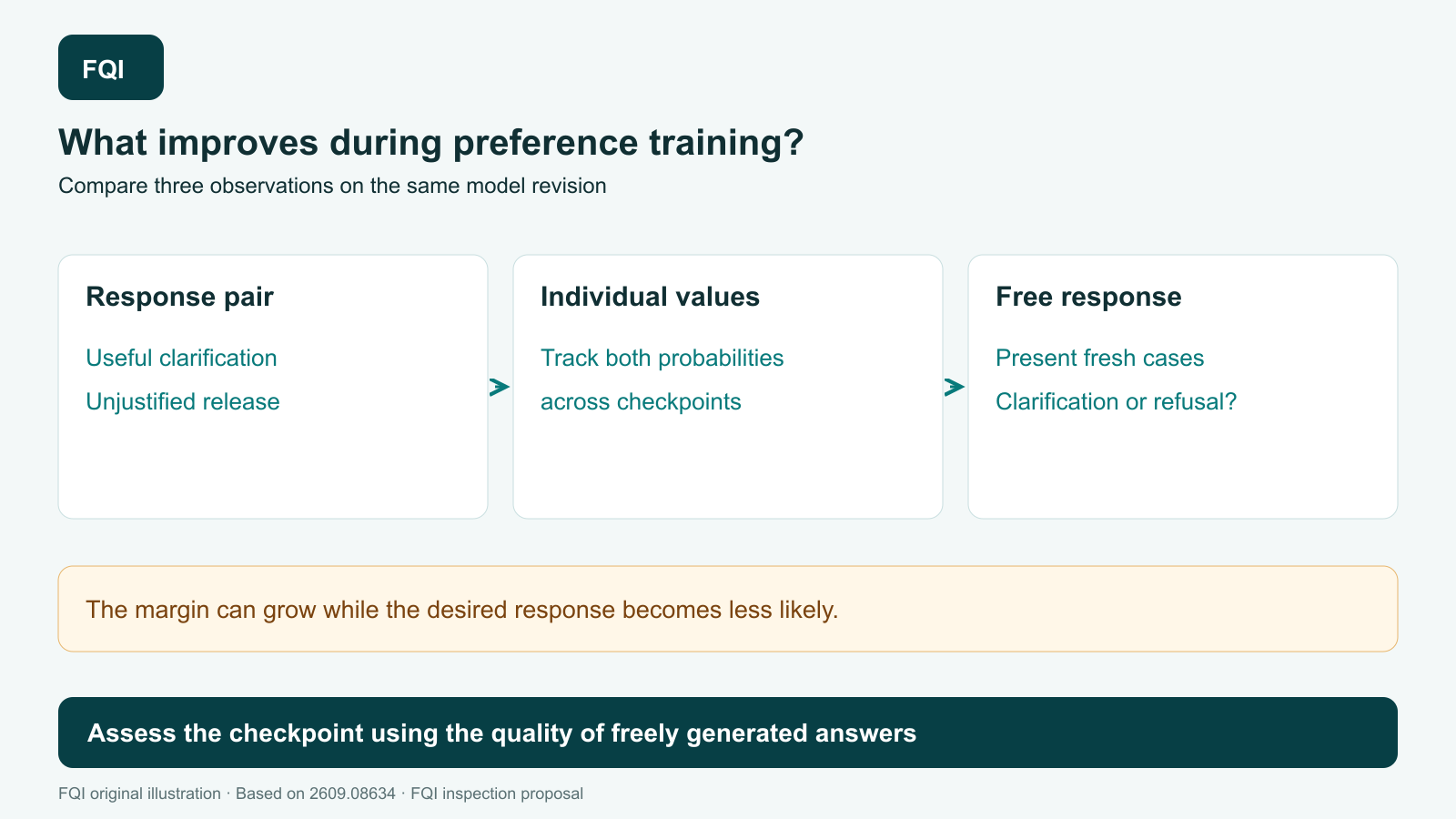
A language model should favour a suitable response over an unsuitable one to the same request. The margin can grow even while the suitable response becomes less likely. The Suan paper investigates this effect in language-model post-training. For a new model revision, track the change in each of the two responses as well as the relative preference, and examine what the model generates when offered no predefined answers.
FQI takeaway
- Track both response probabilities across training checkpoints.
- Evaluate legitimate requests separately from problematic ones.
- Check gains on response pairs against free responses to fresh cases.
The principle at a glance
Preference training uses pairs of answers to the same request. One is preferred. A relative objective can improve if the inferior response loses considerable weight. The preferred response need not gain a corresponding amount. If it too becomes less likely, other completions outside the pair may become more likely. Which of those alternatives the user actually receives matters in practice.
Deep dive
The researchers analyse how common objectives change the parameters of a model during a training step. They propose a different formulation at the level of the direction of the update. Experiments across eight language models compare safety behaviour and general capabilities. For quality management, a useful aspect is how the change is observed. A forced comparison measures something different from the answer freely generated by the resulting model.
Consider a simplified FQI example. An assistant reviewing an incomplete inspection file should ask a targeted question. An unjustified release is the inferior response. After training, the comparison favours the question by a wider margin. Yet the assistant might now produce a blanket refusal more often when it is allowed to respond freely. Fix both candidate texts in the test plan, compare their individual changes against the initial checkpoint, and give the system fresh files without suggesting possible answers. Reviewers distinguish a clarification, useful information and an unnecessary refusal.
Repeat the numerical comparison using identical text and preprocessing. A change in the length of a candidate answer can distort the probability comparison. For free responses, exact wording is less important. A useful clarification may use different words from the reference. A literal text match would miss that improvement. Use a short rubric: did the response identify the missing information, ask an answerable question and avoid a premature release? This record can explain why a checkpoint was held back despite an improved pairwise score.
Limitations and risks
The work studies selected models, preference data and benchmarks. Gains on those tasks do not establish equally good behaviour on a particular collection of inspection records. The probability of a single long reference answer is also incomplete as a quality measure. Record the wording, scoring rule and model revision for each comparison. At a service that exposes no response probabilities, a behavioural test is the available direct check.
FQI conclusion
FQI would assess the training change by comparing the gain on the pair with observable improvements in the intended work. A decrease in both candidate probabilities warrants investigation. The distribution of useful answers, harmful responses and needless refusals determines whether the new checkpoint is appropriate for its task. This gives the team a practical distinction between a better training signal and better support for its users.
Sources & transparency
The reported methods and results come from the linked preprint. FQI did not independently reproduce the experiment. Operational examples and proposed checks are FQI interpretations. Sources reviewed on 4 November 2026. Artificial intelligence assisted preparation. Johann Fischer explicitly approved this article package for publication on 2026-11-04.