
Executive summary
Manufacturing a peptide requires finding a solvent for the chemically protected intermediate as well as understanding the final product. PeptSol examines whether learned representations of molecules can predict this property. Its 1,388 measurements cover just 84 parent peptide sequences. Before using its results to plan a new synthesis, a team needs to ask which parts of the test molecule a model has already seen.
FQI takeaway
- Group test cases according to the chemical unit that will actually be new.
- Compare learned representations with a baseline using simple chemical features.
- Register predictions before measuring a new material in the laboratory.
The principle at a glance
In stepwise synthesis, protecting groups temporarily block particular reaction sites. An intermediate can therefore behave differently from the eventual peptide. It is the protected structure that matters when selecting a solvent for this step. Testing the same structure in several liquids provides useful comparisons, yet each additional observation contributes relatively little evidence about an entirely different molecule. PeptSol makes that distinction explicit when it divides the measurements for training and testing.
Deep dive
The authors collected data on 101 protected structures. About 92.5 percent of measurements came from a single historical programme. They evaluated seven pretrained molecular models whose representations stayed fixed during evaluation. One baseline combined chemical fingerprints with explicit molecular descriptors. A fingerprint encodes recurring structural features and makes a simple comparison of molecules possible.
On the historical subset with peptides held out in their entirety, the best binary prediction achieved a macro-F1 of 0.843. This score balances the fraction of a class recovered with the fraction of predictions for that class that are correct, then averages across classes. In the same evaluation cell, the best score for three ordered levels of solubility was 0.614. Screening a list of solvents and choosing between neighbouring processing categories demand different resolutions. Model rankings also varied with the task and the split.
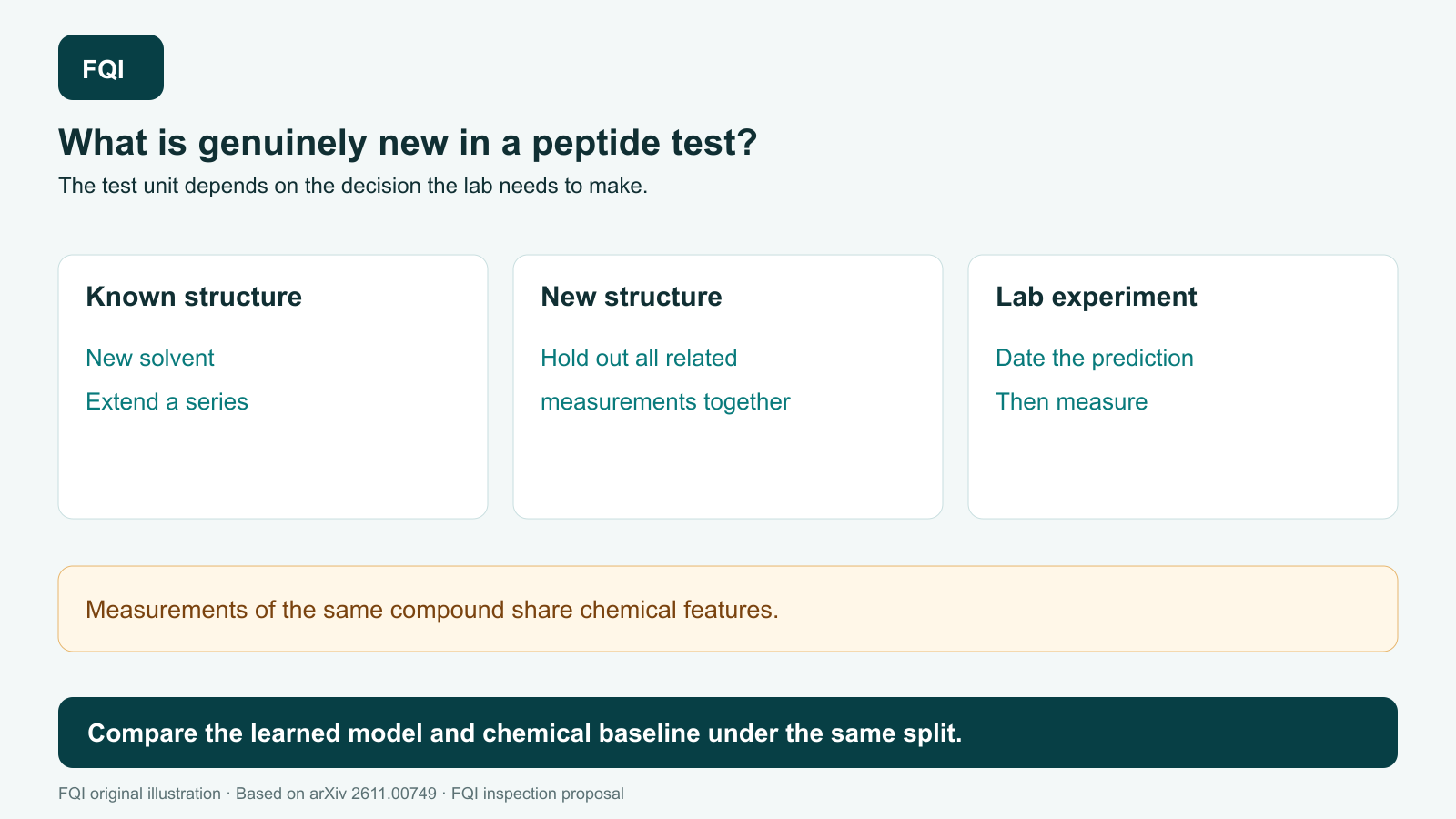
FQI suggests writing down the intended decision before allocating the data. Is the lab trying another solvent for a known compound or planning work on a new peptide family? For a new family, keep related observations together in the held-out set. Record which protecting groups, terminal groups and solvents appeared in training. That record can explain where a prediction was an extrapolation.
Consider a simplified experiment on one intermediate in four solvents. Training on three measurements and testing on the fourth explores an extension of a familiar series. Holding out all four measurements tests transfer to the protected structure. Both experiments are useful, provided each has its own label and is compared against the same type of chemical baseline.
Limitations and risks
Combining historical measurements requires harmonizing categories across experimental protocols. Borderline cases may be sensitive to the chosen classification. The small number of independent structures particularly limits comparisons between laboratories. Even an accurate solubility judgement leaves open whether the intermediate can be recovered in the required yield and purity after reaction. Those outcomes require their own measurements.
FQI conclusion
A simple model may already be useful for prioritizing an experiment. Its value depends on comparison with a transparent chemical reference under a split appropriate to the intended decision. Record the prediction, date, compound and solvent before running the next experiment. That sequence makes it possible to judge whether the prediction helped on a genuinely new compound.
Sources & transparency
The methods, figures and limitations come from the authors’ publicly accessible paper. The proposed workplace test and simplified example are FQI interpretations. Study record. Original study.
Guidance from the National Institute of Standards and Technology (NIST) offers a framework for planning evaluation in the intended context of use. The numerical results in this brief come from the study. NIST evaluation guidance.
Artificial intelligence assisted preparation. Johann Fischer approved this article package for publication on 2026-11-06.