
Executive summary
A safety certificate for a neural controller describes a particular operating environment. A newly detected obstacle can change which states are unsafe. Researchers studied how to repair the certificate locally while preserving the original controller and proof in unaffected regions. The change still needs a check at the interface between old and new regions. This gives quality teams a concrete question to ask when an update is described as local.
FQI takeaway
- Treat a new unsafe region as a change to the assumptions behind the existing certificate.
- Verify transitions between repaired and unchanged regions as part of the combined proof.
- Budget the time needed to obtain the new verified result.
The principle at a glance
A neural controller chooses an action based on the state of a system. A mathematical barrier certificate can show that trajectories avoid a defined unsafe region under specified assumptions about system behaviour. An obstacle changes the set of states that the controller must avoid. The original proof may continue to describe much of the operating space, but its original guarantee covers only the earlier definition of the unsafe set.
Deep dive
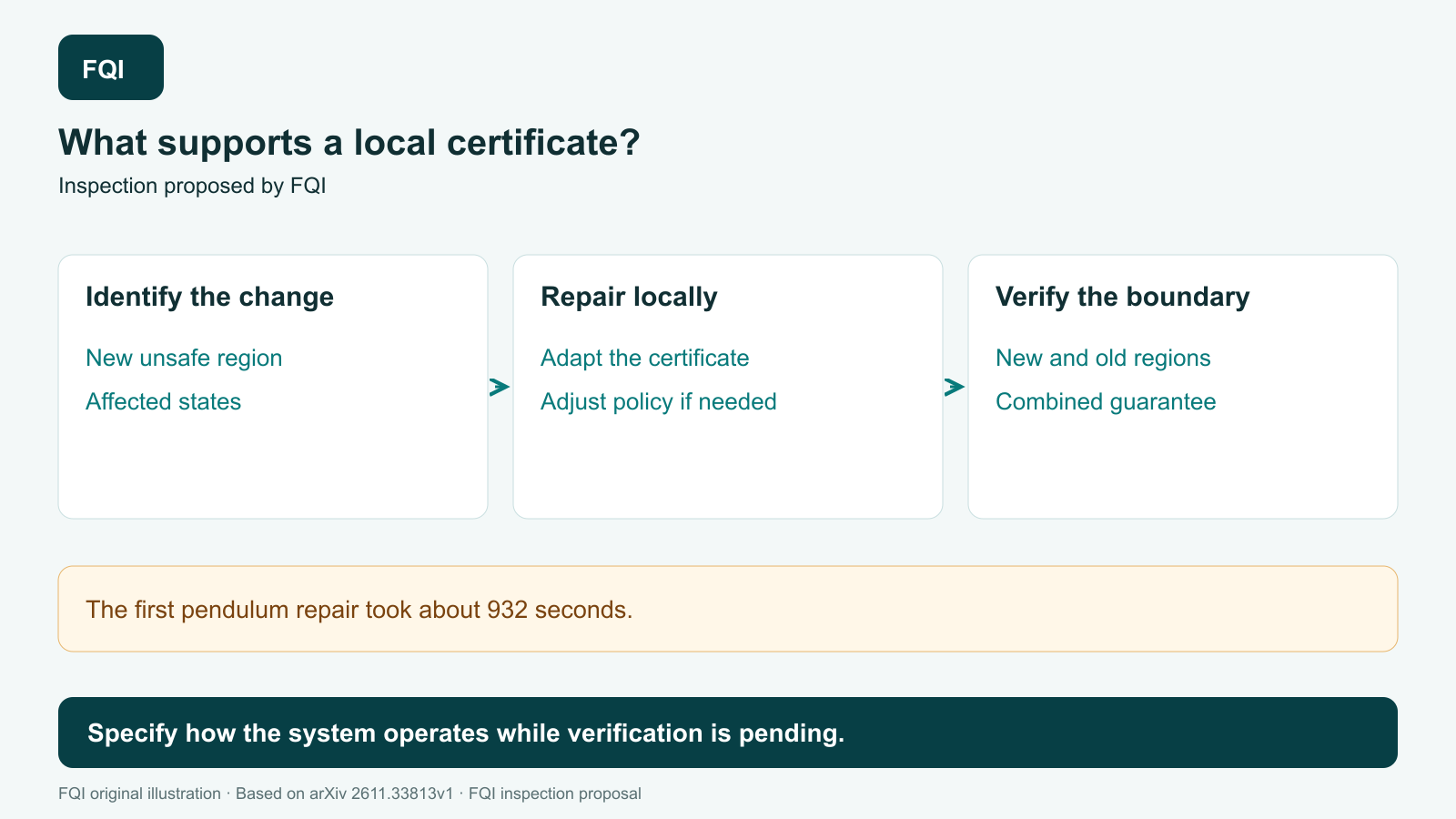
The method constructs a repair region around the newly unsafe states. It first tries to adapt the certificate while retaining existing behaviour where possible. Later stages can adjust both the control policy and the certificate, or use local retraining when simpler changes are insufficient. The aim is to reuse verified structure and limit the scope of the update.
Verification is a separate step after adaptation. The authors compute possible transitions at the switching interfaces and check a condition for the combined certificate. A locally successful fit alone cannot tell the reviewer how a trajectory moves across the boundary. It is the combined condition that supports the stated safety result for the modelled system.
The experiments used four benchmark tasks with five obstacles introduced in sequence for each task. The proposed approach restored certification in all tested configurations. Global retraining frequently timed out. Among instances in which retraining also succeeded, the local method was 17.3 times faster on average. Including cases where the comparison method had no successful completion would change the meaning of that ratio.
Absolute time also matters. The table gives about 932 seconds for the first pendulum repair, including the attempted stages and verification. Later repairs could reuse a previous local certificate. A speed advantage measured across successful cases does not specify how a real installation behaves while a repair is pending.
FQI would ask for four records in a change review. Describe the changed environment, show how the repair region was chosen, record the outcome of each stage and retain the verification of the interface. An operating procedure must also specify a safe state during detection and verification. This proposed procedure is an application of the findings. The experiments did not validate it on a production line.
Limitations and risks
The guarantee depends on assumptions about system dynamics, the controller and the bounded operating space. The method takes a detected obstacle as input, and the runtime comparison excludes the detection cost shared with the alternative. Initial certificate adaptation is limited to its last network layer. Four benchmark systems do not establish performance under real sensor error or unmodelled dynamics.
FQI conclusion
A local change can preserve useful earlier work while still requiring a system-level argument. In this case, the crucial evidence concerns the boundary between two regions and the time until the argument is complete. FQI would include that evidence and the operating assumptions in the same release record so the person authorizing operation can determine exactly when the revised guarantee takes effect.
Sources & transparency
Ensuring Deployment-Time Safety of Neural Network Controlled Systems via Localized Certificate Repair · arXiv v1
Author preprint v1. FQI checked the cited sections of the original study. Workplace examples and inspection proposals are FQI interpretations. The experiments were not independently replicated.
Codex drafted the texts and checked them against the original study. Johann Fischer authorized publication on that basis on 27 November 2026.