
Executive summary
A verifier must establish that the output of a neural network respects a specified limit for every admissible state. That requires an accurate description of which input combinations belong to the operating domain. Fit-LRP demonstrates on mathematical benchmarks how rectangular enclosures can create extra work. Using the documented boundaries directly allowed some regions to be certified on the first bound.
FQI takeaway
- Document joint input constraints alongside individual minimum and maximum values.
- Compare verifiers on the same property and the same intended domain.
- Report branch counts separately from total work and the time for the hardest region.
The principle at a glance
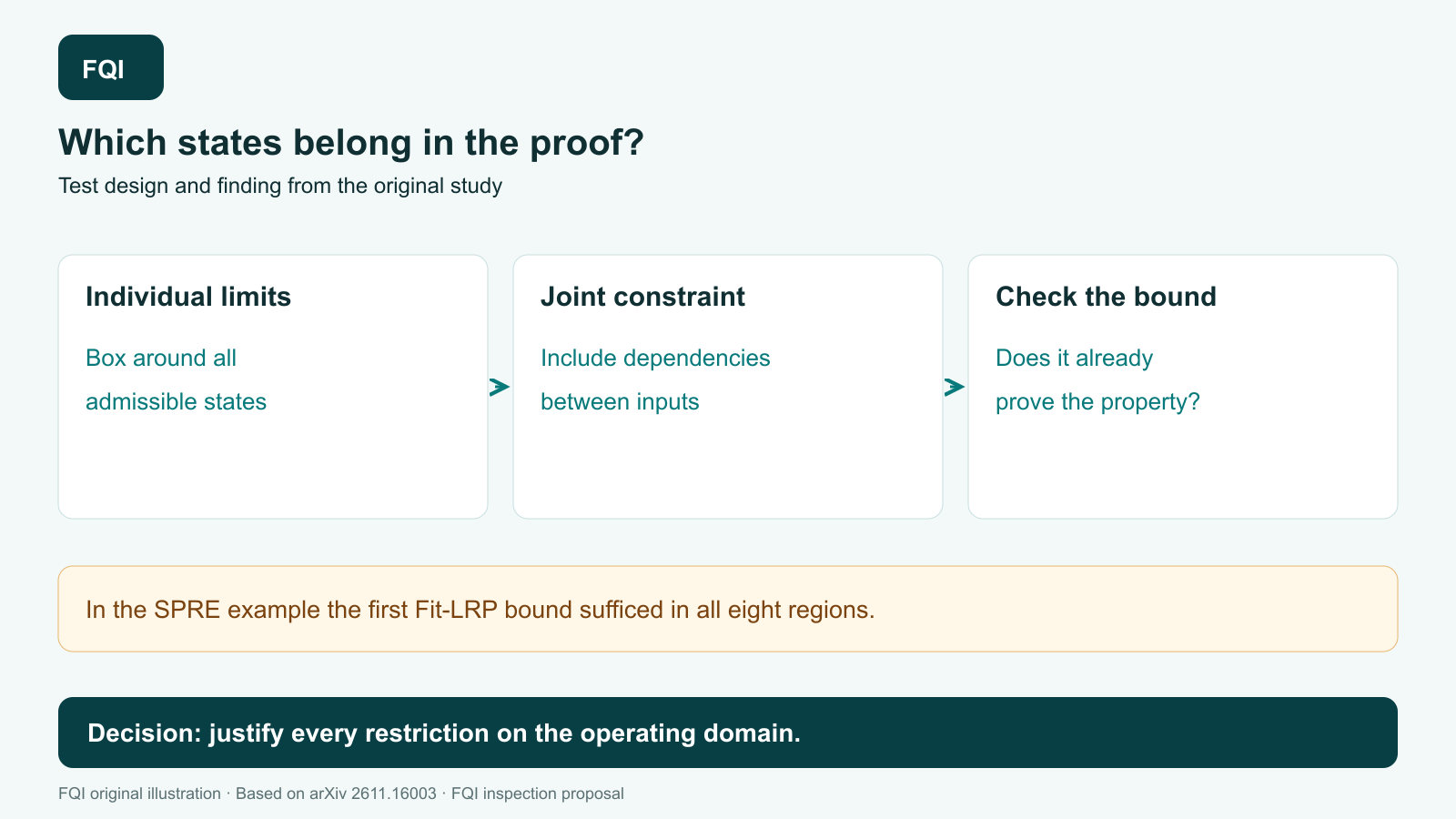
Consider two quantities with a limit on their sum. Each quantity also has an individual maximum. A rectangle spanning the individual ranges includes the corner where both reach their maximum at once. If their sum there exceeds the allowed value, that corner is outside the operating region. A verifier working over the whole rectangle nevertheless has to account for it.
A verifier can enclose the behaviour of a neural network between simpler upper and lower bounds. When a bound already proves the property, that region needs no further work. Otherwise the verifier can divide the region and repeat the calculation. Including impossible combinations may thus increase the number of open subproblems even though the model and the required property have stayed the same.
Deep dive
Fit-LRP optimises a linear bound subject to the actual linear constraints of an input region. Several regions together can represent a set with an indentation or disconnected components. The exact part here is the optimisation of the derived linear bound over the specified shape. The bound still approximates the behaviour of the nonlinear network.
Section 4 compares methods that apply the same rule when selecting a direction for a new split. On the SPRE example in Table 1, Fit-LRP certifies all eight regions with the first bound. For four regions with slanted edges, the enclosing box initially yields a positive bound of 23.1. Optimising over the actual region gives a negative bound of −0.82. Because the relevant limit is zero, the sign change resolves that part of the proof without further subdivision.
In an industrial assessment, trace every constraint to its source. A relationship might follow from a physical coupling, a guaranteed interlock or merely the combinations seen in historical data. Excluding states from a proof requires support for the restriction. Once the domain is justified, the team can measure whether solving the extra optimisation problems saves work on the regions that dominate its verification run.
Limitations and risks
The benchmarks use selected verification problems and specific implementations. Computing a tighter bound itself takes time, and fewer branches do not promise a speed-up on every computer or network. The result also depends on whether the stated domain includes the entire region the application must cover. A proof for an inadvertently narrowed domain leaves the omitted operating conditions unresolved.
FQI conclusion
Record the allowed states in terms that the process owner and the verification specialist can both check. If a proof is expensive, compare the cost attributable to the network with the extra work caused by a coarse enclosure. A useful acceptance record preserves the original property, the justified domain and the measured cost of proving it.
Sources & transparency
The study is an author preprint. The proposed operational checks are FQI interpretations. Fit-LRP: Fitting Linear Relaxations to Polytopes for Neural Network Verification over Non-Convex Regions · Version record
Codex assisted with drafting and checked the claims against the cited original sources. Johann Fischer authorized publication on 2026-11-15.