
Executive summary
A photograph can be dark overall and still have a small overexposed region. NightIQA examines whether a model can identify a distortion, locate it and assess its nature. That distinction matters when someone will use the answer to change the lighting, focus or position for another exposure. An accurate description of the overall scene may still direct the operator to the wrong part of the image.
FQI takeaway
- Evaluate global and object-specific distortions separately.
- Keep photographs of the same scene together when splitting data.
- Require an identifiable region and an expert reference for the judgement.
The principle at a glance
A model can supply the right error category while focusing on the wrong place. A moving person blurred against a sharp background calls for a different response from a camera that has focused the entire scene incorrectly. This illustrates a decision at an inspection station. Determining the physical cause can require additional capture information or a controlled repeat exposure.
Deep dive
The researchers captured 1,769 real night images. Their benchmark contains 1,078 visually grounded multiple-choice questions on four levels, spanning perception, technical assessment, localisation and testing possible explanations for the location and appearance of an observed distortion. They grouped similar scenes, split the groups as units and manually checked boundary cases. Otherwise a second view of a familiar scene might appear in the test after a related view had already appeared during training.
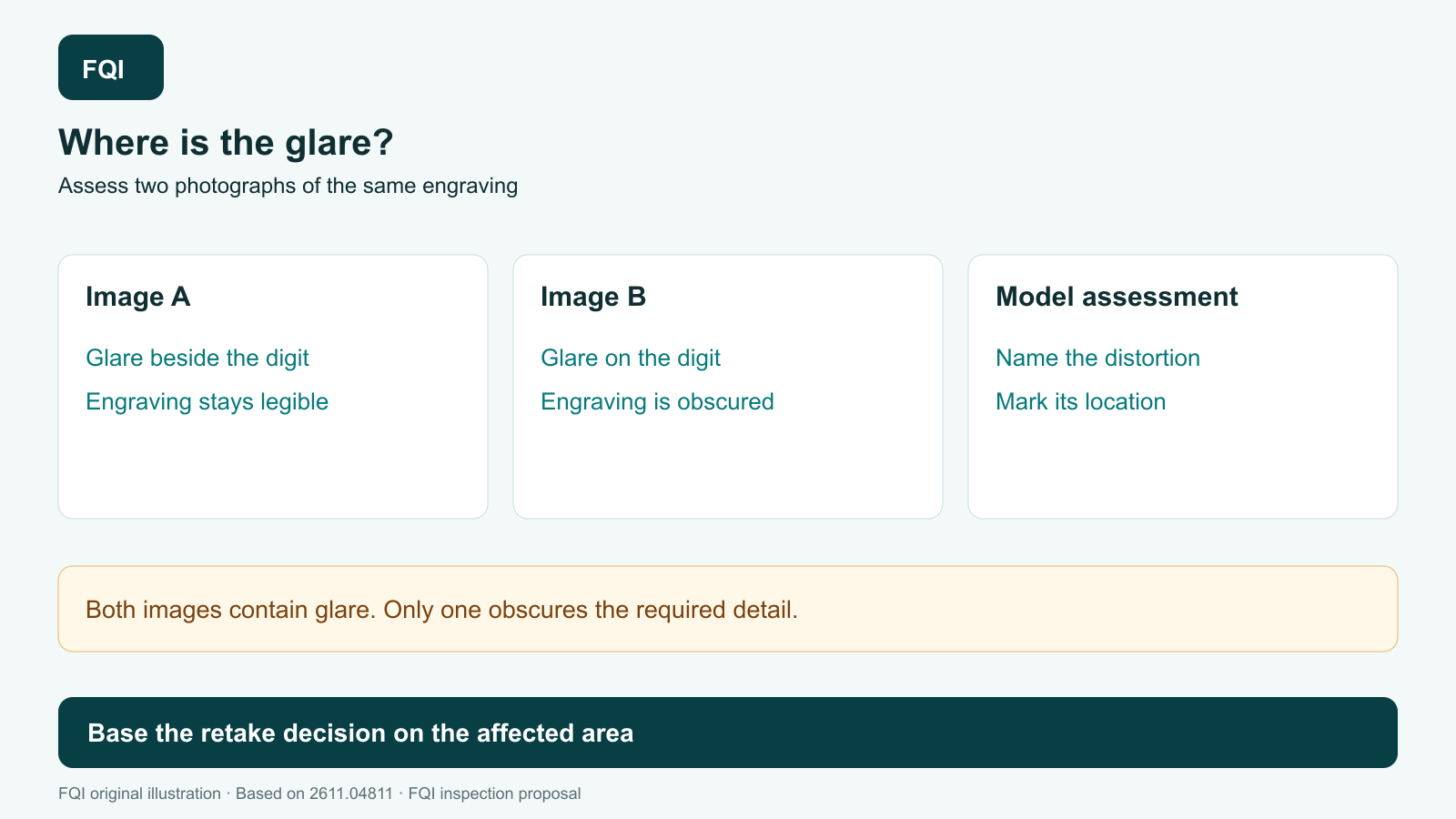
The researchers also generate synthetic distortions affecting either the whole image or a particular object. For a local inspection station FQI suggests combining both levels with real exposures. An inspector might mark the region where an engraving must remain legible. The team varies the lighting there while checking whether the background remains readable. A correct reference to overexposure earns credit for the distortion type. Pointing to the background earns no credit for locating the affected digit.
A useful pair shows the same engraving twice. In one shot the glare lies outside the critical area. In the other it obscures a digit. Rejecting both pictures detects glare but discards a usable image. Accepting both loses the unreadable digit. Specify beforehand which reflections are tolerable and who adjudicates uncertain cases. This can distinguish an error in the model’s judgement from an instruction that did not define the relevant region clearly enough.
Limitations and risks
The research studies night photography. Its results do not establish an industrial defect detection rate. A plausible answer to a multiple-choice question cannot establish a physical cause. Distinguishing reflection, subject movement and machinery vibration can require repeated captures or additional sensors. A synthetic change tests the response to the alteration actually introduced.
FQI conclusion
For each difficult image, document whether the model found the location, what kind of distortion it reported and whether the proposed retake restored readability. This separates the parts of the answer an operator can rely on. A single quality score provides little guidance about which intervention to try or when a specialist should examine the image before making the decision.
Sources & transparency
The reported methods and results come from the linked preprint. FQI did not independently reproduce the experiment. Operational examples and proposed checks are FQI interpretations. Sources reviewed on 4 November 2026. Artificial intelligence assisted preparation. Johann Fischer explicitly approved this article package for publication on 2026-11-04.