
Executive summary
A recent study on automated fibre placement connects three tasks that are often separated: a vision-language model locates defects in depth maps, a knowledge graph supplies process evidence, and a person confirms the diagnosis and response. The most important result for quality management is not the artificial intelligence (AI) model itself but the auditable evidence chain. Fully supported diagnostic claims increased from 70.6% to 80.4% in the experiment. That is meaningful progress, but it is not a basis for automatic release.
FQI takeaway
- Localisation and diagnosis need separate evidence: A correctly marked defect does not prove that the proposed cause is right.
- Structured knowledge improves auditability: Source identifiers and permitted relationships make individual claims easier to check.
- Human review remains a real decision: With 80.4% fully supported claims, it cannot become a routine confirmation step.
The principle at a glance
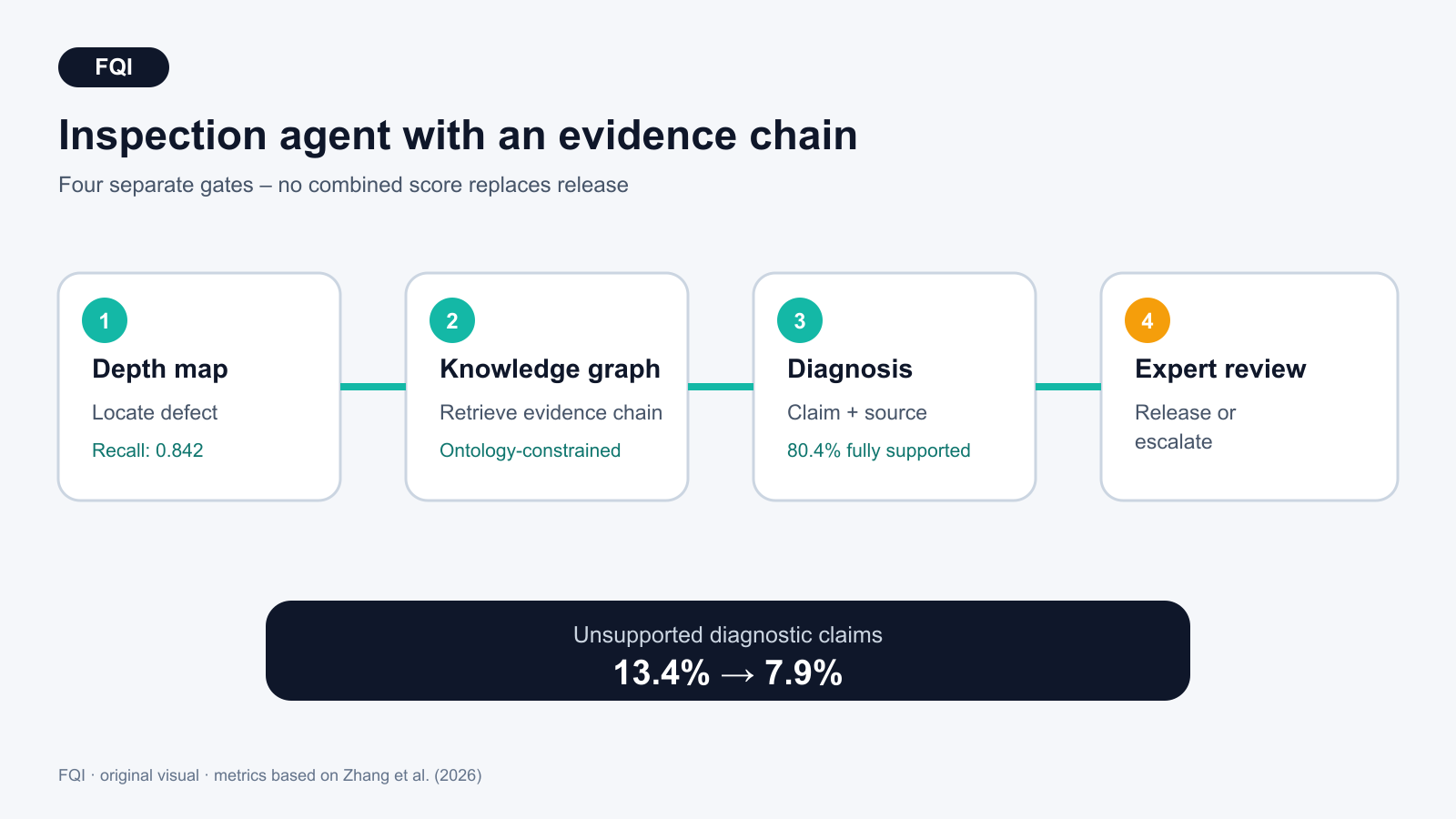
The authors studied automated fibre placement, a process that lays narrow fibre tows into large composite components. Gaps, overlaps and wrinkles need to be identified early. Their system uses a Vision-Language Model (VLM), which combines image and language processing, to evaluate depth maps. It then retrieves process relationships and sources from a knowledge graph. Operators review the marked location, cited evidence and proposed diagnosis.
Terms explained
- VLM: An AI model that processes visual information and language together.
- AI: Artificial intelligence; systems that infer patterns from data or automate tasks.
- RAG: Retrieval-Augmented Generation; external information is retrieved before a model produces an answer.
- Ontology: A defined model of specialist concepts and the relationships permitted between them.
- MSA: Measurement System Analysis; evidence that an inspection process is suitable for its intended decision.
Deep dive
The study uses 1,403 production depth maps. With only 40 labelled images, the system achieved class-agnostic recall of 0.842 for defect localisation. Recall describes the proportion of existing defects that were found. It does not show how many false alarms occurred or whether every defect class performed equally well. An inspection decision therefore needs separate measures for detection, false acceptance and false rejection.
The second part is especially relevant to FQI. After localisation, the agent is not supposed to speculate freely about causes. An ontology constrains valid relationships among process, material, equipment and defect concepts. The knowledge graph retrieves evidence chains with source identifiers. Compared with conventional RAG over text chunks, fully supported diagnostic claims rose from 70.6% to 80.4%. Unsupported claims fell from 13.4% to 7.9%, while citation precision increased from 84.6% to 91.4%.
These metrics distinguish three quality characteristics. The defect must be located correctly, the diagnosis must fit the observation, and every central statement requires evidence that can be checked. A single combined score would conceal those failure modes. Each stage should therefore have its own gate in the industrial Control Plan, the documented production inspection and response plan.
Practical validation starts with qualified depth maps and boundary samples. An attribute MSA should then cover different components, equipment conditions and rare defect types. The diagnostic layer needs tests showing that a source actually supports the claimed relationship and that obsolete process rules are detected. Only after those checks should a suggestion enter a response plan. Hold, rework and parameter changes remain tied to defined roles and release limits.
Limitations and risks
The results come from one automated fibre-placement dataset. Forty labelled images are attractive from a cost perspective, but they do not automatically represent material changes, new geometries or equipment ageing. The diagnostic evaluation contains only 50 multi-turn cases. Even 80.4% fully supported claims leave a relevant share without complete support. A knowledge graph can also reproduce obsolete or incomplete rules with great consistency. Finally, accurate citation means that the reference matches the statement; it does not prove that the source is strong enough for a release decision.
FQI conclusion
The paper points towards a sound architecture for AI-assisted inspection: measurement evidence first, technically constrained interpretation second, and a visible evidence chain before action. The agent becomes a traceable support system rather than an autonomous quality decision-maker. Quality teams should translate model metrics into separate process measures and give human reviewers the defect image, supporting sources and explicit escalation rules needed for a genuine decision.
Sources & transparency
- Zhang et al.: A two-stage post-trained, knowledge-enhanced multimodal agent for intelligent defect perception in automated fiber placement, Computers in Industry, volume 180, article 104523, DOI 10.1016/j.compind.2026.104523.
- Evidence status: The original journal page provides the abstract, core metrics, a method overview and parts of the evaluation. The issue is listed for November 2026.
- FQI transfer: Applying the findings to MSA, separate quality gates, Control Plans and role-based release is an editorial interpretation by FQI.
- This article was researched and prepared with AI support. Sources, figures, translation and FQI analysis were reviewed and approved for publication by Johann Fischer on 21 August 2026.