
Executive summary
Three language models extract hazard statements from documents. A voting rule combines their answers. The reliability of the result depends on which documents cause several models to fail together and on the reliability of the voting rule itself. In a chemical hazard extraction study the majority protected against the weakest model. The results gave no clear advantage for the majority over the best single model.
FQI takeaway
- Compare the voting system with the best individual model.
- Test single-statement and multi-statement documents separately and weight them for the intended use.
- Examine common failures and faults in the voting stage explicitly.
The principle at a glance
The authors distinguish documents containing one hazard statement from documents containing several. The task requires a complete set of codes. One model might omit a code while another returns an empty list. Both have failed on the same input despite producing different answers. Knowing only each model’s average success rate leaves open how often these errors coincide and what a combined decision would do with them.
Deep dive
In the multi-statement trials one model missed none of its cases, the second failed on seven of 69 runs, and the third on thirty of 70. None failed on single-statement documents. Even there, the estimated ranges for future failure differed. The estimates incorporate both the limited observations and assumptions about the relationship between the document groups.
The authors propagate the individual ranges through a description of the system’s failure logic. They vary both exposure to common causes and the chance that the voter itself fails. At an assumed voter failure probability of five percent, the lower failure bound for the redundant configuration reaches the corresponding bound for the middle model. Five percent was a scenario used to test sensitivity. It was not an observed rate of software failure.
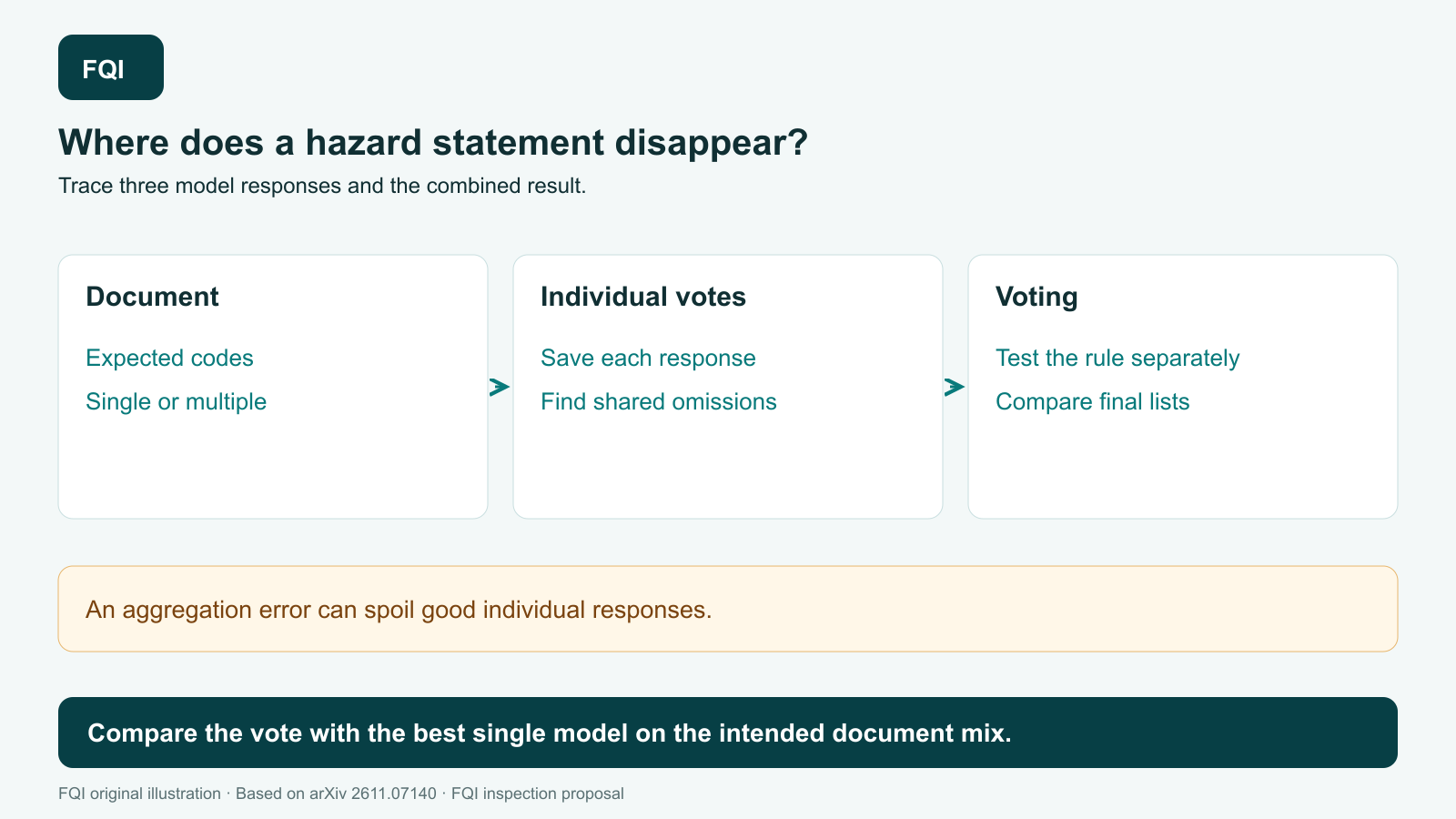
For a local trial FQI proposes retaining each model’s output, the combined result and the expected list. An investigator can see whether two systems missed the same code or whether the voter lost a code that the models supplied. Additional examples of difficult documents address the first problem. Feeding known votes into the aggregation software tests the second.
A simplified test can supply three votes without running any language model. One vote lists both expected codes, another lists only the first, and the third lists only the second. Define in advance whether votes are counted for each code or for entire lists. Two teams can reasonably mean different things by a majority and produce different lists from identical inputs.
Limitations and risks
The comparison of calculated and measured ranges uses the same runs. Independent future documents would be needed to test prediction. The operational mix may also change. A growing share of multi-statement documents gives more weight to exactly the cases in which the models differed in this study.
FQI conclusion
Choose majority voting when the additional work has an evidenced benefit under the anticipated mix of documents. Put the single models, the voter and the remaining shared failures in one report. The uncertainty range can also guide the next round of testing by showing which document group most needs further reference cases.
Sources & transparency
The methods, figures and limitations come from the authors’ publicly accessible paper. The proposed workplace test and simplified example are FQI interpretations. Study record. Original study.
Guidance from the National Institute of Standards and Technology (NIST) offers a framework for planning evaluation in the intended context of use. The numerical results in this brief come from the study. NIST evaluation guidance.
Artificial intelligence assisted preparation. Johann Fischer approved this article package for publication on 2026-11-06.