
Executive summary
An airport with few recorded examples of late flap deployment faces a different training decision from a site with many such cases. A study of 53,750 approach windows at three airports compared learning from local data with learning from pooled data. Local specialization helped at the two larger sites. The smallest site benefited from pooling. A decision about which model to use therefore needs evidence for each event at each airport.
FQI takeaway
- Report the number of labelled windows available for each airport and event.
- Test a continuous deviation measure alongside features derived from flight data.
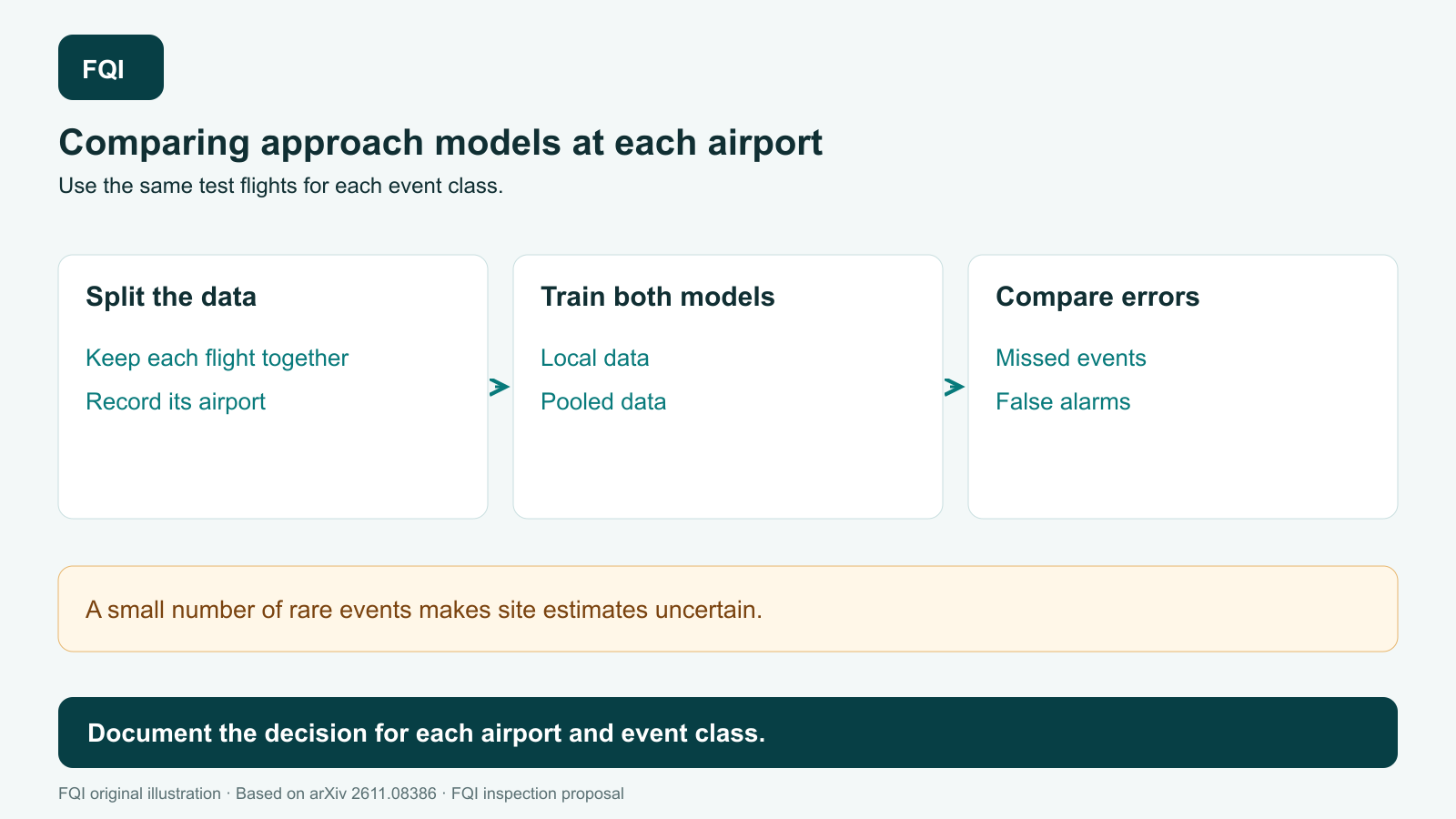
- Compare local and pooled models on the same held-out cases.
The principle at a glance
The researchers distinguish normal approaches from three events. An aircraft may be fast, high on its approach path, or late in reaching the intended flap setting. An isolated measurement can have several explanations. The system therefore uses time series as well as statistical features of individual flight parameters. Its first learning stage sees normal approach windows and tries to reconstruct the observed signals. The difference between the reconstruction and the observation measures how poorly a window fits the learned pattern.
Deep dive
A classifier made up of decision trees combines that measure with other features. It gives rare classes greater weight during training. The study compares this arrangement with using reconstruction error alone and with applying a hard threshold before further processing. Keeping the deviation as a continuous value allows the second stage to weigh a modest departure alongside speed, vertical position or aircraft configuration. In these experiments the combination performed better than either simpler alternative.
The researchers trained the processing chain repeatedly on different partitions. At each airport, the mean recall averaged across classes exceeded 0.90 under repeated training. Recall is the share of labelled events a system recognizes. Giving each class equal weight answers a different question from counting correct decisions across all windows, a figure easily dominated by normal approaches.
FQI proposes a local acceptance table with one row per airport and event. Record the number of examples, detections, misses and confusions with other classes. A good site average can otherwise conceal weak evidence for a rare event. Evaluate both candidates on those same cases to see where specialization helps.
In a simplified example, a local model finds additional fast approaches but also classifies more normal windows as late flap deployment. Both lists matter. Inspect the time series and count distinct flights to see whether an apparent gain comes from several flights or many windows from a single unusual approach.
Limitations and risks
Three airports cover only a limited range of procedures, aircraft configurations and operating conditions. The task assigns labels to approach windows. It establishes neither a guaranteed warning time nor a reduction in incidents. An operational alert trial would also need to measure when an alert appeared and how many unnecessary alarms occurred per flight. Keep windows from the same flight together when separating training and evaluation in that trial.
FQI conclusion
Document the choice at each site. Where rare events have barely been observed, pooled training merits a direct comparison. A switch to a local model becomes defensible if the gain for the relevant events persists on later flights and the additional alarm burden remains acceptable.
Sources & transparency
The methods, figures and limitations come from the authors’ publicly accessible paper. The proposed workplace test and simplified example are FQI interpretations. Study record. Original study.
Guidance from the National Institute of Standards and Technology (NIST) offers a framework for planning evaluation in the intended context of use. The numerical results in this brief come from the study. NIST evaluation guidance.
Artificial intelligence assisted preparation. Johann Fischer approved this article package for publication on 2026-11-06.