
Executive summary
An unusual training method can be worth investigating even if a simpler alternative performs just as well in the intended application. A bearing-monitoring study examines an anomaly detector designed to process vibrations with limited computing resources. It applies simulated quantum methods to two training steps. The revealing comparison for a quality team is a conventionally trained model with rounded weights. It achieves a comparable result in the reported comparison. Timing the detector on the intended device remains a separate task.
FQI takeaway
- Assess feature selection and training separately from the cost of one prediction.
- Evaluate the same vibration windows with a conventionally trained reference model with rounded weights.
- Measure the runtime of the complete signal-processing chain on the target device.
The principle at a glance
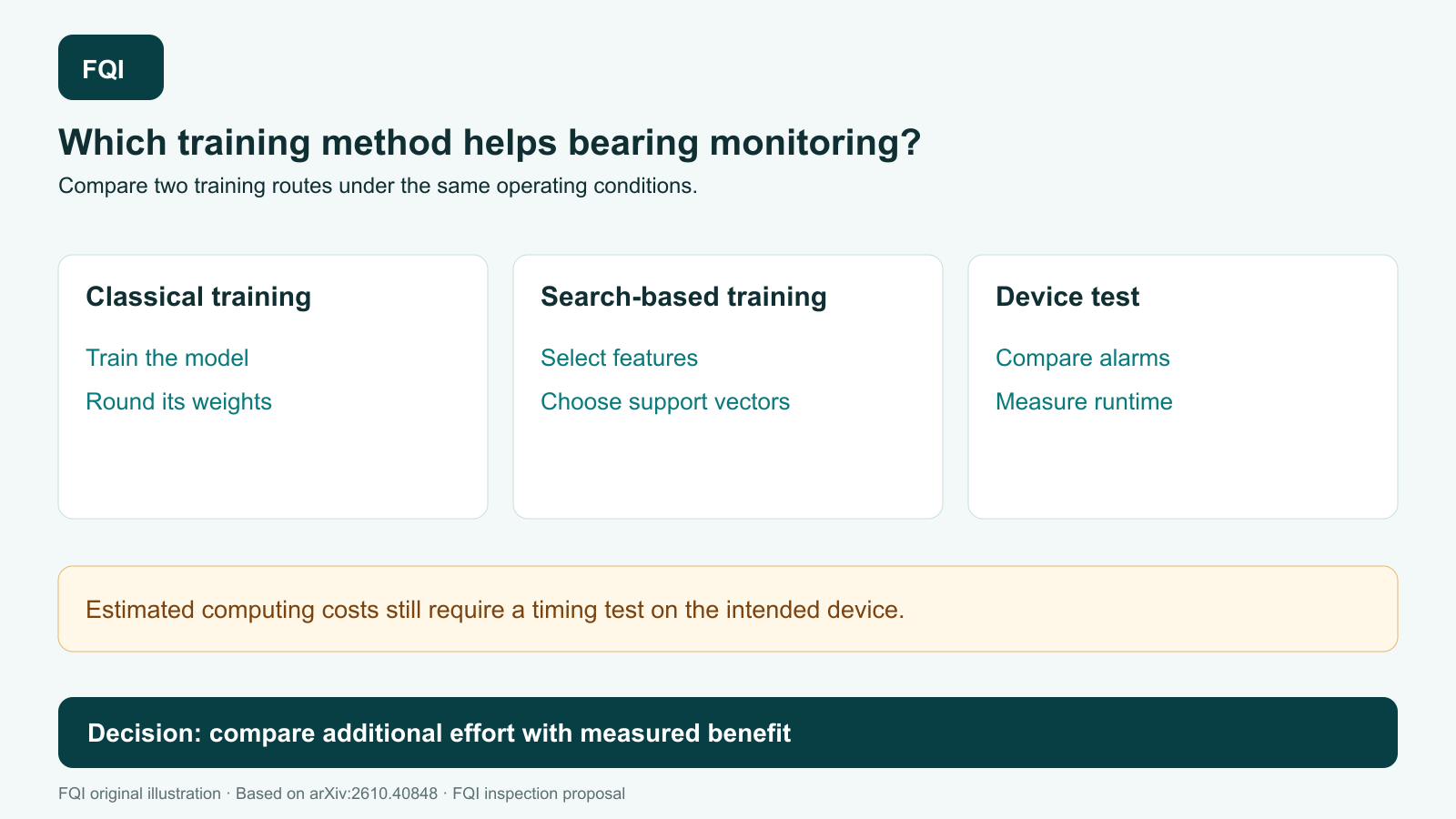
A bearing produces vibrations during operation. From a short time window, a detector can calculate features that indicate departures from normal operation. A one-class support vector machine learns which observations are typical and subsequently flags deviations. The time needed for a decision also depends on calculating the input features. An inexpensive classifier alone does not make signal preparation inexpensive.
The study intervenes at two points during training. One optimizer searches for suitable features under a computing budget. Another chooses examples to support the detector. The resulting model is intended to operate on a small device without floating-point operations. The expensive search takes place before deployment.
Deep dive
The study uses bearing data from Paderborn University. In the feature-selection experiment, a variant using the Adam optimizer found the optimal subset in 36% of the tested runs. This is the success rate of a search procedure in a small simulated problem. It measures neither the detection rate for damaged bearings nor the time saved on the device.
When selecting support examples, the method initially performed better than random selection. A classical local search eliminated that difference. The classical reference trained a conventional model and rounded its weights. It reached a comparable result without that search. A plant trial can use this reference to weigh the extra optimization effort against a readily available alternative.
FQI proposes a second experiment on the intended hardware. Feed a fixed set of vibration windows through both variants. For each window, record the time from receipt of the complete signal to the decision, the memory requirement and the result. Where the judgments differ, check the known bearing condition. For the maintenance team, the important question is whether a missed deadline or an additional alarm changes its response.
Limitations and risks
The study simulates small optimization problems. Its computing costs come from an analytical model partly informed by published library timings. A timing series on the actual microcontroller is still needed. Petrobras supported the project. Independent guidance from the National Institute of Standards and Technology (NIST) supports documenting measurement conditions and comparison methods. It does not confirm the bearing study’s performance figures.
FQI conclusion
Before choosing a training method, the plant should identify its operating constraint. If processing time is scarce, measure the complete chain, including feature computation. If alarm reliability is the issue, use independent test cases and examine the consequences of false alarms. The more demanding search warrants further investigation at the site when it can demonstrably improve one of these constraints under the same conditions as the simpler alternative.
Sources & transparency
Feature selection, classical reference model, cost model and bearing damage results.
- Predictive Maintenance at the Edge: An Embedded Anomaly Detection Pipeline Trained with Quantum Optimization
- Original full text
- NIST AI RMF Playbook, MEASURE 2.1
Operational examples and inspection proposals are FQI interpretations. The source study has not been independently replicated by FQI.
Artificial intelligence assisted preparation. Johann Fischer approved this article package for publication on 2026-11-06.