
Executive summary
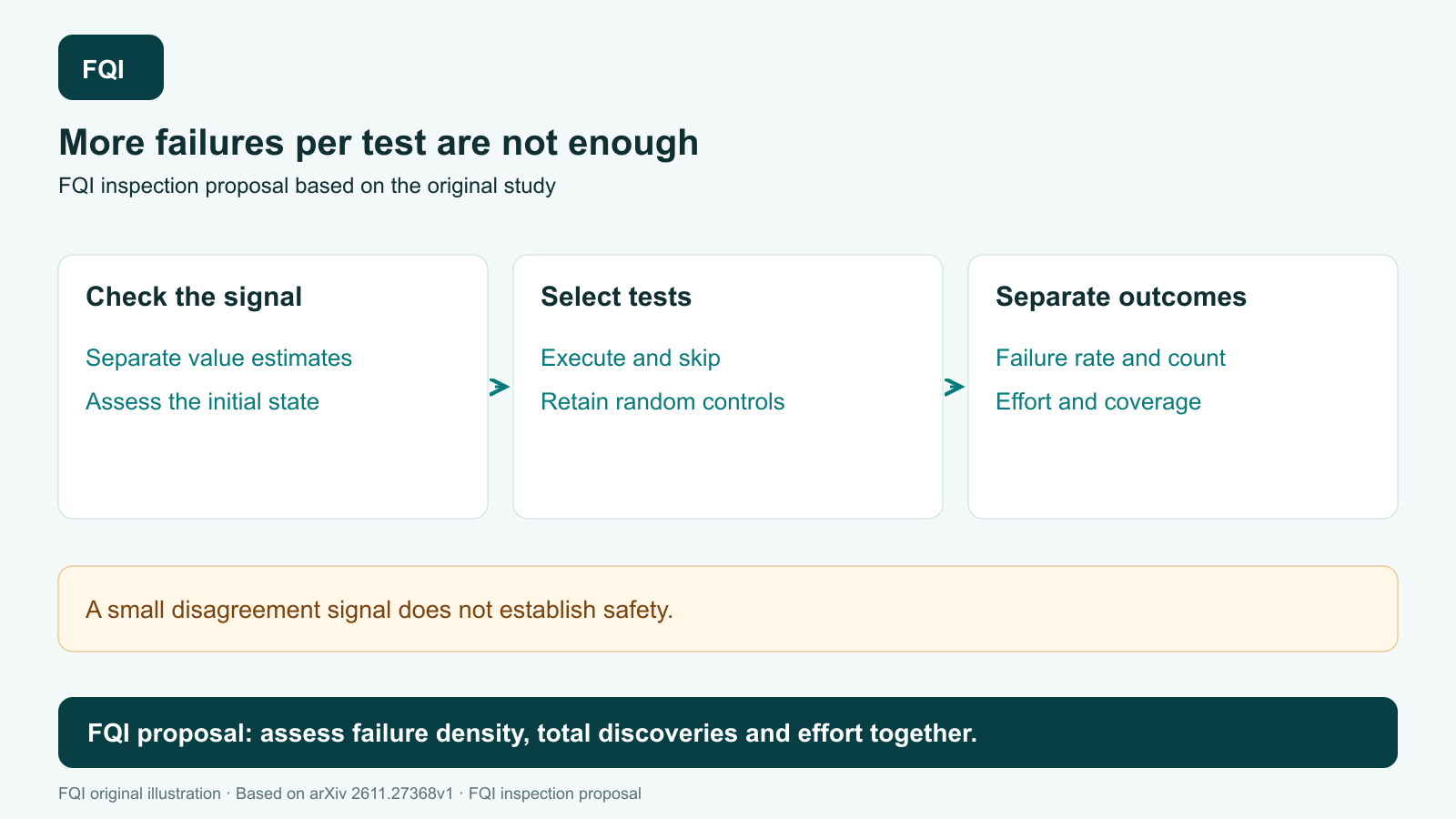
Cooperating artificial intelligence (AI) agents may value the same starting situation differently despite pursuing a common objective. DisQ uses this disagreement to select promising failure tests. The study evaluates value-based learning agents in four simulated environments. It increases failure density in several configurations but also exposes boundaries and counterexamples. FQI should assess selection effects, absolute failure discoveries and effort separately. A higher proportion of failing executions is not, by itself, evidence of broader failure coverage or greater safety.
FQI takeaway
- Confirm that independent per-agent action-value estimates are available.
- Report selected, skipped and executed cases separately.
- Retain random tests for failures without an initial disagreement signal.
The principle at a glance
In reinforcement learning, agents learn actions through rewards. Value-based methods estimate the future return associated with actions. DisQ compares those estimates across cooperating agents in a shared starting situation.
A large gap may indicate poor coordination. The method uses that signal before running a complete episode. It is a selection heuristic, not a confirmed failure. Execution and a predefined failure criterion are still required to establish what happened.
Deep dive
The study uses four environments, including landmark coverage and a task with a speaker and a navigating listener. Random and search-based tests are compared with and without DisQ. A short calibration phase determines a selection threshold from observed gaps.
The main experiments are repeated 25 times. Results report rewards, failure counts, executed cases and failure rates. This separation matters because DisQ skips many initial states. In one centralised speaker–listener configuration, random testing finds 1,250 failures in 25,000 executions, or 5%. Random testing with DisQ finds 385 failures in 3,535 executions, approximately 10.9%. Failure density increases while the absolute number of discoveries decreases.
The relevant budget must therefore be explicit. If complete simulations are expensive, selection may be worthwhile. If the objective is to discover diverse failure behaviour, proportions alone are insufficient. State inspection, calibration and skipped cases also consume resources. Considering those costs is an FQI application of the paper’s selection mechanism.
Improvements are not universal. Some failures emerge later and do not produce a detectable gap at the initial state. Others never carry the signal. Exclusive use of initial-state selection may systematically exclude those cases. A small gap must not be interpreted as a safety certificate.
An operational pilot would begin with a controlled simulation containing known coordination problems. Both methods receive the same admissible starting states and a predefined budget. The report should include execution time, distinct failure types and failures per executed test. A random control sample helps determine whether the selection rule misses part of the failure spectrum.
Calibration should also follow the tested agent version. Retraining, changing rewards or adding participants can alter what a given gap means. FQI would treat those changes as reasons to reassess the signal. This is a proposed acceptance practice rather than a demonstrated industrial deployment of DisQ.
Limitations and risks
DisQ requires accessible, independent action-value estimates for each agent. It does not directly apply to arbitrary language-model agents or to probabilities of actions. Shared critics do not necessarily expose the required disagreement. The experiments are simulated, and a reward-based failure criterion is not a general proof of operational safety. Resource comparisons must also distinguish proposed test budgets from the smaller numbers actually executed after filtering.
FQI conclusion
DisQ offers a precise approach to targeted coordination testing when the necessary model signals exist. Its value depends on the inspection objective and the available estimates. Greater failure density may use expensive executions efficiently while still discovering fewer failures overall. Both facts belong in the acceptance report. An unselected control sample helps prevent the chosen heuristic from being mistaken for complete coverage of the system’s failure modes.
Sources & transparency
- Testing for Coordination Failures in Cooperative Multi-Agent Reinforcement Learning
- Testing for Coordination Failures in Cooperative Multi-Agent Reinforcement Learning
Codex assisted with drafting and checked the claims against the cited original study. Results were not independently reproduced. Operational recommendations and simplified examples are FQI interpretations.
Codex assisted with drafting and checked the claims against the cited original sources. Johann Fischer authorized publication on 2026-11-23 following review by Codex. Individual human reading is not claimed.