
Executive summary
A smaller AI (artificial intelligence) model may need less storage while taking longer to compute on particular hardware. A machinery fault-detection study compares compression methods across nine platforms and demonstrates this dependence. Selecting a compact file therefore does not establish that the complete system is suitable.
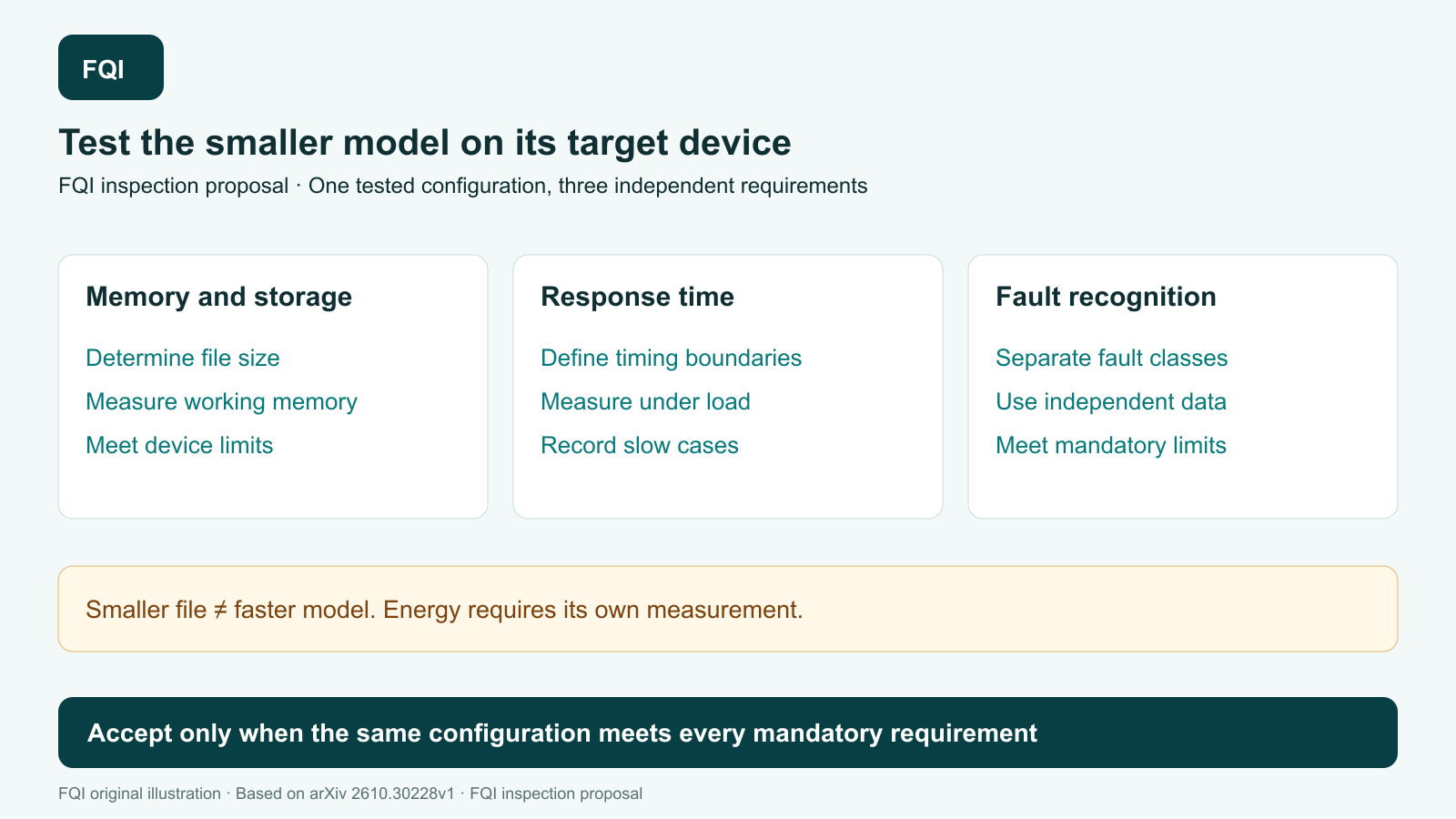
Storage, response time and fault recognition need separate evidence on the intended configuration. FQI derives an inspection plan that evaluates technical savings alongside the operational requirements, rather than allowing one improvement to conceal another failure.
FQI takeaway
- Define storage limits, permitted response time and fault-class requirements before comparing models.
- Measure every candidate on its intended hardware and runtime software.
- Measure energy consumption directly; shorter computation time alone is not evidence of energy savings.
The principle at a glance
The neural networks studied classify vibration signals into machine conditions. Compression can change numerical representation or model structure. Quantization stores numbers at fewer levels. Knowledge distillation instead trains a smaller model with guidance from a larger one, changing the learning process as well.
In a simplified FQI example, a compact diagnostic model must run on an existing controller. Its file fits the available storage. However, it may miss the alarm deadline if the hardware performs its operations inefficiently. File size cannot answer that second question.
Terms explained
- Quantization: A coarser representation of model numbers intended to reduce storage requirements.
- Knowledge distillation: Training a smaller model with additional learning signals from a larger model.
- Target configuration: The model, hardware, software and data processing combination evaluated together.
Deep dive
The paper investigates four compression approaches for machinery fault classification. Mean runtime depends strongly on platform and method. For example, dynamic quantization increases runtime on one high-performance processor from 7.34 to 12.44 milliseconds, while accelerating it on other platforms. A smaller network trained through distillation runs particularly quickly in the comparison.
These findings motivate measurement, but do not establish a generally best method. Distillation combines a smaller architecture with renewed training. Its comparison therefore does not isolate a change in numerical representation. The study explicitly excludes direct measurements of energy consumption.
An FQI pilot should first define the relevant diagnostic errors. Missing bearing damage may carry a different consequence from an extra alarm during normal operation. The team specifies the permitted change against the existing solution for each important fault class. A good overall average must not compensate for a critical class becoming worse.
Create a trial matrix in which every row links a model to a device and software configuration. Record file size, actual memory use, response times and incorrect domain decisions. Define the measurement boundary: model computation alone and the complete journey from sensor signal to usable alarm are different quantities.
FQI recommends repeated timing measurements under intended operating conditions, including competing tasks, startup behavior and a predefined treatment of occasional delays. A mean alone does not show whether rare slow responses exceed the operational time budget. These additional checks are FQI recommendations, not operational results demonstrated by the paper.
Evaluate diagnostic quality separately with reference data. If long recordings are split into short windows, separate training and testing by original recording and suitable operating groups. Otherwise very similar segments can occur in both sets. Document this independence before interpreting high recognition scores.
Select a candidate only when fault recognition and technical operating requirements are met together. Savings in one measure cannot compensate for a violated mandatory requirement elsewhere. Changes to the device or runtime software reopen the affected checks.
Limitations and risks
The study uses a laboratory machinery dataset and a limited set of fault classes. The independence of original recordings after windowing is not sufficiently traceable in the reviewed text. Classification scores are therefore not used here as proof of industrial generalization.
Devices, software versions and architecture also limit the transferability of runtime results. The FQI plan requires local measurements; no independent reproduction was performed.
FQI conclusion
The useful question is which configuration delivers the required diagnosis reliably and in time on the intended device. Storage is a necessary but insufficient measure. A small pilot with separate requirements and consistent measurement boundaries helps prevent premature purchasing or release decisions.
Cases in which compression slows computation or worsens particular fault classes are especially informative. Only the combined result supports a defensible selection for the intended use, and that selection remains bound to the tested configuration.
Sources & transparency
- Oliveira et al.: Benchmarking Model Compression Techniques Across Heterogeneous Edge Platforms; version 1, methods 2.1–2.5, tables 2–3, discussion and conclusion.
Preliminary research; no independent reproduction. The trial matrix, acceptance boundaries and controller example are FQI interpretation. AI-assisted article, approved for publication by Johann Fischer on 2026-10-24.