
Executive summary
Artificial intelligence (AI) reliability depends on who uses a service and for which tasks. A perspective by Xingyu Zhao distinguishes finding faults from estimating how often failures will occur in future use. These purposes require different test samples. For quality management, a reliability claim should identify its user population, task, failure definition, system version and uncertainty. The paper presents a research roadmap and a hypothetical example. It does not demonstrate a fully validated acceptance procedure.
FQI takeaway
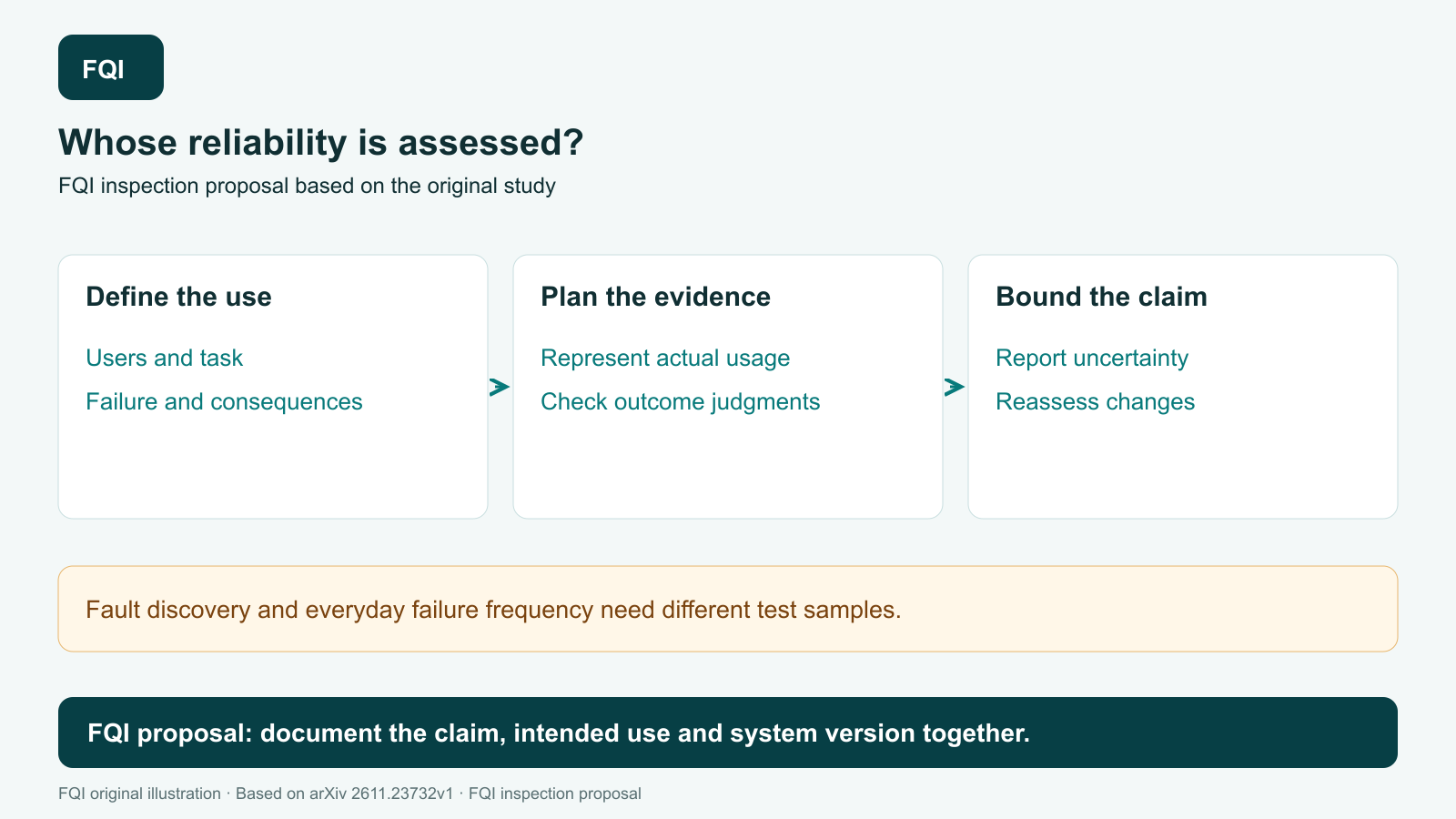
- Plan fault discovery and representative acceptance testing with separate test sets.
- Define usage frequencies, failure consequences and the unit of assessment before analysis.
- Bind each claim to the service version, assessment method and validity conditions.
The principle at a glance
A public benchmark measures performance on selected tasks. An organization needs to know how often its particular assistant fails under specified conditions. The questions are related, but their populations differ.
An operational profile describes the tasks and variations that actually occur. Languages, conversation histories, retrieved documents and user groups can all matter. Two differently worded requests may represent the same task while producing different responses. The paper therefore also considers the distribution of valid variations within a task.
Deep dive
The paper organizes assessment around ten modelling considerations. These begin with the claim, the statistical unit and the meaning of failure. They also cover the reliability of outcome judgments, dependence between observations, the operational profile and statistical uncertainty. Finally, a claim needs validity conditions and triggers for reassessment.
A complete conversation is a different unit from an individual response. Responses within one conversation are not automatically independent observations. Several customers may also rely on the same faulty document. A large response count can therefore suggest more certainty than the evidence supports.
A hypothetical customer-support example illustrates the distinction. An estimated probability of a severity-3-or-higher failure of 1.8 percent does not support acceptance when its one-sided 95 percent upper confidence bound is 2.9 percent and the requirement demands a bound below 2.5 percent. These are illustrative numbers, not measured product results. Failure to meet the acceptance rule also does not prove that the true probability exceeds the threshold.
FQI recommends translating the argument into a short assessment brief. Identify the intended users, complete task and relevant failure, including severity. Then define how cases will be sampled, how outcomes will be judged and how repeated or related observations will be handled. Calculate the metric only after these choices are explicit.
Consider a simplified FQI example: an assistant drafts complaint responses. A collection of unusually difficult complaints is useful for finding defects. Estimating the routine failure frequency additionally requires evidence about how often those complaints occur. Both collections remain useful, but they support different statements in the assessment report.
The proposed decision record should retain the service configuration and the assessment conditions. A later change to retrieval, instructions or the user population may affect the interpretation of an earlier result. The paper treats reassessment as part of a bounded claim rather than a permanent score attached to a model name.
Limitations and risks
The proposed framework has not been validated empirically as an integrated procedure. Automated judges can make systematic errors. Sparse observations for particular users, selective feedback and changing document collections also constrain estimation.
A low average failure probability does not establish safety or resistance to deliberate attacks. Agents that use tools, maintain memory and affect their environment would require additional system assumptions. The paper primarily addresses language-model services; extending the framework to complete agents remains further research.
FQI conclusion
The practical contribution is a more precise assessment claim. A model name and a strong average score are insufficient for an operational reliability statement. FQI recommends recording the intended use and the limits of the claim before acceptance testing. Changes to users, documents, instructions or judgment rules can then trigger traceable reassessment. This makes clear which decisions the evidence supports and where assumptions remain.
Sources & transparency
- Reliability is a user-specific property of large language models
- Reliability is a user-specific property of large language models
Codex assisted with drafting and checked the claims against the cited original study. Results were not independently reproduced. Operational recommendations and simplified examples are FQI interpretations.
On 2026-11-21, Johann Fischer authorized editorial approval following source and quality review by Codex. Approval relies on that review; individual human reading is not claimed.