
Executive summary
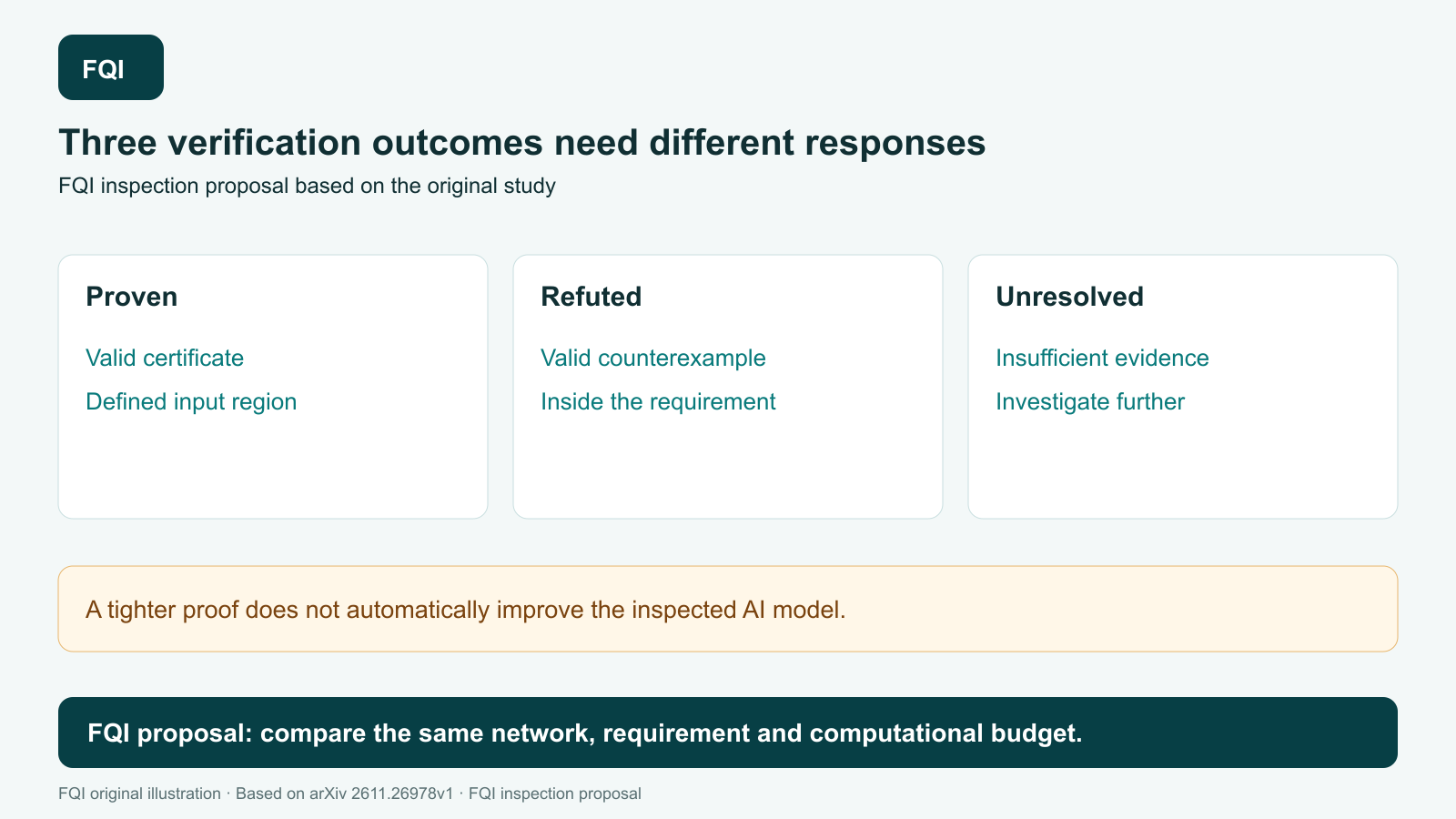
When a verification tool cannot prove the robustness of an artificial intelligence (AI) model, the model need not have a demonstrated fault. An overly loose mathematical approximation may prevent the proof. A new SDP-CROWN variant tightens these approximations for specified input perturbations, certifying more cases on unchanged image networks. FQI’s practical distinction is between a valid counterexample, a successful proof and an unresolved result. Those outcomes call for different actions before a team decides to retrain its model.
FQI takeaway
- Record “not certified” separately from “demonstrably faulty”.
- Compare verification methods on the same network, requirement and computational budget.
- Do not describe a higher certification rate as an improved trained model.
The principle at a glance
A neural network can assign an image to a class. Robustness verification asks whether that class remains unchanged for every input variation within a defined region. Individual trials may discover counterexamples. A proof must cover the entire specified region.
Many methods replace complicated intermediate network states with larger sets that are easier to calculate. This conservative approximation includes states the network cannot actually reach. If the enclosing set is too loose, a valid robustness proof may fail. The paper addresses this computational gap.
Terms explained
- Robustness certificate: evidence that a particular property holds throughout an explicitly defined input region.
- Euclidean perturbation: a bound on the square root of the sum of squared input changes.
- ReLU: a neural-network activation function that replaces negative values with zero and leaves positive values unchanged.
Deep dive
Affine-Image SDP-CROWN studies robustness to Euclidean-bounded perturbations. It more accurately represents the shape and orientation of intermediate sets transformed by network weights. Earlier approximations using independent intervals or axis-aligned shapes can greatly overestimate possible intermediate states. The new representation retains more of their joint geometry.
The authors combine this representation with optimised linear bounds. Sufficient, more tractable conditions and implementation on graphics processors keep computation manageable. The result remains a conservative bound under its mathematical assumptions, not a claim to decide every possible network and perturbation problem.
Experiments use image networks for the MNIST and CIFAR-10 datasets. In Table 1, the normally trained small MNIST network has a certified rate of 42 percent under original SDP-CROWN and 69 percent under the new method. With additional subdivision of the verification problem, the new variant reaches 86.5 percent. Reported average times are 8.39, 10.07 and 26.67 seconds respectively. These values concern the same listed network and perturbation radius, not newly trained classifiers.
The subdivision procedure is called branch-and-bound: it divides the verification domain into smaller problems and bounds their possible outcomes. Relevant comparison methods use a 150-second limit per instance. A fair report therefore includes the method, budget and undecided cases alongside its certification percentage.
FQI proposes a three-way result register. “Proven” requires a valid certificate. “Refuted” requires a valid counterexample inside the agreed perturbation region. “Unresolved” means neither direction has adequate evidence. The paper studies image classification; applying this register to acceptance of an AI inspection system is an editorial transfer.
An unresolved case may justify more computation, a tighter verifier or a model change. The substantive perturbation region must remain fixed. Shrinking it could increase certificates while testing a weaker requirement. Weights, preprocessing and numerical settings also need recording to preserve the identity of the test object.
A simplified example is visual pass/fail inspection with a defined image-noise allowance. A tighter verifier may resolve an open case without retraining. Whether Euclidean pixel noise represents real camera variation still needs independent justification from the measurement process.
Limitations and risks
The implementation supports ReLU networks only. Research images are not production validation, and bounded pixel changes do not automatically represent lighting changes, contamination or new defect types. Earlier approximation errors can persist through later layers. The reported experiments were not independently reproduced for this article.
FQI conclusion
A missing proof and a demonstrated failure require different responses. The study shows that the verification tool can materially affect the certified proportion. Teams should describe the unresolved evidence before concluding that the model is deficient. Keep the network, requirement and budget explicit. More proven cases then represent stronger evidence; any genuine improvement in the network’s operational performance must be established separately. A certificate remains bounded by its mathematical and application assumptions.
Sources & transparency
- Affine-Image Propagation for Tight and Scalable Neural Network Verification
- Affine-Image Propagation for Tight and Scalable Neural Network Verification
Codex assisted with drafting and checked the claims against the cited original study. Results were not independently reproduced. Operational recommendations and simplified examples are FQI interpretations.
Codex assisted with drafting and checked the claims against the cited original sources. Johann Fischer authorized publication on 2026-11-25 following review by Codex. Individual human reading is not claimed.