
Executive summary
Additional reference context can improve average AI (artificial intelligence) performance while making previously correct answers worse. An original study investigates this problem using explicit knowledge graphs and recurring local inconsistencies. It assesses bounded semantic domains before adding context selectively. The quality-management decision is concrete: a knowledge correction should demonstrate which errors it fixes and which correct answers it preserves. Agreement with the graph remains a controlled reference assessment, not proof of absolute truth.
FQI takeaway
- Trace failures to specific concepts and relationships in an approved reference.
- Compare targeted context with unchanged answers and indiscriminate augmentation.
- Count newly introduced errors separately from corrected ones.
The principle at a glance
A knowledge graph describes concepts and their relationships. It may state that a narrower concept belongs to a broader class. Several questions can then be derived whose answers should remain mutually compatible.
The study uses such question clusters to locate language-model inconsistencies. It assesses agreement within an explicitly bounded reference domain rather than arbitrary universal truth. Recurring local patterns help identify regions that deserve targeted follow-up.
Deep dive
The authors use 7,980 question clusters derived from the MITRE D3FEND cybersecurity ontology and eight Wikidata-derived domains. Six language models are compared. A small additional collection of manually written compositional questions supplements the main assessment.
The analysis associates vulnerable relationships with tree, star and cycle patterns. These local problem areas recur across models. The study examines whether problem areas found in other models predict failures in a held-out model, going beyond simply naming individual errors afterwards.
For correction, it investigates additional graph information. Indiscriminate augmentation can improve aggregate performance while introducing local regressions. A layered strategy supplies stronger structural information only where simpler assistance is insufficient. Evaluation considers both improvements in problematic answers and preservation of previously graph-consistent answers.
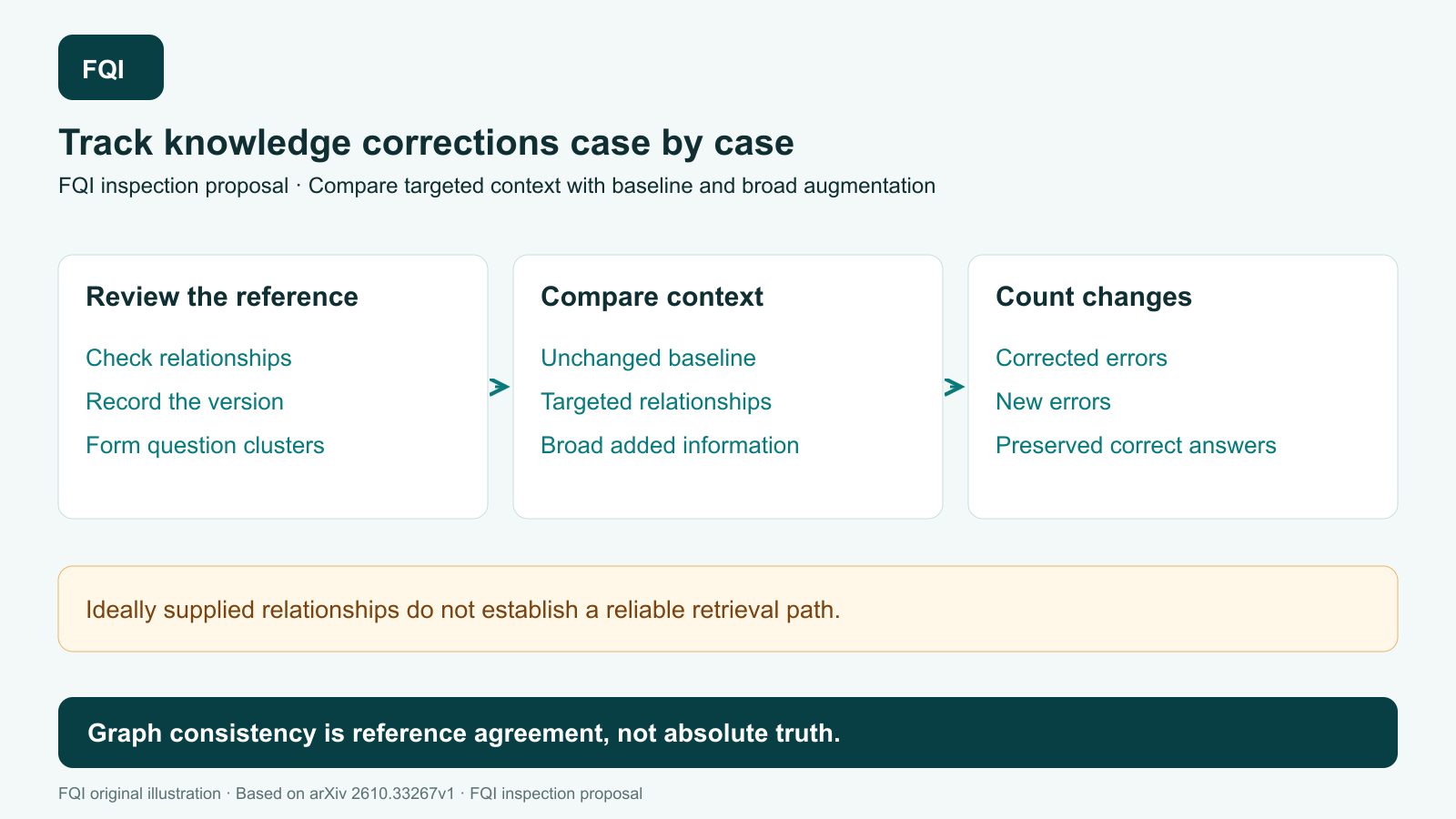
FQI proposes a tightly bounded experiment with a versioned operational reference. Domain experts choose a clear conceptual region and review its relationships. They create semantically equivalent questions and explicitly opposing controls. Baseline answers are retained for comparison rather than replaced by the corrected outputs.
Targeted and indiscriminate context are then compared on the same cases. The report includes at least four groups: correct before and after, corrected, newly incorrect and still incorrect. An improved aggregate success rate can no longer conceal damage to a particular important relationship.
Practical adoption must also cover the actual retrieval path. Ideally supplying exactly the required reference edge is different from finding it automatically in operation. Both experiments may be useful, but they should be reported separately. Only the latter tests whether the application reliably finds the appropriate information.
The reference version and question mapping should remain part of the assessment record. If either changes, a previously observed consistency improvement may no longer describe the deployed process. This operational control is an FQI interpretation of the study’s bounded scope, not an additional outcome demonstrated by the authors.
Limitations and risks
The reference itself may be incomplete, disputed or wrong. A discrepancy therefore initially identifies a conflict with a specification. The study concentrates mainly on hierarchical and relational structures; temporal, causal and procedural step-by-step inference are not comprehensively validated.
Some intervention conditions assume ideal access to the queried relationship. The supplementary test of complex questions is small. Observed graph patterns also do not fully explain the internal model mechanisms causing failures. Industrial transfer and reliable mapping of real user requests remain separate assessment questions.
The authors are affiliated with IBM. The NIST framework (National Institute of Standards and Technology) supplies independent normative support for purpose-specific assessment, but does not reproduce or confirm the paper’s experimental results.
FQI conclusion
The central quality rule is to track corrections locally. Reporting only an improved average can hide newly introduced failures. FQI therefore recommends a bounded, expert-reviewed reference region and paired comparison of the same cases before and after each context change. The source supplies a testable research approach. Operational acceptance additionally requires current references, a demonstrated retrieval path and explicit handling of conflicts between model output and the controlled reference. A graph-consistent answer is not automatically universally correct.
Sources & transparency
Primary source: Scoped Semantic Invariance as a Foundation for LLM Reliability; versioned full text reviewed. Preliminary research; methods, relevant results and limitations were assessed. No independent reproduction.
NIST AI RMF Playbook, MEASURE provides normative support for independent, context-specific evaluation. It does not validate the performance figures reported in the study.
AI-assisted article. Operational examples and inspection proposals are FQI interpretations, not additional study results. Approved for publication by Johann Fischer on 2026-11-01.