
Executive summary
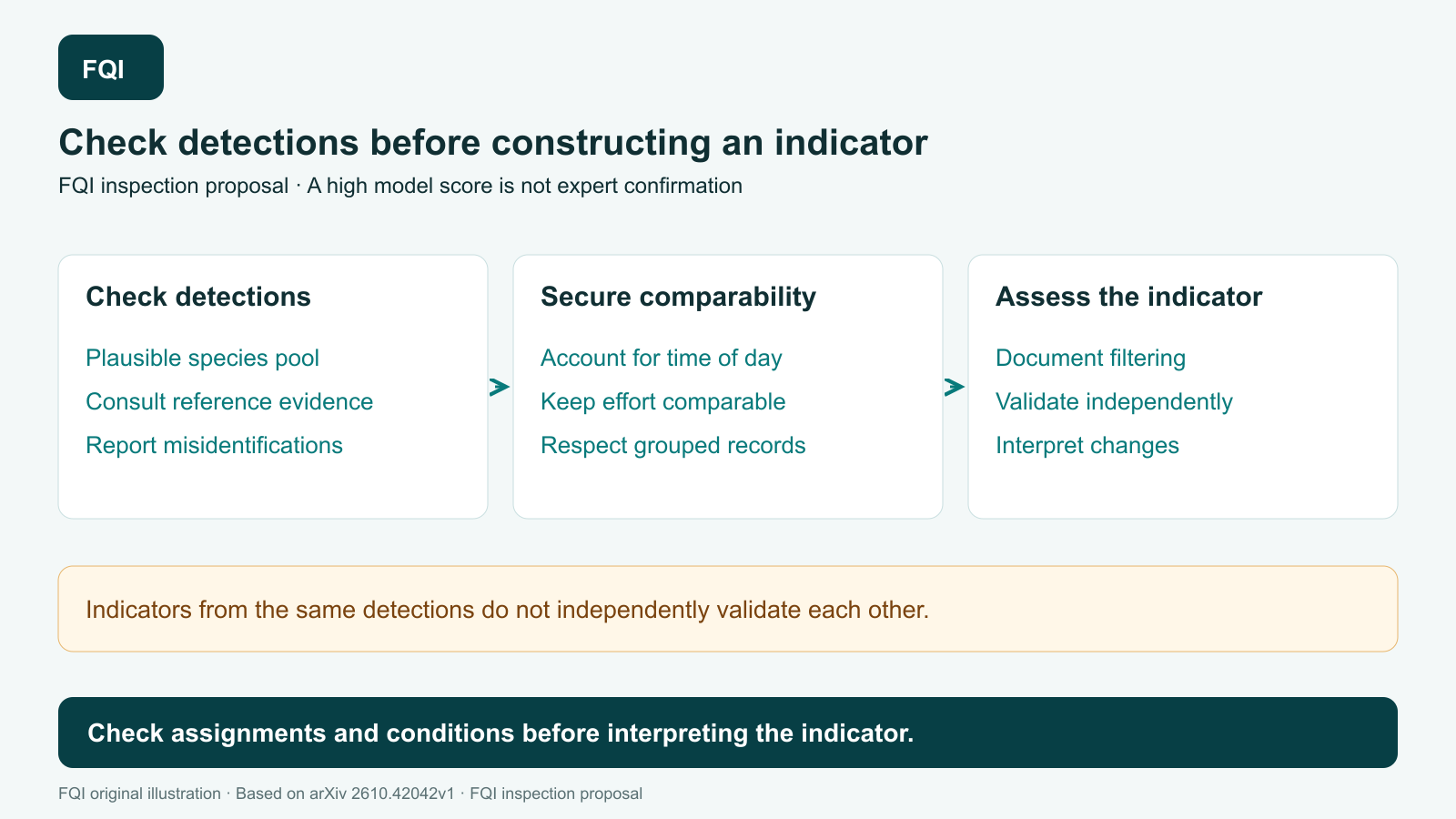
A metric derived from artificial intelligence (AI) detections depends on the underlying assignments. A bioacoustic study examines this relationship for bird detections in a savanna and a zoo. Even high model scores include species considered implausible for the location. The transferable quality-management question is the order of operations: assess detection performance, admissible context and comparable observation conditions before interpreting the aggregate. Confidence alone replaces neither expert references nor a comparable amount of observation.
FQI takeaway
- Keep related recordings grouped during development and assessment.
- Report contextual filters and expert checks alongside model confidence.
- Standardize observation effort and reference populations before comparing metrics.
The principle at a glance
An acoustic model assigns possible bird species to audio segments. These detections feed an indicator summarizing diversity and frequency. Incorrect species labels therefore directly affect the result. A mathematically correct aggregation cannot repair erroneous upstream detections.
The study also separates diversity from temporal stability. A natural daily cycle may reduce a stability score despite being biologically expected. Combining these properties uncritically could give an undesirable negative meaning to a normal change.
Deep dive
Saeed and colleagues first compare classifiers using a labeled tropical dataset. Assessment folds keep related recordings together. An additional comparison shows that randomly splitting short frames can make accuracy look substantially better. Similar frames from the same recording do not constitute independent validation.
Field analysis uses a pretrained model with location and seasonal information. A stricter retrospective location filter removes 517 detections of nine implausible species at the zoo. This does not confirm every retained label: the authors explicitly state that comprehensive expert verification remains missing.
The resulting diversity indicator uses the expected regional species pool. Site comparisons also require standardized recording effort with matched times of day. Longer observation may reveal more species without a corresponding difference in the underlying environment. Sampling rules and the denominator therefore belong to the definition of the metric.
The authors report a strong relationship between their indicator and detected species richness. This is not independent validation of all species labels because both quantities depend on the same detection data. Different years, seasons and few recording locations further limit the field comparison. It identifies an assessment problem rather than establishing a universal ranking of habitats.
FQI derives a control plan for detection-based counting and frequency metrics. In an acoustic equipment-monitoring example, repeatedly detected sound classes might feed a condition indicator. Before comparing sites, the team would specify recording conditions, duration and permitted classes. This industrial example is an FQI illustration, not an outcome demonstrated in the ecological study.
Retain raw and filtered assignments together. Every exclusion needs a documented reason. Expert sampling should examine common detections and suspicious exclusions. A context filter may remove false assignments while also suppressing rare true events; both error directions need visibility.
Only then assess how the aggregate responds to changed thresholds, reference groups and observation times. The report should distinguish changes in incoming evidence from changes in the evaluation rule. This preserves the connection between the metric and its actual measurement process.
A useful operational record would also identify the model and filter version used for each interval. Otherwise, a revised regional list or threshold could create an apparent process improvement that is really an analysis change. This record is a proposed control, not another measured finding from the paper.
Limitations and risks
Field recordings differ in season and year. Spatial replication is limited, and the analysis does not cover all animal groups or frequency ranges. Species assignments lack comprehensive expert confirmation. A retrospective context filter may improve apparent results without prospective validation. Site contrasts are therefore bounded demonstrations. The proposed industrial controls require their own assessment and cannot inherit performance guarantees from a bioacoustic example.
FQI conclusion
Before detections become a metric, examine their validity and reference conditions. This study illustrates how contextual errors, dependent data splits and unequal observation effort can shape the result. FQI recommends retaining a traceable distinction between raw data, filtering decisions and aggregation. That allows a change to be investigated more precisely, rather than treating every number as a direct and self-validating description of the underlying state.
Sources & transparency
Primary source: A richness-sensitive Acoustic Biodiversity Index from species-level detections: classifier benchmarking, false-positive control and validation against standard soundscape indices in an African savanna and an urban zoo; versioned full text reviewed. Relevant methods, results and limitations were reviewed on 2 November 2026. Scientific preprint; FQI has not independently reproduced the findings. Operational inspection plans and examples are FQI interpretations, not additional experiments reported by the authors.
Artificial intelligence assisted preparation. Johann Fischer explicitly approved this article package for publication on 2026-11-02.