
Executive summary
A machine-checked proof may depend on assumptions that have not themselves been verified. KAPPA organizes language-model agents and a formal proof checker so those dependencies remain explicit. The quality-management lesson concerns evidence produced with artificial intelligence (AI): a successful result should show both the statement actually checked and the external premises supporting it. A conditional proof must not become unconditional acceptance evidence merely because its technical build completes successfully.
FQI takeaway
- Record the verified statement together with all supporting assumptions.
- Separate problems in the original argument from translation failures.
- Keep unfinished work distinct from a disproved statement.
The principle at a glance
KAPPA uses language models to translate mathematical statements and proof steps into Lean, a language with machine proof checking. Its kernel checks whether the formal conclusion follows from the declared assumptions. It does not automatically determine whether the translation expresses exactly the original statement.
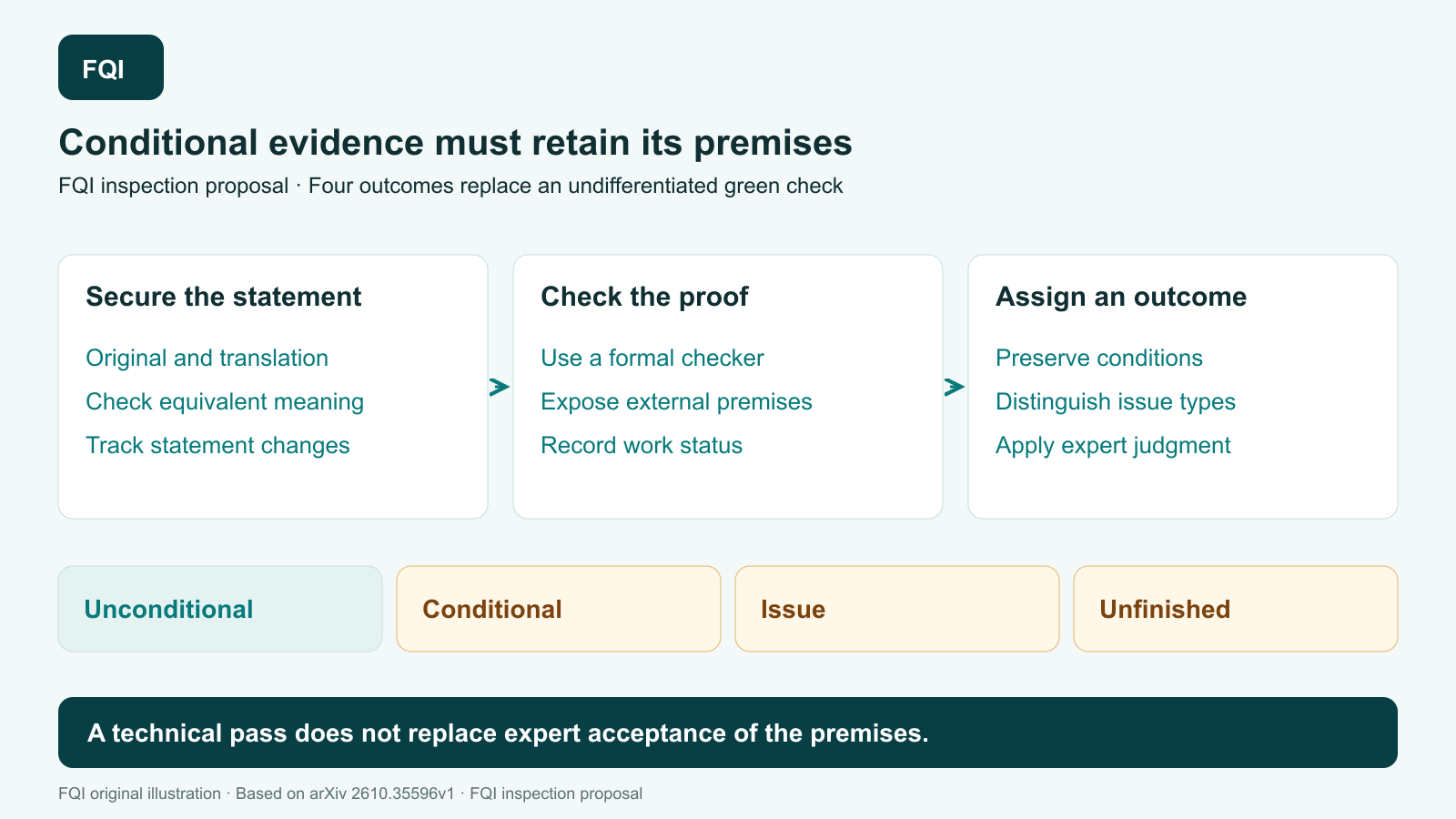
The workflow therefore distinguishes four outcomes: unconditional verification, verification under named assumptions, an issue recorded and unfinished work. Missing foundations or an interrupted translation cannot silently become a complete proof.
Deep dive
She and Wang review a statement before an agent constructs its proof. A digital fingerprint then binds the reviewed statement. Separate roles prepare and audit the translation. The resulting evidence should later be reproducible without another language-model call.
If a proof relies on a cited theorem that is not proved within the run, that theorem appears as an explicit named premise. The report identifies where it is used. Conditional verification remains useful, provided its complete scope remains visible to the reviewer.
Issue classes distinguish a false conclusion from a gap in the original argument. Translation errors and missing proof-library interfaces are recorded separately. This protects the source material: a tool’s inability to express a required construction does not establish that the original result is wrong.
The evaluation covers four prepared example papers and three published statistics papers in versions preceding public corrections. In those three cases, the workflow finds the subsequently corrected error locations. Overall, the case studies contain 42 results, each checked once. That is insufficient for estimating a general error rate or dependable success probability.
A particularly important failure mode is a formal statement narrower than the original claim. The kernel can accept a valid proof while the required claim remains unverified. Statement review is therefore an essential part of the evidence chain rather than an optional presentation step.
FQI applies the principle to bounded technical evidence. Before generating an inspection justification, a team can specify the exact object, assumptions and excluded cases. It then versions the result together with those assumptions. This is an FQI quality-management proposal, not an industrial release workflow validated by the paper.
Changing an assumption should trigger review of affected results. Unchanged components need not automatically be recreated, but the scope of renewed checking must remain traceable. KAPPA correspondingly distinguishes unchanged evidence from modified statements and proof steps when a paper is revised.
The human review question is concise: does the checked statement match the required claim, and are all outstanding premises acceptable for this use? A documented answer connects technical proof to a substantive decision. If a premise remains unresolved, the evidence can retain conditional status without being discarded or overstated.
The same distinction prevents unfinished work from unfairly counting against a technical claim. A missing library interface, exhausted work budget or encoding problem calls for a different response from a demonstrated counterexample. Combining these outcomes would obscure both tool limitations and genuine defects.
Limitations and risks
The kernel validates the formal statement rather than its meaning in the original text. Semantic correspondence still depends on reviewable translation. Conditional results are only as reliable as their premises. Missing library support can leave work unfinished. The authors state that agent permission rules are not a security boundary. The small set of once-checked case studies does not establish general reliability or industrial release readiness.
FQI conclusion
The value lies in accurately stating the reach of the evidence. KAPPA makes external assumptions and incomplete work visible instead of hiding them behind a successful tool run. FQI recommends the same separation for AI-assisted inspection justifications: statement, technical checking and expert acceptance should remain traceable together. Conditional evidence can be valuable while its conditions remain explicit and a responsible person determines their suitability for the intended decision.
Sources & transparency
Primary source: KAPPA: Checking the Proofs in Statistics Papers with Lean 4 and Language Model Agents; versioned full text reviewed. Relevant methods, results and limitations were reviewed on 2 November 2026. Scientific preprint; FQI has not independently reproduced the findings. Operational inspection plans and examples are FQI interpretations, not additional experiments reported by the authors.
Artificial intelligence assisted preparation. Johann Fischer explicitly approved this article package for publication on 2026-11-02.